
Overhead Conveyor or Power and Free? Which One Your Line Needs
The difference between an overhead conveyor and power and free comes down to one question: does the part need to be able to stop on the line? The mechanical difference, a decision table, investment and running-cost comparison, written by the line builder.
 Enlarge
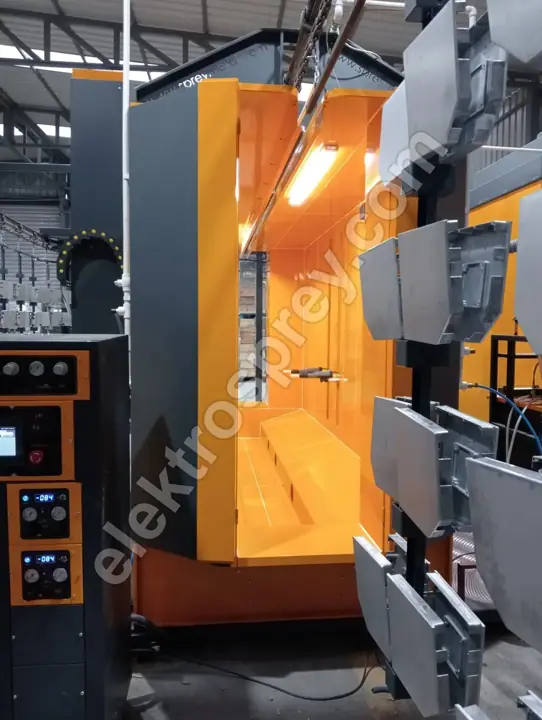
The difference between an overhead conveyor and power and free comes down to a single question: does the part need to be able to stop on the line? A continuous overhead conveyor is one chain; every hanger on it moves at the same moment, at the same speed, holding a steady flow between 1–6 m/min. A tunnel type powder coating line produces its 500–5,000 parts/hour on exactly that steady flow. Power and free separates the driving chain (power) from the track the carrier rides on (free): a carrier can be released from the chain, held at a station, queued in an accumulation bank, switched off to a second oven or a backup booth, and picked up by the chain again. On a line with one oven, one part type and no waiting at the booth, an overhead conveyor is the right and the cheaper decision. If your part mix is wide, if manual spray time varies from part to part, or if you may add a second oven or an accumulation bank later, the value of power and free does not appear in year one — it comes back in year three.
This is a separate decision from throughput. How many parts you can push through is set by your powder coating line capacity calculation; the question here is not how many parts, but whether a part has to be able to stand still.
The mechanical difference: one chain or two tracks
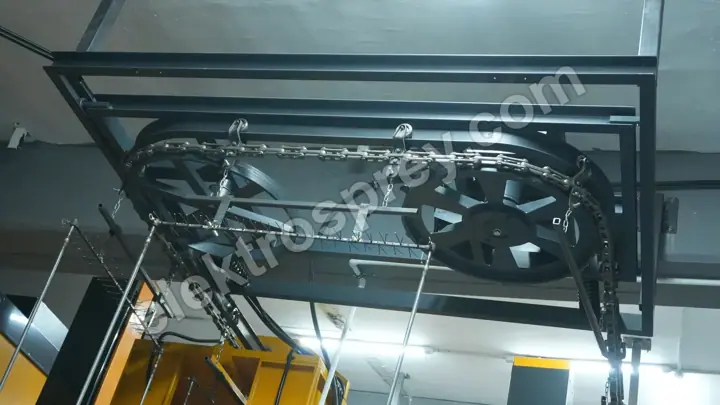
On a continuous overhead conveyor the hanger is fixed to the chain. If the chain moves, everything moves; if the chain stops, every part on the line stops at once. This is the simplest and most durable form a line can take: few components, few adjustments, few faults. But the line speed is a single number, and that number is dictated by the slowest station. In a production run that needs 6 minutes in pretreatment, 40 seconds at the booth and 20 minutes in the oven, one chain forces everyone to walk at the pace of the slowest man.
Power and free uses two tracks. The chain runs continuously on the upper track; the carriers ride free on the lower one. The carrier is pulled only as long as a pusher on the chain stays in contact with the dog on the carrier. The moment a stopper pushes that dog down, contact is broken, the chain slides past, and the carrier waits where it is. In other words, one part can stand still while the line keeps running. Every capability of the system grows out of that one mechanical detail.
The price is component count: two track profiles, carriers, pushers, stoppers, switches, transfer units and the PLC that orchestrates them. On an overhead conveyor you watch the chain, the track and the drive; on power and free every stopper, every switch and every sensor joins the maintenance list.
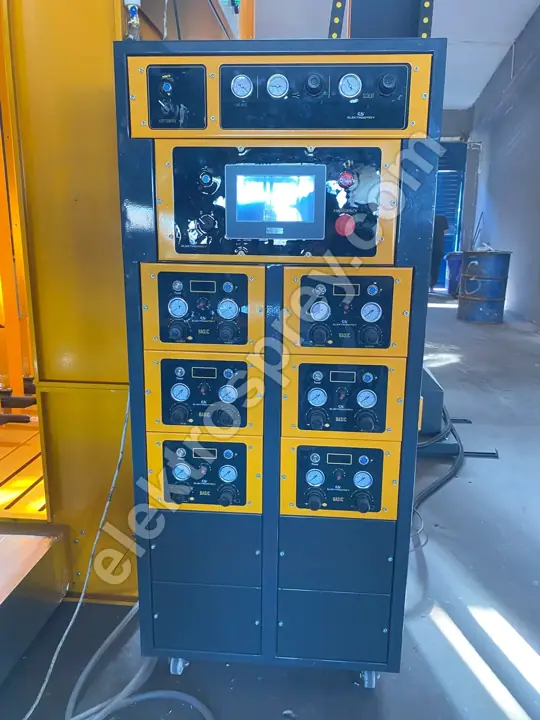
Decision table: which line takes which system
| Situation | Continuous overhead conveyor | Power and free |
|---|---|---|
| One part type, high volume | Right choice — fixed speed, lowest investment | Needless complexity |
| Wide part mix | Struggles; speed locked to the slowest part | Right choice — each part takes its own time |
| Manual spraying, variable time | Operator must follow the line | Right choice — part is held at the station |
| Two ovens or parallel booths | Impractical; a second line is needed | Right choice — fed from one line via switches |
| Accumulation before the oven | None; the oven idles or the line stops | Right choice — the queue keeps the oven full |
| Load/unload without stopping the line | Line is slowed or halted | Loading station runs on its own cycle |
| Heavy, large single parts | Hanger capacity sets the limit | Load can be shared across two carriers |
| Tight budget, fast start-up | Right choice — few parts, short installation | Longer installation and commissioning |
| Small floor area, short line | Right choice — turns on a small radius | Needs extra length for switches and banks |
| Weak or untrained maintenance team | Right choice — simple to maintain | Stoppers and sensors need discipline |
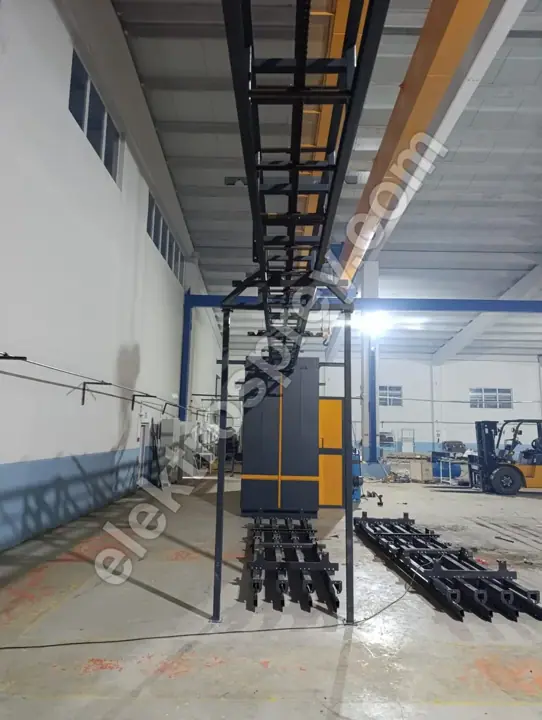
The rule the table produces is this: if the line can run on one rhythm, use an overhead conveyor; if the rhythm changes from part to part, use power and free. There is a middle answer and it is used often: build the whole line as a continuous overhead conveyor, and add indexed stopping or rotating hangers only in the load/unload zone. That buys a small share of what power and free offers, at a far smaller cost.
The four things power and free genuinely buys you
Accumulation. A queue of 10–20 hangers in front of the oven keeps short stoppages in pretreatment from ever reaching the oven. Oven capacity is the most expensive item on the line; not running it empty is the most concrete return power and free delivers.
Asynchronous station time. If one manually sprayed part needs 90 seconds and the next needs 25, a continuous conveyor must be set to 90 and the rest of the line slows down with it. On power and free each part takes its own time and the line runs on the average.
Routing flexibility. Parts arriving on the same line can be split — some to the powder booth, some to a water curtain wet paint booth or a second oven. On colour-change work the part waits in the queue while the booth is cleaned; on an aluminium U-type powder coating line a colour change is done in under 20 minutes, and an accumulation bank absorbs that time without stopping the line.
End-of-shift handling. As a shift closes, the parts on the line are accumulated at the oven exit and the next shift starts with a full queue. On a continuous conveyor you cannot stop the line without emptying it first.
Investment and running-cost difference
We do not publish price figures, because every line is built to the customer's largest part and there is no catalogue size. What we can state plainly is which cost item pushes the decision in which direction.
| Item | Overhead conveyor | Power and free | Direction |
|---|---|---|---|
| Mechanical part count | Chain, track, drive, hangers | + carriers, pushers, stoppers, switches, transfers | Investment up for power and free |
| Automation | Simple speed control | PLC, sensors, position tracking, recipes | Up for power and free |
| Installation and commissioning | Short | Noticeably longer | Up for power and free |
| Maintenance workload | Low; lubrication and chain tension | Stoppers, switches and sensors to check | Up for power and free |
| Oven occupancy | Drops during stoppages | Kept high by the queue | Energy cost down with power and free |
| Labour efficiency | Operator follows the line | Line follows the operator | Down with power and free |
| Expanding later | Usually needs a new line | Grows by adding switches and banks | Future cost down with power and free |
| Scrap and repainting | Rhythm pressure can raise defects | Part waits, so there is time to adjust | Down with power and free |
The decision sits on that balance: power and free pushes first investment and maintenance load up, and pulls oven occupancy and labour efficiency down in your favour. If your annual volume is low, the item above does not outweigh the item below, and the overhead conveyor is the correct answer.
The honest case for the plain overhead conveyor
Power and free being more capable does not make the overhead conveyor a poor system. The simple line has three concrete advantages. First, its failure surface is small: no stoppers, switches or sensors means none of them can fail. Second, commissioning is fast; the time from erection to production is short. Third, speed is stable: a fixed m/min fixes the cure time, and in a box type electric oven holding 80–250 °C with ±3 °C uniformity that produces a repeatable result. We cover how conveyor speed ties to oven length separately in conveyor speed and oven length.
The cost of power and free that deserves to be written honestly is this: a badly maintained power and free line runs worse than an overhead conveyor. One jammed stopper or one mis-set switch locks the entire flow at a single point. In a plant without maintenance discipline, the simpler system produces more.
Five things to measure before you choose
- Number of part types and the spread in their times. If station times across your parts are close to each other, the gain from power and free shrinks.
- The slowest station time. This number governs the line, and the difference between the two systems is born there.
- How you spray. A full automatic gun array runs at fixed speed; manual spraying demands variable time.
- Your five-year growth plan. If a second oven, a second booth or a second shift is on the table, the track is decided today.
- Floor area and ceiling height. Queues and switches take physical space; the layout logic in powder coating plant area and layout feeds directly into this decision.
Frequently asked questions
What is the core difference between an overhead conveyor and power and free?
On an overhead conveyor the hanger is fixed to the chain, so a part cannot stop unless the chain stops. On power and free the carrier can disengage from the chain, so a single part can be stopped, accumulated or routed elsewhere while the line keeps running. Every other difference is a consequence of that one mechanical distinction.
When is a power and free line simply wasted money?
On a line with one part type, a fixed station time, one oven and one booth. In that kind of production power and free adds neither capacity nor quality; it only adds investment and maintenance load. The right decision there is a continuous overhead conveyor, with the saved budget put into pretreatment stages or oven insulation.
Can a continuous overhead conveyor be converted to power and free later?
Because the entire track system changes, in practice this is not a conversion but a new conveyor installation. The building, the oven and the booth usually stay; the conveyor is replaced in full. That is why a plant with growth ambitions should decide at the start. As a middle path, indexed stopping can be added to an overhead line in the load/unload zone alone.
How long should an accumulation bank be?
It is sized to the longest stoppage on the line. The job of a queue in front of the oven is to keep feeding it for the duration of an upstream stop, so bank length comes out of that duration multiplied by conveyor speed. We cannot give a fixed figure — it cannot be calculated without measuring your stoppage pattern and your part length.
How is conveyor speed set on a power and free line?
Chain speed is still held constant in the 1–6 m/min band; what varies is how long a part waits at a station. Cure time inside the oven is therefore set by chain speed and oven length, while station time is set by the stopper program. That separation is what lets a 25-second and a 90-second spray time run on the same line.
Is coating efficiency the same with both systems?
Coating efficiency depends on booth and recovery design, not conveyor type; 98.5%+ transfer efficiency is reachable with either on a properly built line. The indirect contribution of power and free is this: because the part can wait, gun settings can be corrected before spraying, which lowers the repaint rate.
Summary
The choice between an overhead conveyor and power and free is not a decision about speed — it is a decision about the ability to stand still. On lines that run on one rhythm, with one oven and one part type, a continuous overhead conveyor means fewer components, fewer faults and faster start-up, and the budget is better spent on pretreatment and the oven. If your part mix is wide, manual spray times vary, or a second oven or parallel booth is planned, the accumulation and routing flexibility of power and free returns the extra investment by around the third year. The decision sits on the balance between annual volume and part variety, and because every line is built to the plant, there is no catalogue answer. Our powder coating plant setup guide covers the general approach with every line item. Every line we build is delivered with a 2-year manufacturer warranty.
Send us your part mix, your slowest station time and your annual volume — we will work out whether you need an overhead conveyor or power and free, and quote it with the track dimensions.