
How Is a Powder Coating Plant Shipped From Turkey to the World?
A plant is never shipped in one piece; it is broken into modules. Booths, conveyors and equipment mostly fit a 40' High Cube container, while oven body panels usually fall out of gauge and travel on flat racks. Routes, the A.TR Movement Certificate, Incoterms and the ISPM 15 packing rule in one place.
 Enlarge
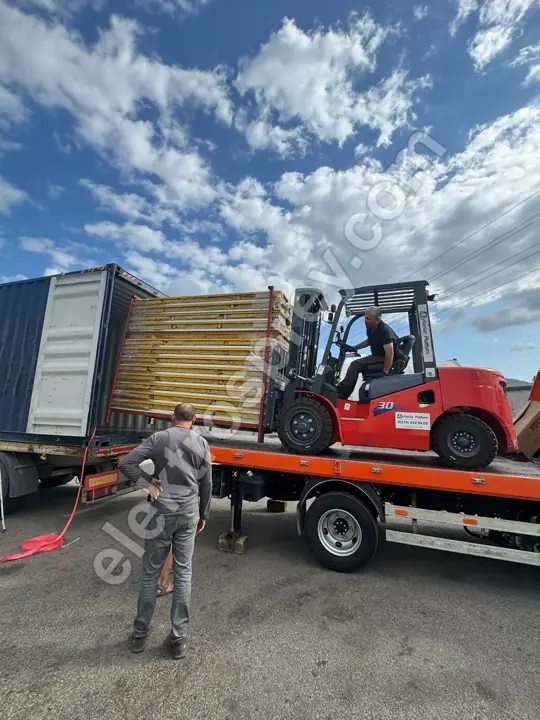
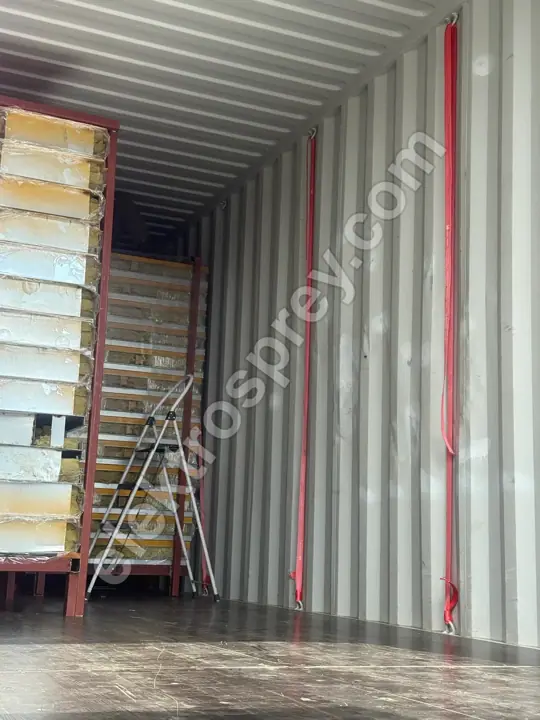
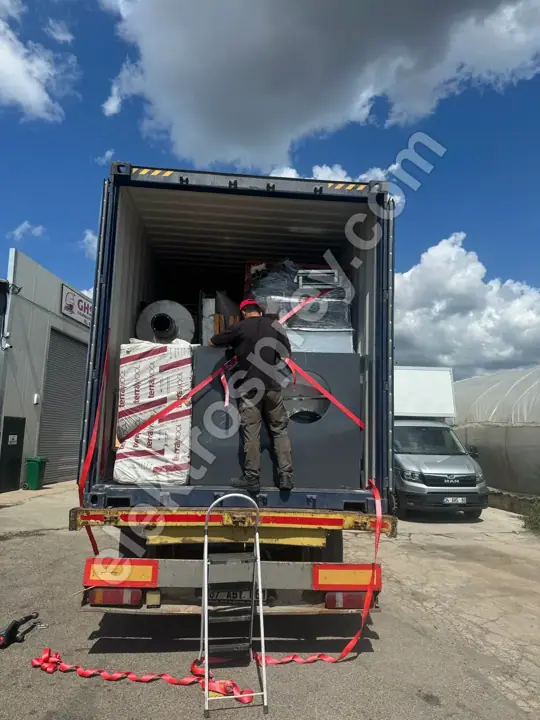
A powder coating plant is never shipped in one piece; it travels broken into modules. Booth bodies, filter units, conveyor rail and chain, guns, control units and electrical cabinets almost always fit inside a 40' High Cube container — internal dimensions 12.03 × 2.35 × 2.70 m, volume 76.4 m³, payload 28,600 kg. The one group that usually does not fit is the oven body panels and large pre-treatment tunnel modules: they are wider than the container door opening, which makes them out of gauge (OOG), and they travel on a flat rack or open top. So the real question is not "will it fit" but "which part goes on which equipment".
How is a plant divided into parts?
A plant is split not by assembly sequence but by the limit of transportability. Each module must stay coherent in itself while staying inside container or flat rack dimensions. Bodies assembled in the factory are numbered and dismantled, connection points marked, and the same numbers followed on site.
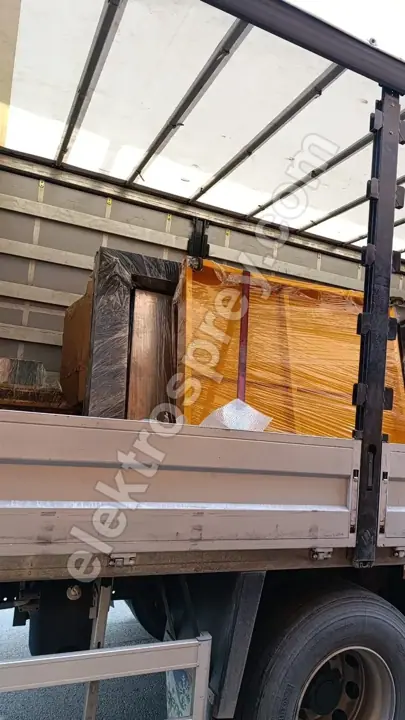
Volume is not the only reason for splitting. Sensitive groups — cartridge filter units, PID cabinets, gun sets — are packed separately from the steel bodies; their vibration and moisture sensitivity is not a welded frame's.
| Plant part | Typical shipping condition | Transport mode |
|---|---|---|
| Powder booth body (removable panels) | Panels palletised flat | 40' High Cube container |
| Cartridge filter unit and fan group | Separately crated | 40' High Cube container |
| Oven body panels (10 cm insulation) | Width often exceeds 2.35 m | Flat rack (out of gauge) |
| Oven fan / heater group, gas burner | Crated, separate group | Container |
| Pre-treatment tunnel modules / dip tanks | Long and wide bodies | Flat rack or open top |
| Conveyor rail profiles, chain, carriers | Bundled and strapped | Container (if under 12 m) |
| Powder guns, control units, cable sets | Wooden crate with foam lining | Container, apart from bodies |
| Electrical and automation cabinets | Crated, with moisture packs | Container |
| Water curtain wet paint booth tank | Welded body, not dismountable | Flat rack or open top |
This mapping is not fixed. Every plant is built around the customer's largest part, so module boundaries are redrawn on every project. How the physical size of a line is set is covered in powder coating plant space and layout.
What does out of gauge mean, and how do flat rack and open top differ?
Any load that cannot pass through a standard container door opening is out of gauge (OOG). There are two basic solutions.
A flat rack is a platform with no side walls and folding end walls. The load is placed from the side or above by crane or forklift, then secured with straps and chains to the deck's lashing rings. Heavy industrial machinery is typically carried on flat racks; oven body panels and long tunnel modules fall into this class.
An open top is a container with four walls but an open — or removable tarpaulin — roof. The load is lowered from above by crane. It suits parts of standard width that exceed the height.
The practical difference for a buyer: these loads are not priced like standard containers, port handling differs, and they require a crane on arrival. The unloading plan therefore belongs in the conversation before the shipping plan is fixed.
Which routes are used from Turkey to Europe?
There are two basic corridors from Turkey to Europe: road transport through the Balkans, and Ro-Ro, where the truck itself boards the vessel. Ro-Ro's main advantage is not speed but predictability: it bypasses Balkan road transit entirely, along with the road transit permit quota bottleneck. Border queues, exhausted quotas and seasonal closures leave the equation. Turkey's main Ro-Ro ports are Pendik and Yalova (Istanbul region), Çeşme (Aegean) and Mersin (Mediterranean).
| Ro-Ro line | Approx. sea time | Frequency | Regions served from the arrival gateway |
|---|---|---|---|
| Pendik – Trieste (Italy) | ~64 hours | Weekly | Germany, Netherlands, Central Europe, north-east France |
| Yalova – Sète (France) | ~76 hours | 5 sailings per week, both directions | France and Northern Europe |
The times above are the sea leg only; total delivery adds port handling, customs clearance and the road leg from the arrival port. Conventional container freight takes longer but suits one transport chain that also covers out of gauge parts. For Middle East and North Africa buyers, sea services out of Mersin and direct road transport are the working options.
Which is more sensible: Ro-Ro or containers?
It depends on the geometry of the load. If the whole plant fits container dimensions, conventional sea freight makes the simpler chain. With out of gauge parts such as oven panels, the path forks: either the OOG pieces move on flat racks consolidated with the containers on the same vessel, or the whole plant goes onto trucks by Ro-Ro. European buyers often prefer Ro-Ro because it narrows the variance around the delivery date; every day an installation crew waits on site is a direct cost.
The A.TR Movement Certificate and the Customs Union
This is the part with the most money in it for the buyer. Turkey and the EU have operated a Customs Union since 1996, covering industrial products.
The A.TR Movement Certificate is the document proving that goods are in free circulation within the Customs Union. Powder coating plants and their components are classified under HS chapters 84 and 85 (machinery and electrical equipment). Goods in these chapters enter the EU with 0% customs duty when accompanied by an A.TR.
Without it, standard third-country (MFN) rates apply, running from 3% to over 20% by product. On a capital investment of this size that is not a rounding difference — and the entire gap is documentary, unrelated to the goods themselves.
| Item | With A.TR certificate | Without A.TR certificate |
|---|---|---|
| EU duty on HS 84-85 machinery | 0% | MFN rate, 3–20%+ by product |
| What the document proves | Goods are in free circulation in the Customs Union | — |
| Excluded product groups | Agricultural, coal and steel products (A.TR cannot be used) | — |
| Result for the buyer | Duty burden removed | Import cost becomes uncertain |
Three points deserve attention. A.TR is not a certificate of origin; it shows free circulation status, not where goods were made. It is issued per shipment, endorsed by customs, and must reach the buyer with the export documents. And agricultural, coal and steel products sit outside the Customs Union and cannot use A.TR — an exception that does not affect coating lines, which fall under the machinery chapters.
A.TR does not apply outside the EU; there, bilateral trade agreements and origin certificates take over. The most useful thing a buyer can do at quotation stage is to confirm the rate against the HS code with their own customs broker.
What does the choice of Incoterm change?
An Incoterm defines where the seller's responsibility ends and the buyer's begins. This is the buyer's decision, and it determines directly what the figure in a quotation covers.
| Incoterm | Point of handover | Freight and insurance | Suits which buyer |
|---|---|---|---|
| EXW (Ex Works) | Factory gate | Entirely on the buyer | Buyers with their own forwarder in Turkey |
| FOB (Free on Board) | On board at the loading port | Sea leg onward on the buyer | Buyers with their own carrier agreements |
| CIF (Cost, Insurance, Freight) | Arrival port (minimum insurance included) | Sea freight and insurance on the seller | Buyers wanting one invoice but clearing customs themselves |
| DAP (Delivered at Place) | Buyer's nominated address | On the seller; import clearance on the buyer | Buyers wanting one counterpart to the door |
Two quotations must be compared on the same Incoterm. An EXW price next to a DAP price compares two different scopes; the gap is transport, not machinery. The same logic applies to installation items, broken down line by line in powder coating plant installation cost.
Is cargo insurance really necessary?
Under CIF the seller's obligation is minimum cover, usually thin for heavy machinery. Out of gauge parts are craned twice — loading and discharge — and that is where most of the damage risk sits. Buyers commonly arrange their own marine cargo policy covering the entire transport chain.
Packing: ISPM 15 and the wooden crate rule
Wooden packaging is subject to an international plant health standard. ISPM 15 requires heat treatment of wood packaging material to prevent the transport of pests: the wood must be held at a core temperature of at least 56 °C for at least 30 minutes.
Treated wood is then marked indelibly. The mark carries the IPPC logo plus three codes:
- Country code — where the wood was treated
- Producer / treatment provider code — the registration number of the authorised facility
- Treatment code — heat treatment or another accepted method
This is not optional: all non-EU wood packaging entering the EU must carry the mark. Unmarked or incorrectly marked wood can lead to the load being held at customs, the packaging destroyed on the spot, or the shipment returned. Daily demurrage on a waiting container costs more than the packaging itself.
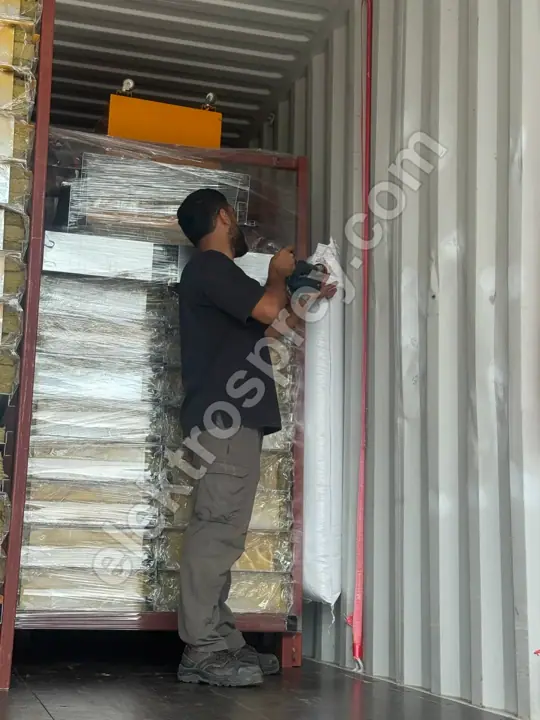
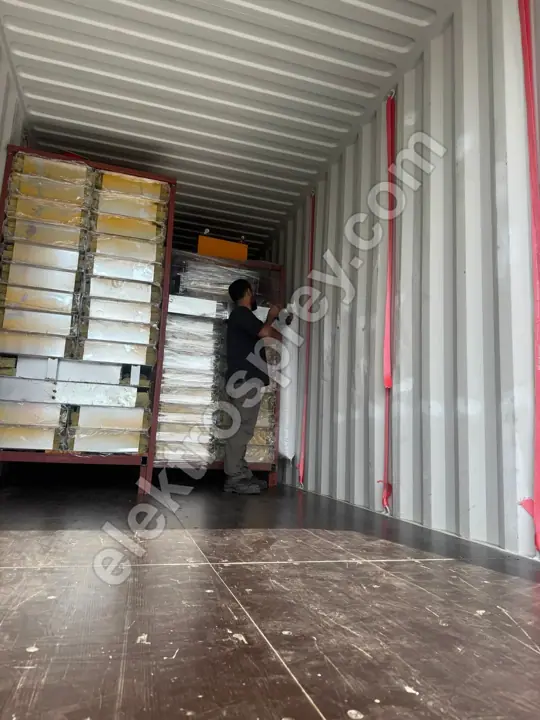
Plant shipments use three packing classes: palletised and strapped steel panels, enclosed wooden crates (guns, cabinets, electronics), and secured bodies lashed directly onto flat racks. Desiccant packs inside electronics crates are standard, because of condensation risk at sea.
What has to be ready on site for unloading and installation?
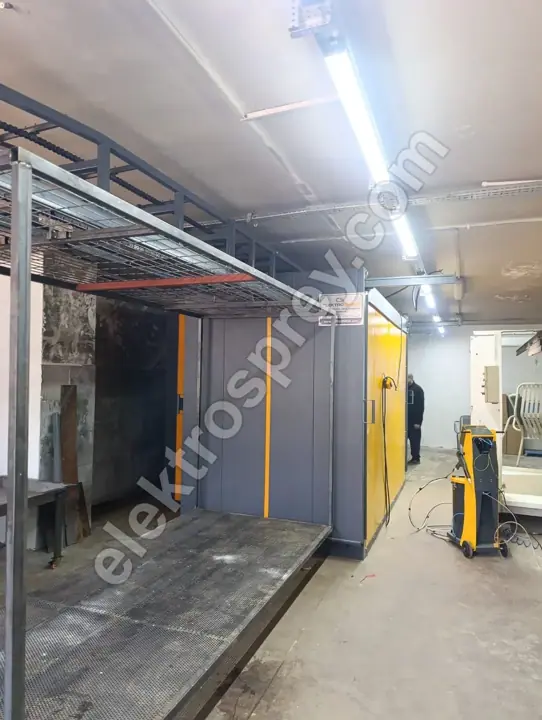
Shipping does not end when the load reaches the factory. If the following points are not settled before the goods leave, trucks wait on site:
- Crane access: Oven panels and tunnel modules on flat racks are lifted off by crane. That needs an approach area, manoeuvring clearance, and capacity for the heaviest piece — whose weight and lifting points are known in advance from the packing list.
- Floor: Both the unloading area and the ground the machines sit on must carry the load. Concrete thickness and flatness matter for ovens and dip tanks; for conveyors, the capacity of the roof or columns carrying the hanger points.
- Entry opening: The largest module must be smaller than the narrowest passage into the building. If that dimension does not work, the module split plan is changed before shipment.
- Utilities: Electrical connection and contracted capacity, a gas line for gas-fired ovens, water and waste water for the pre-treatment line — live before installation begins.
- Storage: Not every module is installed the same day. A closed, dry interim storage area is essential, particularly for electronics and cabinet crates.
For layout, ceiling height and site preparation as a whole, the powder coating plant setup guide is the umbrella reference. Module splitting matters most on continuous lines with long bodies, such as a tunnel type powder coating plant.
Frequently asked questions
How many containers does a powder coating plant take?
No fixed number can be given; it depends on line capacity and oven size. What decides it is how many modules the booth and conveyor break into for the 12.03 × 2.35 × 2.70 m interior of a 40' High Cube, and how many flat racks the out of gauge oven and tunnel bodies need. That figure is clear only once the module split plan exists.
Can machinery enter the EU without an A.TR certificate?
It can, but the 0% duty advantage is lost and standard MFN rates apply, running from 3% to over 20% by product. A.TR proves that goods are in free circulation within the Customs Union. It cannot be used for agricultural, coal or steel products, but it is valid for the machinery chapters.
Does the oven arrive in one piece or in sections?
The oven body is made of 10 cm insulated panels and its width usually exceeds the container interior, so panelled shipment is the norm. Panels are numbered as they are dismantled and reassembled in the same order on site. Small box type ovens can ship as a single body, in which case the entry opening becomes the critical figure.
How long does shipping take?
The sea leg is roughly 64 hours on Pendik–Trieste and roughly 76 hours on Yalova–Sète. Total time adds production completion, port handling, customs clearance and the road leg from the arrival port. Conventional container shipping takes longer.
What happens if a wooden crate has no marking?
It creates a problem at customs. All non-EU wood packaging entering the EU must be heat treated under ISPM 15 (at least 56 °C for 30 minutes) and carry the IPPC mark. Unmarked packaging can lead to the load being held, the packaging destroyed, or the shipment returned.
Is a crane mandatory on site?
For out of gauge parts on flat racks, yes. Palletised and crated loads from containers can be handled by forklift, but oven body panels, tunnel modules and welded tank bodies need a crane. Since the heaviest part's weight appears on the packing list, crane capacity can be calculated in advance.
Summary
Shipping a powder coating plant is the sum of three decisions: the module split plan (container or flat rack), the route (Ro-Ro or conventional container), and the Incoterm (where handover happens, who carries what). On top sits one document that converts straight into money for an EU buyer: the A.TR Movement Certificate brings HS 84-85 machinery in at 0% duty. On the packing side, the ISPM 15 mark is not negotiable.
Share the dimensions of your largest part, your factory's entry opening and your crane access situation — we plan the module split of the line accordingly.
Sources
- IPPC — ISPM 15 wood packaging standard
- European Commission — wood packaging material rules
- Republic of Türkiye Ministry of Trade — A.TR Movement Certificate
- ICC — Incoterms® 2020