
Choosing a Powder Coating Booth: Filter or Cyclone?
One question decides the booth: how many colours will you run. A single colour is served by a cartridge filter booth; frequent colour changes push recovery rate and cleaning time to the front. Booth types, gun count, air volume and why the internal air velocity must sit at 0.5–0.8 m/s.
 Enlarge
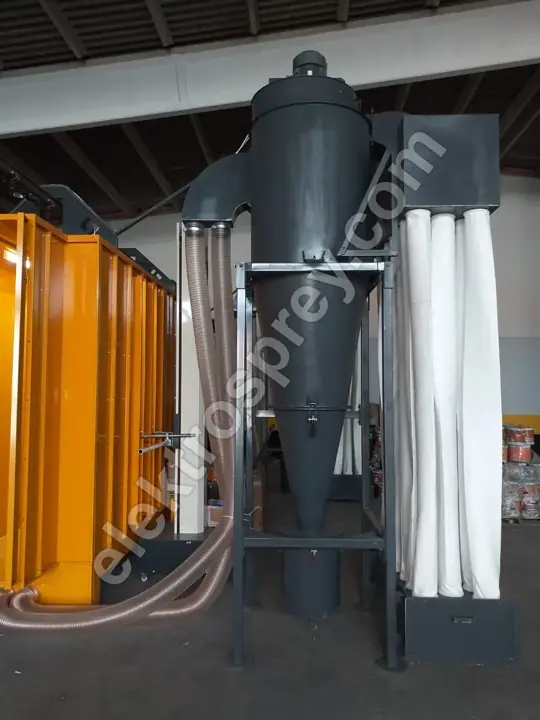
One question decides a powder coating booth: how many colours will you run. A workshop running one colour, or a few close shades, is fully served by a cartridge filter booth delivering 95%+ powder recovery and 99.9%+ cartridge filtration; colour changes are rare enough that cleaning time never blocks production. In a plant changing colour more than once a day, the deciding factor is not coating performance but colour change time and how quickly the recovered powder can be cleaned out — that is where a cyclone or a combined system earns its place.
Everything else — gun count, booth opening, fan volume — is calculated after those two decisions. Booths are not picked from a catalogue; they are built around the largest part you will coat.
Filter, cyclone or combined?
All three separate powder from air the same way. The difference is where the powder is collected and how long the system takes to clean at a colour change.
| Booth type | Colour change time | Recovery | Who it suits |
|---|---|---|---|
| Cartridge filter | 45–90 min (cartridge cleaning or swap) | 95%+ recovery, 99.9%+ filtration at the cartridge | Single colour, or a few colour changes per week; the most common and most economical solution |
| Cyclone | 15–30 min (cyclone body and hopper washed down) | 90–95% at the cyclone, 99.9%+ overall with an after-filter | Plants changing 2+ colours a day; jobbing shops and profile coaters with a wide colour range |
| Combined (cyclone + cartridge) | 20–40 min | Cyclone as primary separation, cartridge as final filter, 99.9%+ total | High-capacity continuous lines that want both fast colour change and safe stack emission |
Let us be honest: a cyclone is not always better. It costs more, occupies more floor area and demands a larger fan. In a single-colour workshop that investment never pays back. Conversely, a colour change in a filter booth means cleaning or replacing cartridges; in a plant changing colour twice a day that consumes a serious share of the shift.
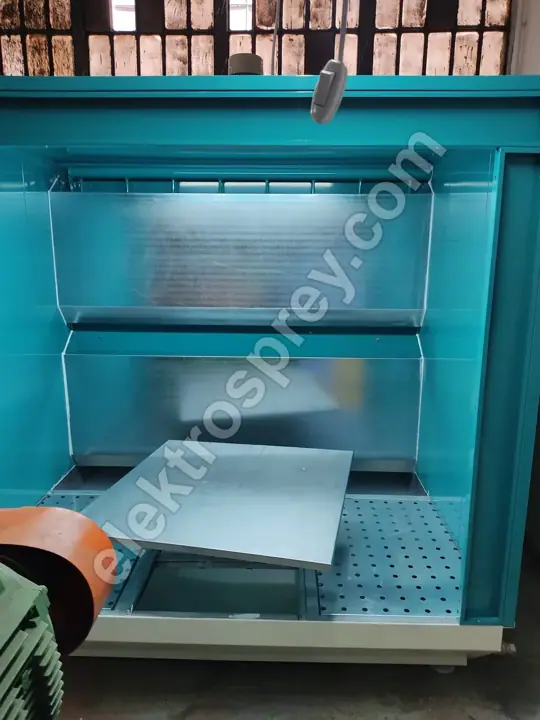
Our cartridge filter powder booths are built with pulse-jet cleaning and configured for 2 to 12 guns. Where colour variety is high, quick-release cartridge cassettes and a separate powder hopper cut the cleaning time significantly.
How is a booth sized?
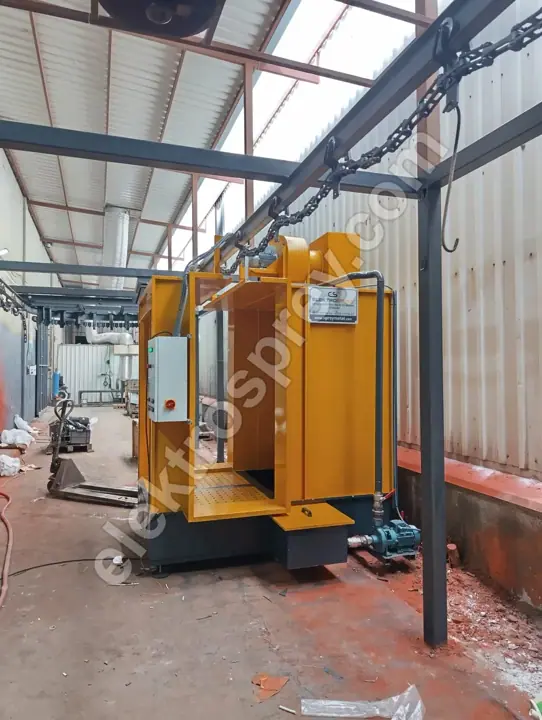
Booth size comes from the part: part width and height + hanging allowance + the working distance the gun needs. If the booth opening (the mouth the part passes through) is too small, powder escapes; if it is larger than necessary, holding the same internal velocity demands a far bigger fan and more energy every hour of every shift.
| Part size (w × l) | Booth opening (approx.) | Gun count | Air volume range |
|---|---|---|---|
| Small parts up to 0.5 × 1 m | 0.8 × 1.2 m | 2 guns (manual) | 6,000–9,000 m³/h |
| Medium parts, sheet metal enclosures, 1 × 2 m | 1.2 × 2.2 m | 2–4 guns (manual, or 2 automatic + 1 touch-up) | 10,000–16,000 m³/h |
| Panels, doors, railings, 1.5 × 3 m | 1.6 × 3.2 m | 4–6 guns | 16,000–24,000 m³/h |
| Aluminium profile, 3–7 m | 0.6 × 3.5 m (narrow, tall opening) | 6–8 guns (automatic, both sides) | 18,000–26,000 m³/h |
| Large bodies and chassis, tunnel line | 2 × 3 m and above | 8–12 guns + touch-up station | 25,000–40,000 m³/h |
Gun count is not a matter of taste; it is arithmetic: conveyor speed × part surface ÷ gun output. On a tunnel line running a conveyor at 1–6 m/min, an undersized gun count forces you to slow the line down — capacity is limited by the guns, not by the booth. We walk through that calculation step by step in powder coating line capacity calculation.
Why must internal air velocity be 0.5–0.8 m/s?
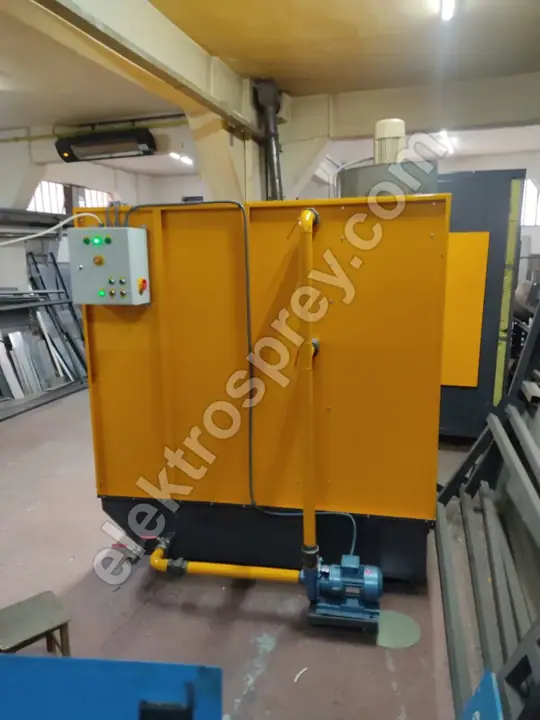
Air velocity inside the booth is the quietest and most critical parameter in the whole system. The correct band is 0.5–0.8 m/s, and both ends of it carry a penalty:
- Below 0.5 m/s: the air cannot hold atomised powder inside the booth. Powder escapes through the opening into the shop, the operator works inside a cloud, and deposits build up on the floor and on neighbouring equipment. The explosive dust cloud risk rises with it.
- Above 0.8 m/s: the airflow becomes stronger than the electrostatic force holding the charged particle on the part. Powder is pulled into the extraction before it can deposit. The visible result: thinner film, poor build on edges and corners, worse transfer efficiency and therefore higher powder consumption.
So the question is never "how powerful is the fan" but whether the volume is correct for the booth opening. Volume is roughly opening area × target velocity: a 1.2 × 2.2 m opening is about 2.64 m² × 0.65 m/s ≈ 6,200 m³/h of free passage; the selected fan sits above that once filter resistance, duct losses and a safety margin are added. Change the booth size and the fan changes with it — which is why cutting a larger opening into an off-the-shelf booth later does not work.
How does pulse-jet filter cleaning work?
Cartridge filters build a cake of powder on their outer surface. As the cake thickens, differential pressure climbs, extraction falls, and internal velocity drops below 0.5 m/s — meaning the booth starts leaking powder. The pulse-jet system prevents that:
- A short blast of high-pressure dry air is injected into the cartridge from the clean side (typically 5–6 bar, lasting a fraction of a second).
- The pulse expands the cartridge in the reverse direction; the cake on the outer surface is mechanically broken off and falls.
- The fallen powder collects in the hopper and returns through a sieve to the recovery system. This is where the 95%+ recovery figure comes from.
- Pulses are fired in sequence while the booth runs; the line does not stop.
Pulse frequency should be governed by a differential pressure (ΔP) sensor, not a timer. A fixed-timer system wears clean cartridges for nothing; a ΔP-controlled system fires only when needed, improving both compressed air consumption and cartridge life.
How often do cartridge filters need replacing?
Three things set the interval, and none of them is the calendar: daily running hours, powder type (metallics and fine-particle powders blind a cartridge faster), and whether pulse pressure is set correctly. In a single-shift, single-colour workshop cartridge life is typically 12–24 months; double shifts and frequent colour changes shorten it. The real indicator is not elapsed time but whether ΔP returns to its original level after cleaning — if it does not, the cartridge is saturated.
Why does compressed air quality matter so much?
The air feeding the pulse-jet line must be dry and oil-free. Moist air turns powder into mud inside the cartridge; that cartridge will never clean again and goes straight to waste. The same moisture reaching the powder feed line destroys fluidisation, makes the gun spit, and produces orange peel and craters in the film. A refrigerant dryer plus an oil filter is the part of a booth investment that should never be negotiated away.
When do you need a wet paint booth?
These two are constantly confused: a powder booth and a wet paint booth are not the same equipment, and neither substitutes for the other. A powder booth is designed to separate and recover dry powder; it cannot capture solvent-borne paint mist, its filters become wet and it accumulates flammable residue.
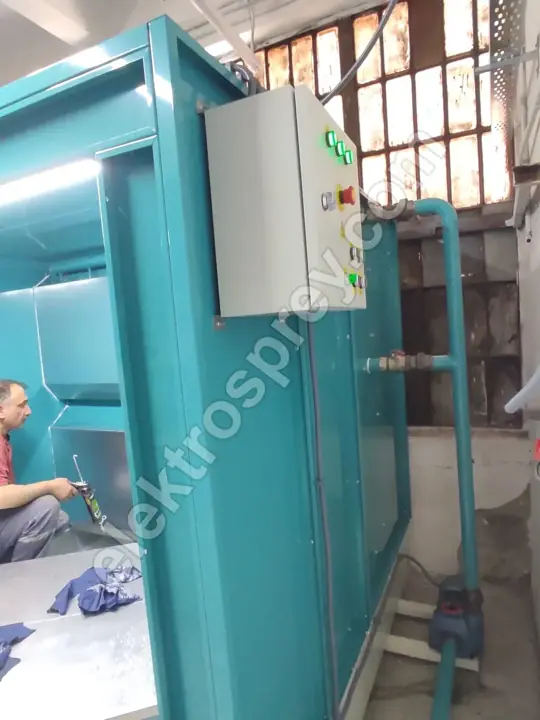
A water curtain wet paint booth is required when:
- The part cannot take the 180–200 °C curing temperature of powder (heat-treated, plastic-containing, timber-bearing or thin-walled parts).
- You run special metallic or matt effect shades, two-pack industrial paints, or repair and touch-up work.
- Decorative work needs a clear lacquer over the powder coat.
In a water curtain booth the overspray is washed out by a continuously flowing curtain: 99% overspray capture, a closed-loop water system, 600+ lux LED lighting so the sprayer can judge colour correctly, an antistatic grated floor to prevent static build-up, and ATEX Zone 2 equipment classification because of solvent vapour. In a powder booth the ATEX case is a dust cloud; in a wet booth it is solvent vapour — the equipment requirements differ.
Most plants end up installing both: volume work on the powder line, special and heat-sensitive work in the wet booth. A common planning mistake is placing the two side by side sharing the same air volume — we cover separation distances in plant area and layout.
Why are ATEX and CE not negotiable?
A powder coating booth is a volume in which a combustible dust cloud is deliberately created. Organic powder above a certain concentration in air can explode when it meets an ignition source, and an electrostatic gun by definition generates high voltage. Those two sharing one volume is precisely the situation ATEX regulates.
In practice this means: lighting and electrical equipment inside the booth must carry the correct protection class, all metalwork and the grated floor must be bonded and earthed, hanging jigs must be kept clean so they stay conductive, and explosion relief panels and fire detection must be part of the design — not an afterthought.
The CE mark declares that the machine as a whole meets machinery safety requirements: emergency stop, guards and interlocks, technical file, operating manual. Our booths are manufactured in accordance with CE and ATEX requirements and delivered with a 2-year manufacturer warranty. These are not line items to be trimmed for a lower price; any saving is repaid many times over at the first incident or the first inspection. For export, a machine without a CE file can be turned back at customs.
Is the booth chosen before the oven?
The order is: largest part size → oven internal volume → booth opening → conveyor. Oven volume is the most expensive and least flexible item on the line, and the booth is aligned to it. For the oven side, see powder coating oven prices and oven temperature uniformity, where we explain why ±3 °C matters. If you are planning a complete line from scratch, our pillar guide how to set up a powder coating plant is the right starting point.
Can I add guns to my existing booth?
Partly. Adding guns affects the powder feed unit and compressed air capacity, but also the extraction volume. If the fan is already only just holding 0.5–0.8 m/s across the existing opening, the extra powder load from more guns saturates the filter faster and velocity falls. Measure ΔP and air velocity before adding anything.
Summary
Booth selection starts with the number of colours: a filter booth for one colour, a cyclone or combined system for frequent changes. Size comes from the part, gun count from the required capacity, and fan volume from booth opening × the 0.5–0.8 m/s target. A wet paint booth is not an alternative to a powder booth; it is separate equipment for a different job.
Send us the dimensions of your largest part, the number of colours you will run and your daily output target — we will calculate the booth size, gun count and fan volume and quote it.