
What CE Marking Covers on a Powder Coating Line - and What It Does Not
There is no such thing as a CE certificate for a powder coating line; CE is a manufacturer declaration. A line linked by conveyor is one machine in the eyes of the law and carries one CE mark. What belongs in the technical file, what to write into the purchase contract, and who signs what at commissioning.
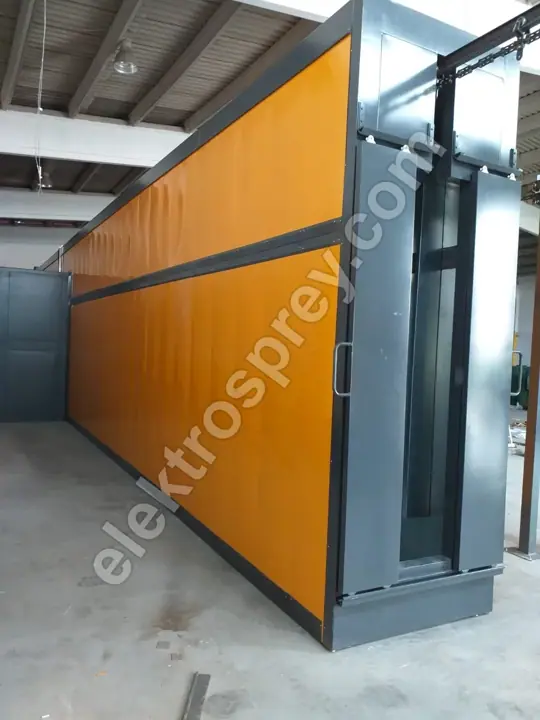 Enlarge
There is no such document as a CE certificate for a powder coating line. CE is not a certificate issued by anyone; it is a declaration the manufacturer signs, and it produces exactly two papers: the EC Declaration of Conformity and the technical file behind it. The second and more important point: a line whose machines are linked by conveyor and driven from a common control panel is, under the Machinery Directive (2006/42/EC), a single machine. Even if the oven, the booth and the conveyor each carry their own mark, the assembly needs one CE mark of its own and one declaration covering the whole. The technical file must be kept for at least 10 years after the last unit is built, the CE mark on the plate must be at least 5 mm high, and the manual must be delivered in the language of the country where the line is used. This article sets out exactly what a buyer should write into the purchase contract.
The confusion has one source: CE audits the machine you bought, not the coating it produces. Salt spray, film thickness and adhesion testing belong to a different world entirely and are no part of CE.
What CE is, and what it is not
CE is not a quality or performance certificate. Its meaning is a single sentence: "This machine meets the essential health and safety requirements of the directives that apply to it, and I hold the technical file that proves it." The manufacturer makes that statement. No institution validates it.
Powder coating lines do not appear on Annex IV of the Machinery Directive, the list of machines requiring a notified body. So no notified body number is needed for the line as a whole; the manufacturer performs the risk assessment, compiles the file and signs the declaration. If a supplier shows you a stamped "CE certificate" with an institution number on it, read its scope line: more often than not it covers one component inside the line - a gas burner, a drive - and not the line itself.
What CE is not is equally clear. That an oven holds ±3 °C uniformity, that a filtered booth recovers 95%+, that a tunnel line runs 500-5,000 parts/hour are not CE matters; they are technical specification clauses in your contract. CE measures safety, not performance. A contract that puts both in the same line protects neither.
Is the line marked, or each machine
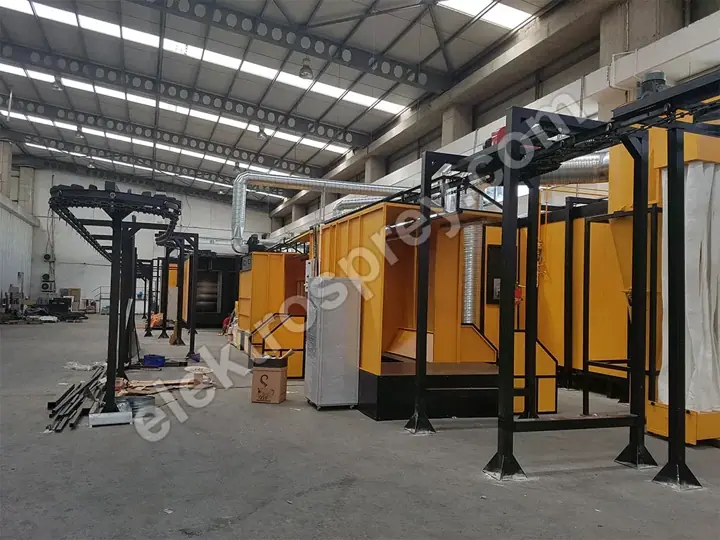
The legislation has a concept called an assembly of machinery: a group of machines joined together and controlled so that they function as an integral whole is itself a machine. A tunnel type powder coating line made of pretreatment, dry-off, booth, curing oven and conveyor is precisely that.
The practical consequence is heavy: whoever assembles and commissions the line counts as the manufacturer of the whole. A buyer who takes an oven from one firm, a booth from another and a conveyor from a third, then joins them on his own floor, has quietly taken the manufacturer's seat and the CE liability that comes with it.
| Scenario | Who marks the assembly | Buyer's exposure |
|---|---|---|
| Whole line from one builder, including installation and commissioning | The builder | Low - one counterparty, one declaration |
| Main equipment from a builder, conveyor local, joined on site | Whoever joins them | High - liability usually shifts to the buyer |
| Equipment bought separately, buyer's own team assembles | The buyer | Highest - file, risk assessment and declaration are yours |
| Booth or oven added to an existing line later | Whoever makes the change | Medium - a "substantial modification" may reopen the declaration |
Sub-machines keep their own CE marks. On top of that comes a separate plate and a separate declaration for the line as a whole, naming the line, its serial number, year of build, the directives applied and the standards relied on. The plate itself carries the manufacturer's name and address, the machine designation, type and serial number, year of construction and the CE mark.
One more warning: a unit that cannot function on its own and is delivered to be built into another machine is partly completed machinery and must not carry a CE mark. It comes instead with a Declaration of Incorporation and assembly instructions. If your supplier sends you that instead of a declaration of conformity, it is not a gap - it is notice that marking the assembly falls to you.
Which legislation comes into play
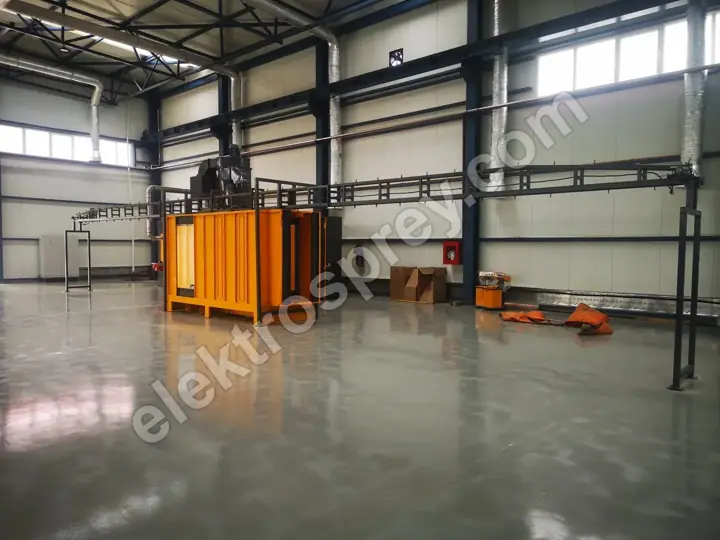
No coating plant runs on one directive; several stack on top of each other, and all of them must be named in the declaration.
| Legislation | What it touches on the line | Practical note |
|---|---|---|
| Machinery Directive 2006/42/EC | Conveyor, booth, oven doors, every moving part, emergency stop architecture | The backbone; the assembly declaration comes from here |
| Low Voltage 2014/35/EU | Control panel, heater circuits, lighting | Panel builder's test reports go into the file |
| EMC 2014/30/EU | Drives, PID controllers, gun power units | High voltage gun units are the critical item |
| ATEX 2014/34/EU | Filtered powder coating booth and equipment in the coating zone | Booth is CE / ATEX; wet paint side is ATEX Zone 2 |
| Gas appliance rules / EN 1020 | Gas oven burner, gas train safety chain | The burner's CE is separate; it does not cover the oven |
| Pressure Equipment 2014/68/EU | Steam or thermal oil boiler, compressed air receiver where fitted | Usually a separate supply; split the scope in the contract |
Underneath these run the harmonised standards: EN ISO 12100 for risk assessment, EN 60204-1 for electrical equipment of machines, EN ISO 13849-1 for safety-related control functions, EN 12981 for powder spray booths, EN 12215 for liquid spray booths and EN 1539 for dryers and curing ovens.
A calendar warning: in Europe the new Machinery Regulation (EU) 2023/1230 replaces 2006/42/EC on 20 January 2027. If you order today for delivery in 2027, write into the contract which framework the declaration will be issued under - that clause protects you if delivery slips.
What belongs in the technical file
The declaration is one page. The weight sits in the file behind it, and that is what an inspector asks for.
| Content | What it does | Who supplies it |
|---|---|---|
| General layout and flow diagram | Defines the boundary - where CE starts and stops | Builder |
| Risk assessment report | Every hazard, the measure taken, the residual risk | Builder |
| Electrical drawings and panel schematics | Isolation, lockout, emergency stop chain | Panel builder |
| Safety function list with performance levels | Door interlocks, e-stop, gas safety chain | Builder |
| Component declarations and certificates | Burner, drives, ATEX equipment | Sub-suppliers |
| List of standards applied | Which clause the design was built to | Builder |
| Operating and maintenance manual | In the language of use, with residual risk warnings | Builder |
| Test and commissioning records | The values actually measured | Builder + buyer |
The whole file need not be handed to the buyer; commercially sensitive parts may stay with the builder. But the manual, the declaration, the safety function list and the commissioning records are delivered to the buyer. Put a clause in the contract that the technical file will be presented to the competent authority on request - that is the only practical assurance the file genuinely exists.
What CE does not cover
The items buyers assume are inside the line's CE and later find are separate work:
- Building-side installation. Incoming supply, earthing, power factor correction, cable trays - plant work, not line work.
- Gas connection and utility approval. The burner may be CE marked; designing and approving the gas train is local jurisdiction.
- Stack, emission and discharge permits. Oven flue and pretreatment effluent belong to environmental law.
- The workplace explosion protection document. The employer side of ATEX (1999/92/EC) is an operator duty, not a machine duty. Even with an ATEX booth, this document is asked of you.
- Fire detection and suppression systems. In-booth measures are in scope; the building system is not.
- Operator competence and running the plant. A manual and commissioning training are delivered; use afterwards is yours.
- Coating performance. Film thickness, adhesion, salt spray resistance - specification, not CE.
- Markets outside the EEA. Export destinations may require their own mark or approval regime.
Splitting who owns which item at the outset is easier if you attach the cost breakdown from powder coating plant installation cost as an annex to the contract.
Clauses to write into the purchase contract
- The CE mark and Declaration of Conformity shall cover the line as a whole; component declarations do not substitute for it.
- The declaration shall list every directive and standard applied, individually.
- The operating and maintenance manual shall be delivered in the language of the country of use.
- The ATEX scope and zone classification of coating-zone equipment shall be stated in writing.
- The technical file shall be held by the manufacturer and presented to the competent authority on request.
- The commissioning record shall itemise the safety functions actually tested.
- If delivery falls into 2027, the framework under which the declaration is issued shall be agreed.
- Where assembly happens on site, who counts as the manufacturer of the assembly shall be stated explicitly.
Who signs what at commissioning
The order is this: the builder installs the line, physically tests the safety functions, fits the plate and signs the declaration. The buyer signs a handover record confirming receipt of the manual, the declaration and the test record. Operator training is minuted separately. The line should not go into production until all three signatures exist - because these papers are the first thing asked for after the first accident.
The full installation sequence and commissioning steps are collected in our powder coating plant setup guide; the contents of the explosion protection side are covered separately in what to look for in an ATEX conformity file.
Frequently asked questions
Is there such a thing as a CE certificate?
No. CE is a mark, not a certificate. What you should hold is the EC Declaration of Conformity: a single signed page naming the manufacturer, the line, its serial number and the directives applied, with the technical file behind it. Some documents circulated as "CE certificates" are marketing pages with a CE logo printed on them.
Is the whole line marked, or each machine?
Both. Sub-machines keep their own marks; once they are linked and driven as an integral whole, the resulting line needs an additional mark and declaration. The one thing a buyer must check is simple: does a declaration exist that covers the line as a whole?
Is a notified body required for CE?
Not for the line as a whole, because powder coating lines are not on Annex IV; the manufacturer self-declares. Some components inside the line may still need third-party assessment under their own rules - gas burners and ATEX equipment being the typical cases. Their certificates go into the file.
Are ATEX and CE the same thing?
No. ATEX is one of the directives running underneath CE, and it concerns equipment in explosive atmospheres. In equipment with solvent vapour, such as a water curtain wet paint booth, Zone 2 classification sits at the centre of the design. ATEX also has an employer side: even with CE marked machinery, the explosion protection document is written by the operating company.
Does CE apply to a line sold on the domestic market?
Yes. National machinery safety regulations transpose the EU directive and apply to machines placed on the domestic market as well. There is no difference in the declaration between an export sale and a domestic one; the differences are the language of the manual and the local gas and electrical approvals.
Does CE transfer when I buy a used line?
If you take the line over unchanged, the existing declaration remains valid and the file should come with it. But if you extend it during the move, add a booth, or change the conveyor speed or the control architecture, that can count as a substantial modification: the risk assessment is redone and whoever made the change issues the declaration.
Summary
On a powder coating plant, CE covers the safety of the machinery you bought. It does not cover coating quality, throughput, building services, gas and flue approvals, or the operating company's explosion protection document. What you should expect on paper is not a certificate but a Declaration of Conformity covering the line as a whole, with a technical file behind it. The most critical point is ownership: whoever assembles the line is the manufacturer of the assembly. Buying equipment piece by piece and joining it with your own team looks cheaper at first, but you take on the CE liability, the risk assessment and the technical file along with it. The lines we build are delivered with an assembly declaration of conformity and a 2-year manufacturer warranty.
Send us your line scope and destination country - we will itemise the declaration scope, the directive list and the document set to be delivered directly in the quotation.