
Setting Up a Powder Coating Line for Automotive Tier Suppliers
For a supplier feeding an OEM, the line is sized by the customer's production schedule, not by the part. How takt time, traceability and rework rate turn into pretreatment stages, booth layout, oven choice and floor plan.
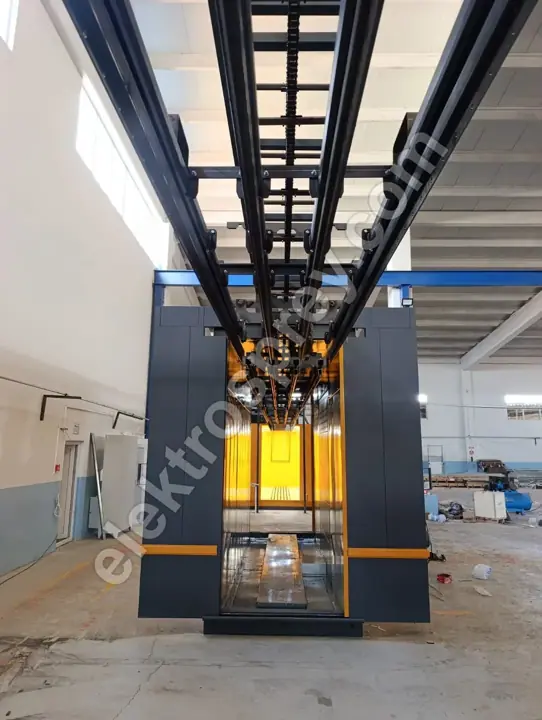 Enlarge
An automotive tier supplier powder coating line is a different job from equipping a general job shop: here the line is sized by your customer's production schedule, not by your largest part. A company feeding an OEM or a Tier-1 has to deliver a set number of parts, at a set hour, to a set quality, with the records to prove it. Those three demands turn straight into hardware: a continuous-flow tunnel type powder coating line running 500–5,000 parts/hour with a conveyor adjustable between 1 and 6 m/min; a pretreatment section that climbs from the 3 stages common in general industry to 5–7 stages for automotive sheet metal; and an oven holding ±3 °C uniformity, because two parts from the same batch will be laid side by side during an audit.
That is what separates this line from every other sector we build for. In a machine shop the part dictates the design; in automotive supply the cycle time dictates it. Your line is built against the customer's assembly line, and if that line stops, the cost of the delay has nothing to do with the value of the part you were coating.
Takt time sizes the line
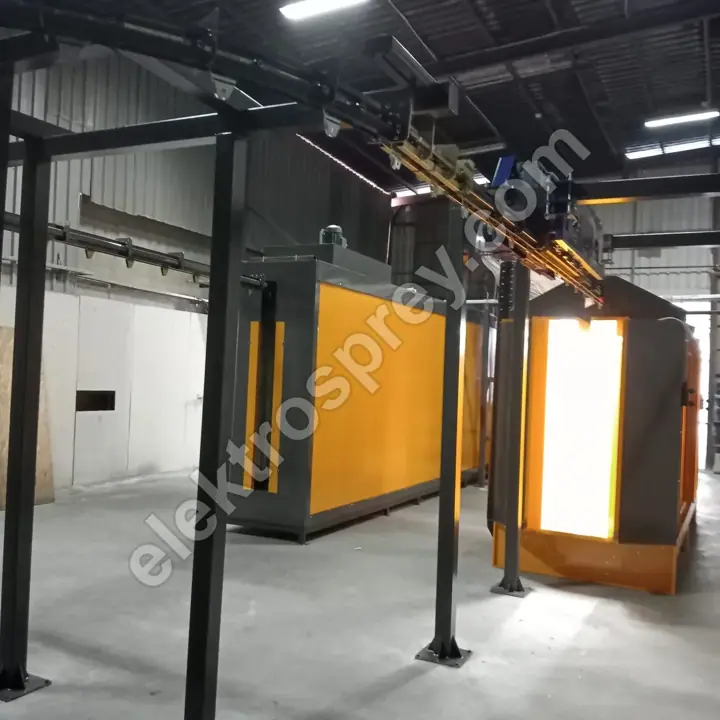
The calculation runs backwards from the hourly requirement, not forwards from the annual figure. The chain is: contract volume per year → working days → shifts → parts per hour → parts per hanger → conveyor speed → tunnel length. Be optimistic about any link in that chain and the error does not show up at the end; it shows up in the body of the line, and lengthening a tunnel after it has been built is a new investment.
Three details make this calculation different in automotive:
- Hanger density is limited by coating quality, not by space. Loading more parts per hanger looks like free capacity, but parts shadow one another, the Faraday cage effect grows and edge thickness scatters. Capacity has to come from line speed, not from crowding the rack.
- An extra shift is not free capacity. A second shift does not make you pay the oven heat-up again, but it narrows the maintenance window. A line that has redundancy on one shift has none on three.
- Plan the contract volume as a floor, not a ceiling. When the OEM exercises its volume option, the line has to be able to grow — which means designing the structure one step larger than today and fitting equipment to current need.
We work the arithmetic through with real figures in powder coating line capacity calculation.
| OEM requirement | What it becomes on the line |
|---|---|
| Fixed delivery schedule, line-stop penalties | Continuous tunnel, conveyor adjustable 1–6 m/min, buffer area |
| Batch-level quality records | PID-controlled oven, batch-to-recipe mapping, 16 curing profiles |
| Coating thickness tolerance | Fixed automatic gun layout, booth rated for 2–12 guns, thickness check point |
| Corrosion specification (salt spray hours) | 5–7 stage pretreatment, conversion coating, demineralised final rinse |
| Colour consistency | ±3 °C uniformity in the oven, the same recipe repeatable batch after batch |
| Traceability and audit | Logged process parameters, bath analysis records, hanger-batch numbering |
| Material efficiency | 95%+ powder reclaim, 98.5%+ coating efficiency |
| Volume growth option | Layout with room to expand, a bottleneck stage that can be doubled |
Pretreatment: how many stages for automotive sheet metal
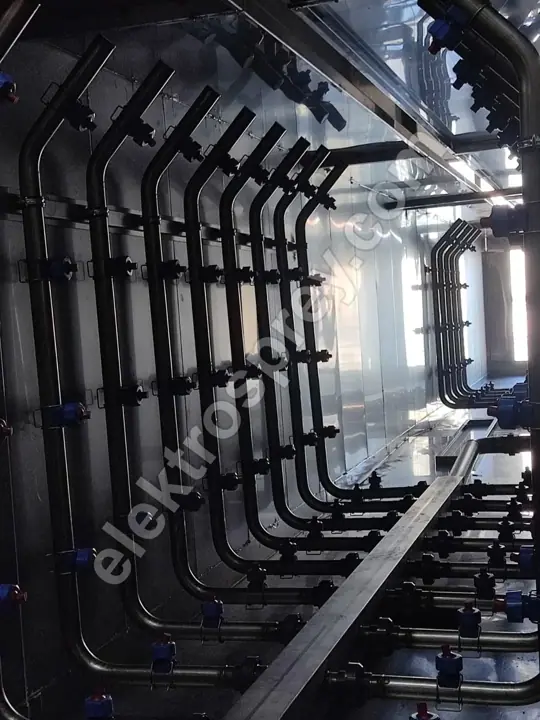
Pretreatment is the part of an automotive line that is not open to negotiation. A corrosion specification is a specification for a coating system, and the first layer of that system is not paint — it is the conversion coating built onto the metal. Work that runs at 3 stages elsewhere typically settles into this sequence: degrease → rinse → conversion coating (phosphating) → rinse → passivation → demineralised rinse → dry-off.
Three points inside that sequence are specific to automotive. First, the conductivity of the final rinse: a final rinse with mains water leaves salts on the surface, and those salts come back as blisters in the salt spray test — demineralised water is a specification requirement here, not a refinement. Second, dry-off: pressed sheet parts trap water in overlaps, hems and spot-weld zones, and that water flashes off inside the curing oven and leaves porosity in the film. Third, closed sections: on box profiles, welded brackets and double-walled housings, the internal surface a spray jet cannot see is only wetted by a dip surface treatment line; some plants run a small immersion cell alongside the spray tunnel purely for that part family.
Which stages a given part genuinely needs, and which can and cannot be dropped, is set out part by part in how many pretreatment stages do you need.
Booth, gun layout and colour change
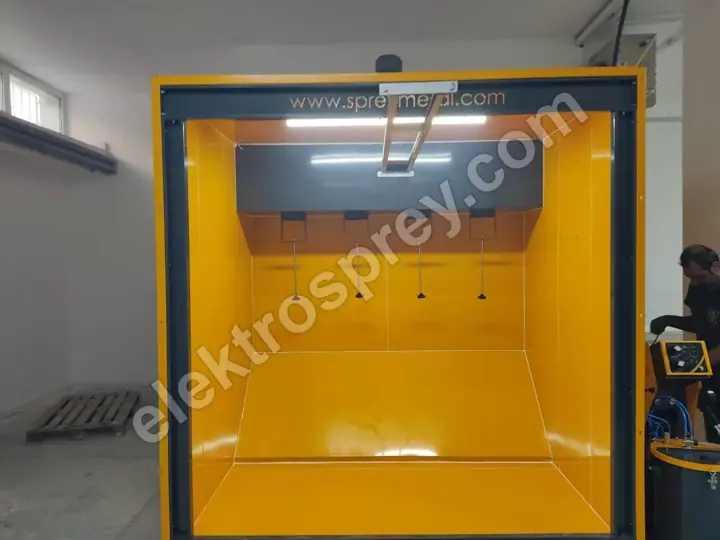
Automotive suppliers usually run few colours — blacks, anthracites and greys dominate — but demand high thickness consistency. That shifts the booth priority away from colour-change speed and towards the automatic gun arrangement. A cartridge filter powder coating booth rated for 2–12 guns, holding an internal air velocity of 0.5–0.8 m/s with pulse-jet cleaning, keeps the film stable and protects material efficiency at 95%+ reclaim; the cartridge filters run at 99.9%+ efficiency and the booth is supplied under CE / ATEX.
Air velocity here is a quality parameter, not a technical footnote: too low and powder escapes the booth opening; too high and the cloud is drawn away before it reaches the part, leaving edges thin. Gun distance and angle should be set once and locked to the hanger type. Operators re-aiming the guns every batch is the single most common cause of a thickness distribution nobody can explain during an audit.
The oven: cure window, uniformity and energy
Powder cure is a temperature-and-time window, and an automotive audit looks at that window through part metal temperature. When the oven air reaches setpoint, a heavy bracket may still be cold; cure time is counted from the moment the part is up to temperature, not the air. That makes oven choice decisive whenever a part family spans a wide range of section thickness.
| Item | Box type electric oven | Top-loading gas oven |
|---|---|---|
| Operating range | 80–250 °C, PID control | 140–220 °C |
| Uniformity | ±3 °C — strong for tight automotive recipes | Depends on burner and air circulation design; harder in large volumes |
| Recipe management | 16 curing profiles, a stored recipe per part family | Fewer profiles; settings rely on operator discipline |
| Power / capacity | 3–150 kW | 50,000–500,000 kcal/h |
| Heat-up time | Stepped and controlled | 35–45 min |
| Energy cost | Reference | 30–40% lower than electric |
| Shell and insulation | AISI 304 inner shell, 10 cm rock wool insulation | Shell built for continuous duty, CE / TS EN 1020 |
| Typical automotive use | Samples, low volume, tight-tolerance critical parts | Continuous-flow series production, high volume |
In most plants the answer ends up being both: the series line runs on the gas oven, while samples and launch batches run through a box type electric oven. We compare the running burden and the selection logic of the two in electric or gas powder coating oven.
Traceability: what an audited line has to record
An OEM audit looks less at the line itself than at the line's memory. In practice the records typically asked for are: the oven temperature-time curve and which batch ran on which recipe; daily analysis values for the pretreatment baths (concentration, pH, temperature, final rinse conductivity); coating thickness measurements; the batch number of the powder used; and scrap and rework counts.
An honest warning from the builder: this recording infrastructure is the item most often left off the first investment list. The oven's PID control already manages temperature, but storing that history is a separate decision. It can be added later — what you cannot do is generate historical data retroactively the week before an audit. Tell us at order stage which parameters have to be logged and where the data should be written.
Rework rate and the capacity it eats
The invisible consumer of capacity on an automotive line is rework. A rejected part is not thrown away; it is stripped and occupies the line a second time. So even with a low scrap figure, the load on the line is higher than the volume you quoted.
The practical consequence: do not plan the line to fit the contract volume exactly. How large the rework allowance needs to be depends on part geometry, pretreatment discipline and operator experience; the figure varies considerably from plant to plant and can only be established by measurement during launch batches. Where stripping will happen — chemical stripping or a burn-off oven — also belongs in the floor plan from the start; a stripping station added later almost always steals space from the pretreatment area.
Thermal mass and hanger loading on heavy, thick-section parts is a separate calculation, covered in heavy part and construction equipment coating lines.
Layout, buffer stock and downtime risk
On a line making scheduled deliveries, the most expensive event is a stoppage. Settle three things in the layout: a buffer area between pretreatment exit and booth entry, holding a few hours of work so short faults never reach the customer; a critical spares stock (pumps, gun control cards, fan belts, filter cartridges — anything with a long lead time); and a maintenance window, because on a three-shift line that does not schedule maintenance, maintenance schedules itself.
How to place the pretreatment-booth-oven-cooling sequence, the load and unload zones and the overall footprint is covered with dimensions in powder coating plant space and layout.
Frequently asked questions
How many pretreatment stages does an automotive tier supplier need?
Work that runs at 3 stages in general industry typically rises to 5–7 stages for automotive sheet metal. The driver is the customer's corrosion specification: a conversion coating, the rinse and passivation that follow it and a demineralised final rinse become effectively mandatory wherever salt spray performance is required. The stage count is set by the specification you were given, not by us — and we build the line to that specification.
Should the line be sized by annual contract volume or by hourly capacity?
By hourly capacity. Annual volume is only the starting figure; what binds the line is the parts per hour left after dividing by working days and shifts, and the conveyor speed derived from it. A line chosen against an annual number will not keep up in the busy weeks, because real deliveries are never spread evenly across the months.
Is powder coating used on visible automotive body panels?
Visible outer body panels are generally painted on the OEM's own line with liquid systems. On the supplier side, powder coating is used mainly on chassis and underbody parts, brackets, seat frames, pedal assemblies, door reinforcements, engine-bay sheet metal and similar groups. In these families the governing requirement is corrosion resistance and thickness consistency, not appearance gloss.
What records does an OEM audit ask the line to produce?
Typically the oven temperature-time log with batch-to-recipe mapping, daily bath analysis values, final rinse conductivity, coating thickness measurements, powder batch numbers and rework counts. Building a line without the infrastructure to log these, on the assumption nobody will ask, is the one shortfall that has no retroactive fix.
How long does a colour change take on an automotive line?
Because supplier lines usually run few colours, colour change is not a daily operation in most plants; it becomes critical on multi-colour aluminium profile lines, where the target is a colour change in under 20 minutes. If your sheet metal line changes colour rarely, it is better to spend the booth budget on gun count and reclaim efficiency than on changeover speed.
How do you protect production if the line stops?
With three layers: a few hours of buffer stock between pretreatment and the booth, shelf stock of long-lead critical spares, and a scheduled maintenance window. On top of that, doubling the bottleneck stage — usually the longest pretreatment bath, or the oven — both adds capacity and stops a single-point failure from taking the whole line down.
Summary
On an automotive supplier line, the design is driven by the customer's production schedule rather than by the part. The calculation runs backwards from the hourly requirement; pretreatment climbs to 5–7 stages because of the corrosion specification; the booth protects thickness consistency with 2–12 guns and 95%+ reclaim; the oven answers the audit with ±3 °C uniformity and stored, repeatable recipes. Plan two more things from day one: the process logging infrastructure and the rework allowance — both are expensive to retrofit. Every plant is built to the customer's largest part and to their schedule; there is no catalogue size, and every line is delivered with a 2-year manufacturer's warranty.
Send us your part family, annual volume, shift pattern and your customer's corrosion specification — we will work out the takt time and dimension the line stage by stage.