
Pretreatment: Should It Be 3 Stages or 7?
The number of stages does not come from your budget; it comes from how dirty the part arrives and how long the coating has to last. What baths sit inside 3, 5 and 7 stage pretreatment, which part suits which, and what each skipped stage costs you later.
 Enlarge
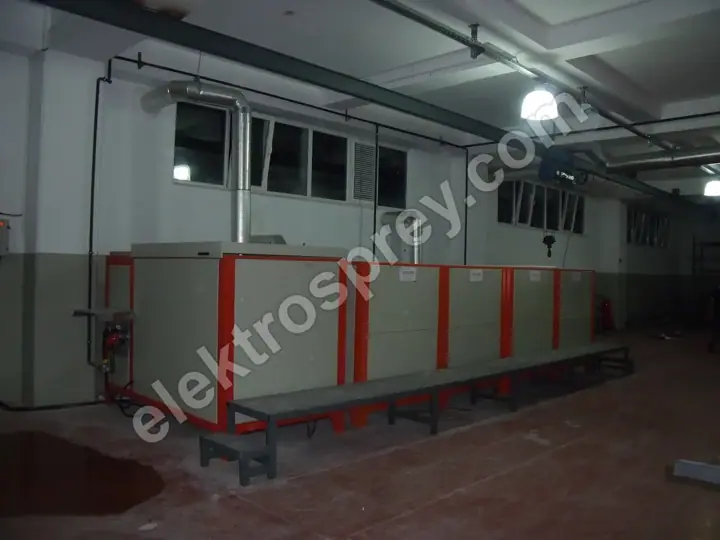
The number of stages does not come from your budget. It comes from how dirty the part arrives and how long the coating has to survive. Our tunnel type lines are built with 3 to 7 pretreatment stages. The two ends look like this: 3 stages means degrease + rinse + dry; it is enough when the steel already arrives clean, the part stays indoors and the coating is decorative. 7 stages is the full sequence — degrease, double rinse, phosphating, passivation, demineralised rinse and dry; it is required for a part that will sit outdoors, meet moisture and salt, and carry a long warranty.
This is also where the most common mistake on site happens: cutting pretreatment to pay for a bigger oven. If the coating does not bond to the surface, the oven will not rescue it. An oven cures coating that has bonded; coating that has not bonded it simply blisters in a perfectly cured state. The bill for missing pretreatment does not arrive on day one — it arrives in month six, at the edge where the paint lifts.
3, 5 and 7 stages — which baths are inside
| Stages | Baths included | Suited to | Typical use |
|---|---|---|---|
| 3 stage | Degrease → rinse → dry | Clean-arriving, lightly oiled sheet parts that stay indoors | Furniture frames, shelving, internal components, decorative goods |
| 5 stage | Degrease → rinse → phosphate → rinse → dry | Parts from machining, oily, expected to last a medium service life | Machine bodies, enclosures, white-goods style series production |
| 7 stage | Degrease → rinse → rinse → phosphate → passivate → DI rinse → dry | Outdoor parts, humid or salty environments, long warranty | Aluminium profile, façade elements, agricultural and construction machinery, posts and railings |
Four and six stage arrangements also exist; the extra stage is usually a second rinse or a separate acid bath. Because we build the line around your part, the stage count is never picked from a catalogue — it is calculated from your part plus your coating-life target.
What each stage does, and what happens if you skip it
| Stage | Function | If it is skipped |
|---|---|---|
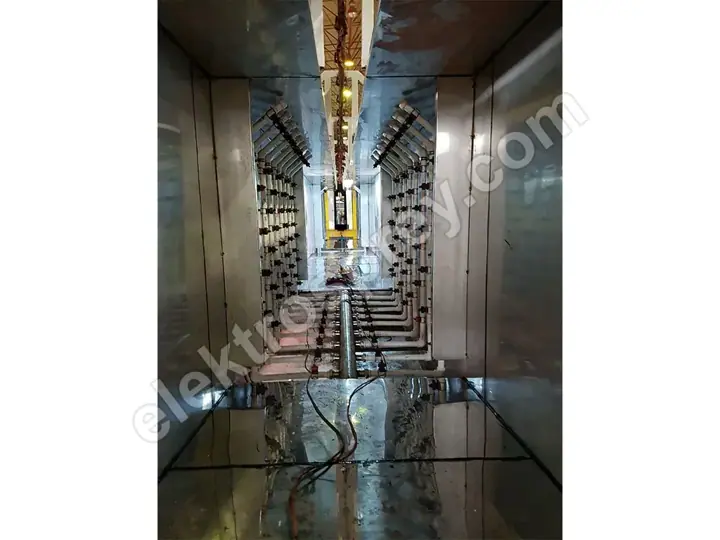
| Degreasing | Removes press and machining oil, fingerprints and cutting fluid from the surface | The coating sits on top of oil: cratering, poor adhesion, flaking at the first impact |
| Rinsing | Carries the previous bath's chemistry off the surface | Chemical carry-over contaminates the next bath and shortens its life; staining and white marks on drying |
| Phosphating | Builds a micro-crystalline conversion layer the coating can chemically key into | The coating only grips mechanically; corrosion resistance drops sharply and rust creeps under the film from any scratch |
| Passivation | Seals the pores of the phosphate layer and locks it in | The phosphate layer stays open; in humid conditions corrosion starts underneath it |
| DI (demineralised) rinse | Final wash that leaves no dissolved salts or minerals behind | Minerals left by drying mains water form ionic sites under the film: blistering and edge corrosion |
| Drying | Sends the part into the coating booth completely dry | Powder clumps on a damp surface and will not lay down; steam bubbles and pinholes appear in the oven |
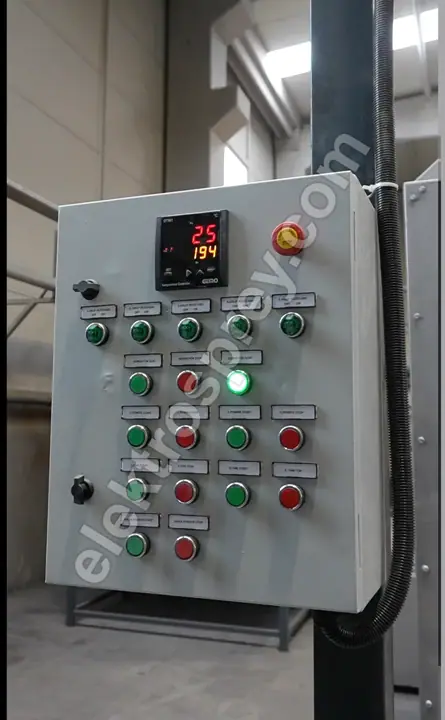
The table makes one point: stages do not substitute for one another. You cannot compensate for missing phosphating with better chemistry, and you cannot compensate for a missing rinse with longer dwell time. Each stage does a different job.
Dip line or spray tunnel?
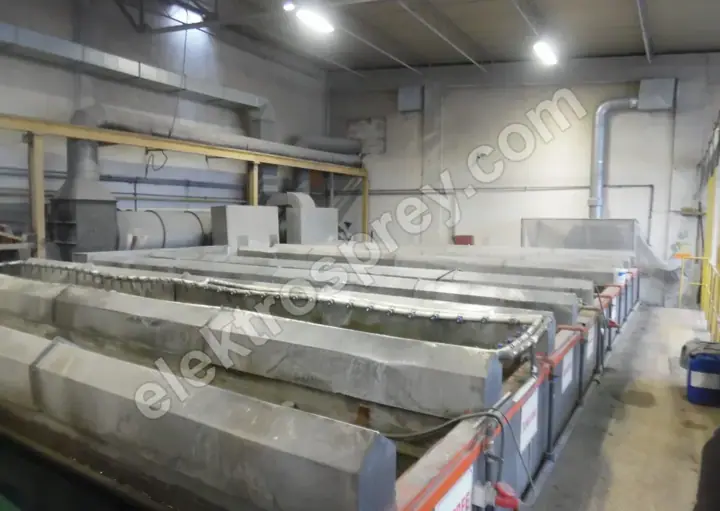
The second decision, as important as the stage count, is how the part enters the baths.
| Dip (immersion) line | Spray tunnel | |
|---|---|---|
| Method | Part is lowered into the bath in a basket or on a hanger and dwells | Part travels on the conveyor while nozzles spray it |
| Complex geometry | Strong — box sections, internal cavities and perforated parts wet out fully | Weak — chemistry never reaches surfaces the nozzles cannot see |
| Capacity | Batch process, limited hourly throughput | Continuous flow, matches lines of 500–5,000 parts/hour |
| Space | More compact overall, but each bath needs tank volume | Needs a long tunnel; costs you metres in the layout |
| Chemical action | Works through dwell time, little mechanical action | Spray pressure adds mechanical cleaning |
| Water and chemical use | Large initial fill, slow turnover | Continuous circulation, higher losses to leakage and evaporation |
A practical rule: complex geometry favours dipping, high volume favours the tunnel. For parts with internal cavities, tube and box sections, or holes the chemistry has to pass through, a dip type surface treatment line is the right choice. Where thousands of the same part move through in a straight flow, the spray tunnel inside a tunnel type powder coating plant is more efficient. Some plants install both: series parts go through the tunnel, awkward geometries through the dip line.
Salt spray resistance versus stage count
A salt spray test measures how many hours a coating survives in salt fog. Let us be honest here: do not trust anyone who hands you an exact hour figure, because the result depends not only on the stage count but on the chemistry used, the substrate, the powder quality, the film thickness and the laboratory running the test.
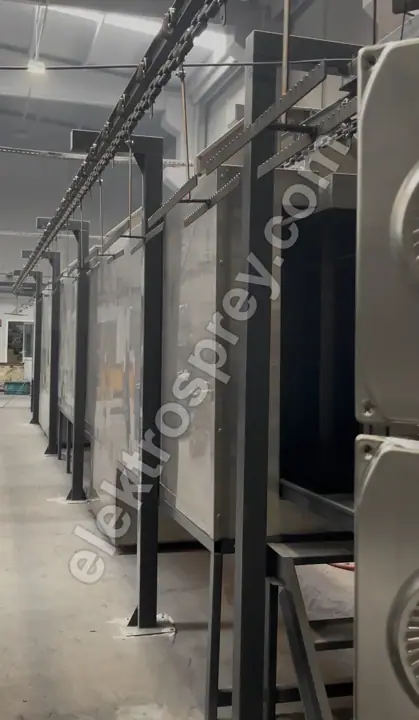
What can be said is the direction: resistance rises as stages are added, and the rise is not linear — it comes in jumps.
| Pretreatment | Resistance direction | Reason |
|---|---|---|
| 3 stage (degrease only) | Lowest | No conversion layer; the coating grips mechanically |
| 5 stage (with phosphate) | A clear jump | Phosphate crystals give the coating a chemical bonding surface |
| 7 stage (passivation + DI rinse) | Highest | The layer is sealed and no ionic residue is left on the surface |
The largest jump happens where phosphating enters. The second jump comes from the passivation + DI rinse pair. So if the budget is tight, the correct order is: add phosphating first, then convert the final rinse to demineralised water.
The cost of adding stages: water, effluent and operation
Adding stages is not free, and there is no point hiding it:
- Water consumption rises. Every rinse is a separate water stream. A 7 stage line has three rinse points, one of them on demineralised water — and producing DI water needs its own water treatment unit (resin or reverse osmosis).
- Effluent load rises. Phosphate and acid baths require treatment. A phosphating line carries a different obligation than a degreasing-only line in terms of a treatment plant and discharge permit. That is a separate investment line in your plant plan.
- Chemical and analysis cost rises. Every bath has a concentration, a pH and a temperature to be measured on a schedule. More stages means more parameters to track, which means a person's time.
- Heating load rises. Degreasing and phosphate baths run hot. More baths means more volume to heat and more fuel burned.
- The line gets longer. Each stage is metres in a tunnel and a tank on a dip line. Those metres must be allocated in your layout from the start — squeezing a stage in afterwards is usually not possible.
For the same reason, "let us build 7 stages just in case" is not a sound decision either. Running a 7 stage line for a decorative indoor product pours water, chemicals, heat and labour away every single day.
How to make the decision
Answer three questions in order:
- How does the part arrive? Oily from machining, coated in die lubricant from the press, dusty from storage, or clean sheet?
- Where will the part live? Indoors, on a façade, in a coastal or salty environment, exposed to chemical vapours?
- What warranty will you give? Are you promising your customer 2 years or 10? That answer speaks directly to passivation and the DI rinse.
The most demanding of the three answers sets your stage count. Then those stages have to be reconciled with line capacity: bath dwell times limit conveyor speed, and conveyor speed limits your parts per hour. We walk through that calculation step by step in powder coating line capacity calculation. For the full investment picture, powder coating plant setup cost and our main guide, how to set up a powder coating plant, cover the next steps.
Frequently asked questions
Is 3 stage pretreatment enough?
It is enough when the part arrives clean, stays indoors and is not expected to last for decades. It is widely used for furniture frames, internal components and shelving systems. For any part that will sit outdoors or meet moisture and salt, 3 stages is not enough; the absence of a conversion layer shows itself within the first year.
Will powder coating adhere without phosphating?
Physically yes, chemically no. On an unphosphated surface the coating grips mechanically only, and its resistance to impact, scratching and moisture is low. Once a scratch appears, corrosion travels under the film from that point. Phosphating is the single stage that delivers the biggest durability jump in pretreatment.
Is demineralised water essential?
For the final rinse it is essential if the coating has to last. Mains water leaves calcium, magnesium and chloride behind as it dries, and those residues form moisture-attracting ionic sites under the paint film that start blistering. For short-life indoor work, a mains water final rinse is acceptable.
Is a dip line better than a tunnel?
There is no single "better"; it depends on the part. For box sections, tubes and parts with internal cavities or holes, a dip line is superior because it carries chemistry to every surface. For high volumes of the same geometry, the spray tunnel is superior because it delivers continuous flow and hourly capacity. The decision sits on the balance between geometry and quantity.
Can stages be added later?
They can, if the possibility was considered when the line was built: an empty module position in the tunnel, tank space on the dip line, and headroom in the chemical and effluent infrastructure. If the layout was planned tightly, adding a stage later usually means rearranging the line. Even if you are building 3 stages today, we advise reserving the space to grow to 5.
Should I cut pretreatment to invest in the oven?
No. This is the most common and most expensive mistake. An oven cures coating that has bonded to the surface; coating that has not bonded it simply blisters in a perfectly cured state. If pretreatment is short, even the most uniform oven in the world will not save the result. With a limited budget the correct order is: the right stage count first, oven capacity second.
Summary
Three stages is for clean-arriving indoor parts; seven is for parts that will stand outdoors under a long warranty. The difference between them is phosphating, passivation and the DI rinse — and those three stages deliver the biggest jumps in durability. In return, water consumption, effluent treatment obligations, chemical analysis and floor space all increase. The right stage count is where the dirtiness of your part meets your coating-life target.
Tell us what your part is, how it gets dirty and where it will be used — we will calculate the stage count and line type and quote it.