
Conveyor Chain Selection: How to Calculate Pull Load and Safety Margin
On a powder coating line the chain is the mechanical decision that costs the most to change later. This article shows how pull force adds up from part load, hanger dead weight, friction and vertical climb, why the safety margin is taken against elongation rather than breakage, and where to leave room for growth.
 Enlarge
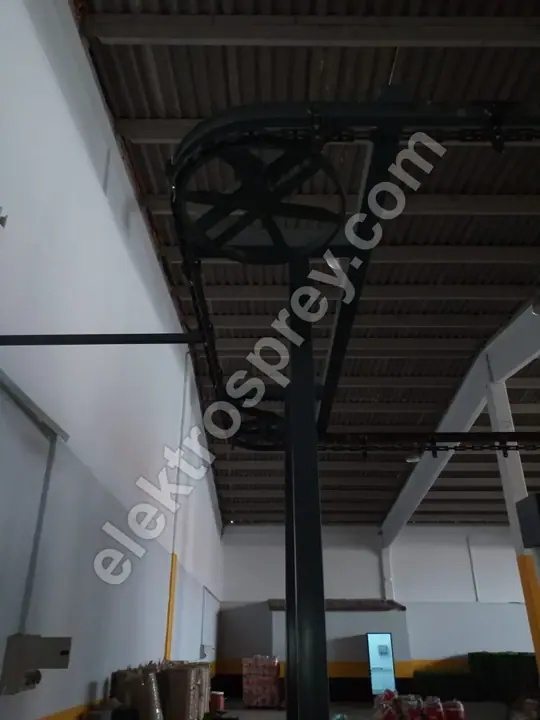
Conveyor chain selection and pull load calculation on a powder coating line never comes off a single catalogue line; it is the sum of four items: the weight of the parts carried, the dead weight of hangers and trolleys, rolling friction in the track, and the gravity overcome on vertical climbs. Those four are added, the drive station's pre-tension goes on top, and the resulting pull force is compared with the chain maker's catalogue breaking strength through a safety factor. The figures are calculated project by project: wherever your line sits in the 500–5,000 parts/hour band, whatever speed it runs within the 1–6 m/min range, and however many kilos hang on each carrier, the chain follows from that. Every line we build is made around the customer's largest part, and the chain is no exception — there is no catalogue size.
Chain selection deserves its own article because almost everything else can be changed later: you add guns, partition the oven, extend a pretreatment stage. The track profile, chain pitch and drive group are the permanent skeleton once installed. A wrongly chosen chain gives no trouble on day one; months later it returns as an elongating chain, a drive sprocket that jumps teeth, a take-up carriage out of travel, and rising noise in the curves.
What the pull force is made of
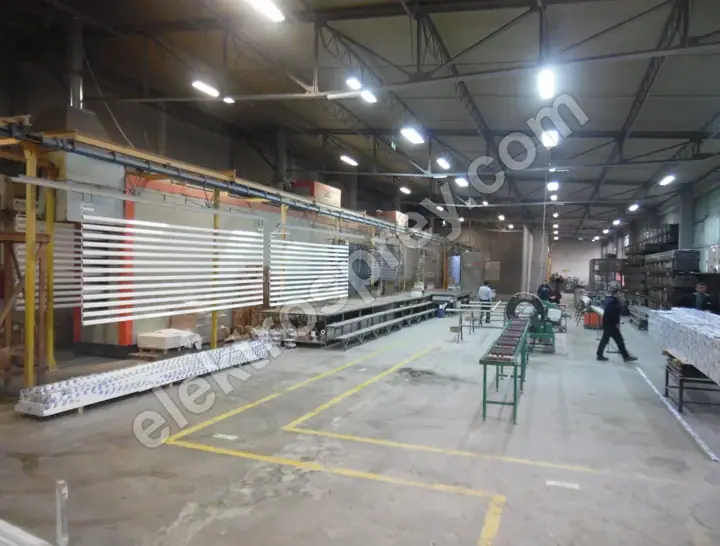
Pull force is not constant along the line; it peaks where the chain enters the drive station. The calculation splits the line into short sections and stacks each section's resistance on the previous one.
| Component | What it represents | How it is established | Most commonly missed |
|---|---|---|---|
| Part load | Weight of every part on the line at once | Heaviest product mix, hanger spacing, line length | Figure it fully loaded, not typically loaded |
| Hanger dead weight | Hangers, carriers, balances, hooks | Weighed once the hanger design is fixed | On heavy fixtures it approaches the part load |
| Rolling friction | Trolley bearing resistance in the track | Vertical load times friction coefficient | Changes with oven heat and lubrication |
| Vertical climb | Gravity overcome on rising sections | Height component of that section's load | A short ramp can double the peak load |
| Curve resistance | Extra friction in horizontal and vertical turns | Number and radius of curves | On folded layouts the total surprises you |
| Pre-tension | Take-up force that stops the chain sagging | Set by drive and take-up design | Left out, so no margin remains later |
That table is a checklist, not a formula. When you collect quotations, ask for a calculation with all six items written out separately; "the chain is sufficient" is not one.
Hanger dead weight: the item everyone underestimates
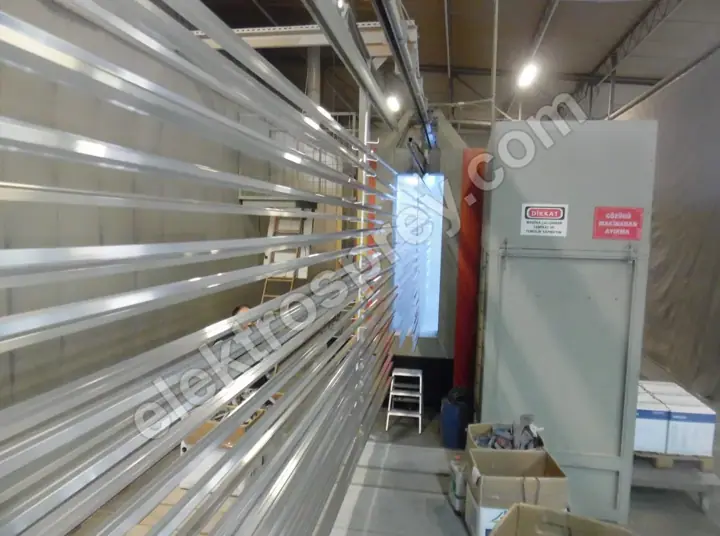
Investors usually discuss pull load in terms of product weight. In a coating shop the hanger is a load in its own right, carried continuously around the loop. Heavy fixtures for large sheet metal parts can approach the weight of the part they carry; on profile lines hangers are light but very numerous.
Hangers also grow heavier by themselves: they pick up powder on every pass and bake it in the oven, and that layer creates a weight problem and an earthing problem at once. Unless you strip or burn them off, hanger dead weight climbs month by month, so the right input is not the clean weight of the hanger but its weight at the end of the maintenance interval.
Chain pitch, hanger spacing and part length
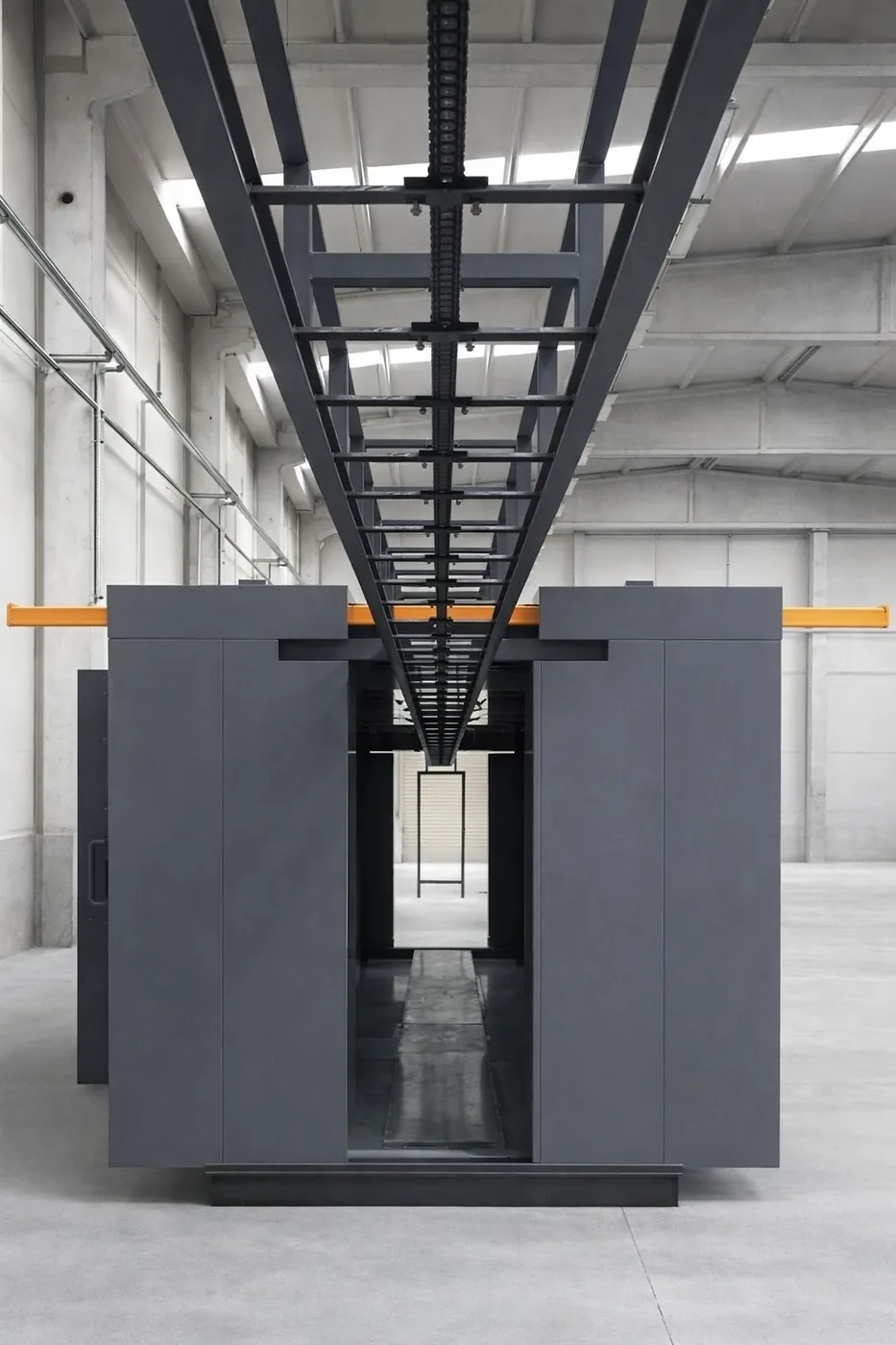
Pitch and hanger spacing are different things, but tied: hangers attach only at defined points on the chain, so spacing comes out as a multiple of the pitch. Part length, swing clearance and oven width set its lower limit.
| Decision | What it is based on | Where you see the result |
|---|---|---|
| Chain pitch | Hanger load, curve radius, sprocket | Polygon effect and vibration in curves |
| Hanger spacing | Longest part plus swing clearance | Parts knocking, coating shadow |
| Track profile | Total vertical load and hanger spacing | Track deflection, trolley life |
| Trolley type | Oven temperature and lubrication regime | Bearing life, noise |
| Drive position | Where peak pull force occurs | Chain tension and motor current |
| Take-up travel | Elongation allowance planned for | Maintenance interval, chain life |
Naming an exact pitch without seeing the part and the layout is impossible; it follows from hanger load, curve radii and line length. We set out the capacity side in powder coating line capacity calculation; hanger spacing ties directly to the parts-per-hour target described there.
Safety margin: chains do not snap, they stretch
Chain breakage is rare in the field. The real failure is silent: pins and bushes wear, the play added in each link accumulates over the loop, and the chain elongates. An elongated chain pulls the take-up carriage to the end of its travel, stops seating on the drive sprocket, rides up the teeth and eventually jumps. The safety factor is therefore not a precaution against snapping but a working-load limit that slows wear.
A chain running close to its catalogue breaking strength is theoretically "enough", but its service life is short. The factor comes from the manufacturer's working-load table and the operating conditions; hot oven sections, three-shift running and dust all push it up. Take that number from your supplier's catalogue rather than guessing.
The load also has a dynamic side: peak forces appear on start-up, on stopping and when a loaded section enters a climb, while the polygon effect of the pitch in curves adds a constant small impact. Part of the safety margin exists to absorb those peaks.
How layout decisions change the pull load
Two lines of identical capacity can need very different chains purely because of layout. Climbs, frequent curves and long oven passes all add resistance. A climb gaining a full floor level writes that section's entire load straight into the pull force, while a descent creates a braking requirement.
With heavy, unbalanced parts, pulling the whole line with one chain is not always right: you may need to separate load groups, accumulate parts, or drive sections with their own units. We compared that decision in overhead conveyor or power and free, and handling heavy parts in a coating shop covers the hanger and track choices.
On a tunnel line the chain runs as one continuous loop from the pretreatment tunnel to the oven, so on tunnel type powder coating plant projects the chain calculation cannot be closed before the pretreatment stage count and oven length are fixed. On aluminium profile lines the load is light but hanger count and line length are high: for an aluminium U type line carrying 3–7 m profiles, the governing item is not part weight but total line length and friction.
Room for growth: the line you will have in five years
Chain selection draws the boundary of how far the line can grow. Raising speed is usually easy; raising load is not. A chain chosen at its limit for today's mix becomes the wall in front of the line the moment a heavier product family arrives.
Leave a deliberate margin on chain and track, and size the drive motor for today's requirement: motors and gearboxes can be scaled up later, track and chain cannot. That margin is the cheapest insurance in the whole investment — but the second condition for chain life is maintenance. Without a lubrication regime and regular elongation measurement, no safety margin saves a chain; we set out the programme in conveyor lubrication and maintenance plan.
Frequently asked questions
What chain pitch should I use?
There is no single answer to read off a catalogue; pitch follows from hanger load, curve radii and line length. Heavy hangers and wide curves point to a larger pitch, light profile lines and tight turns to a smaller one. Never pick the pitch first and fit the load to it.
What should the safety factor be?
The factor comes from the manufacturer's working-load table together with the conditions on your line: hot oven sections, continuous shift work and dust all raise it. We calculate the exact value per project; a general number quoted here would mean either wasted cost or early wear.
How do I know the chain has elongated?
Three symptoms arrive together: take-up travel drops noticeably, a riding noise appears at the drive sprocket, and hanger spacing drifts along the line. Measure rather than wait — check a fixed number of links periodically against the value recorded at installation. Once elongation passes the manufacturer's limit, replace the whole chain, not a section.
If I increase conveyor speed, do I have to change the chain?
Raising speed within the 1–6 m/min band does not by itself increase pull force; the difference shows up in how many parts are on the line at once. Keep the hanger spacing and the load stays the same; tighten it and the load grows. If a fully loaded line at the new speed weighs more than the figure used in the original calculation, the chain must be reassessed.
Can I upgrade the chain after the line is installed?
In practice, no. A larger pitch or a higher load class usually means changing the track profile, trolleys, drive sprocket and take-up group too — close to rebuilding the line. Growth margin on the chain is left at the investment stage; it cannot be bought later.
Summary
The pull force calculation is the sum of six items: part load, hanger dead weight, friction, vertical climb, curve resistance and pre-tension. That sum is compared with the chain's catalogue value through a safety factor taken against wear and elongation, not breakage. Do not look for ready-made numbers for pitch, breaking strength or the factor — each is calculated per project from hanger load, curve radii and line length. Because the chain is the one permanent mechanical decision on a line, the growth margin belongs here. If you are planning the pretreatment side at the same time, a dip type surface treatment line and the conveyor layout belong on the same table; every line we build carries a 2 year manufacturer's warranty.
Send us your heaviest part weight, hanger design, target parts-per-hour and a floor layout sketch — we will break the pull force down item by item and set the chain and track class with you.