
When the Resin Changes, What Must the Oven and Booth Change?
The resin family decides far more than where the coating can be used; it sets the oven's working band, the dwell time, the conveyor speed and the exhaust capacity. This article compares the four powder families not by "which is better" but by what each one asks of your plant.
 Enlarge
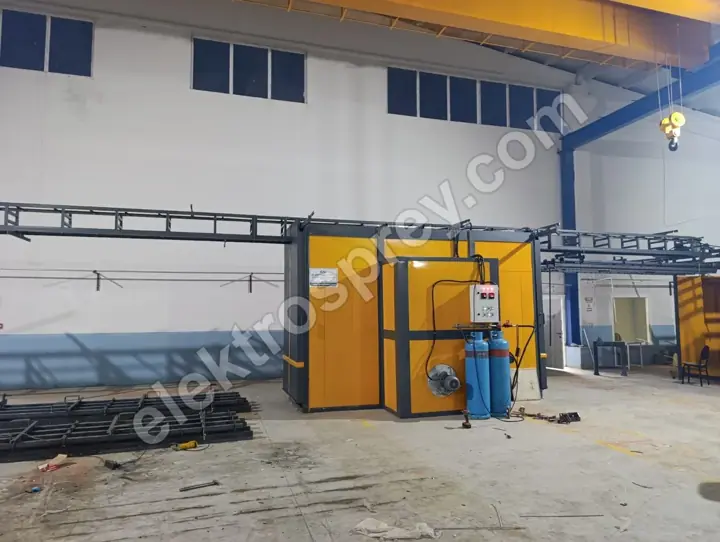
For an investor, the epoxy vs polyester vs hybrid powder coating difference is not a question of which coating lasts longer. It is a line decision that fixes the oven's upper temperature limit, the dwell time inside the oven, the conveyor speed, the recovery arrangement and the exhaust capacity. In short: epoxy and hybrid are interior work and can cure at the lower end of the band; polyester is the only correct answer for exterior work and demands a higher, more stable oven temperature; polyurethane gives the best surface appearance but asks for a longer cure and noticeably better ventilation. The box type electric oven we build works from 80–250 °C with ±3 °C uniformity and 16 curing profiles; the gas fired top-loading oven works between 140–220 °C. The gap between those two figures alone can decide which resin family you will be able to run comfortably.
One thing up front: Elektrosprey does not produce or sell powder, and does not offer contract coating. We build the machine that cures it. The point of this article is not to tell you which powder to buy, but to let you see — before you order equipment — what the resin family your supplier recommends will ask of your plant. Exact curing figures always come from the powder manufacturer's data sheet; our job on the machine side is to hit that window repeatably.
Four families, their line demands at a glance
| Resin family | Typical use | Curing tendency | What it really asks of the line | Weak point |
|---|---|---|---|---|
| Epoxy | Interior, furniture, electrical enclosures, primer | Lower-mid band, relatively short dwell | A modest upper limit is enough; short oven and fast conveyor possible | Dulls and chalks quickly outdoors under UV |
| Hybrid (epoxy-polyester) | Interior, white goods, shelving | Close to epoxy, slightly wider window | Same oven as epoxy; temperature discipline against yellowing | Not sufficient for exterior exposure |
| Polyester | Exterior, aluminium joinery, garden furniture | Upper end of the band, full cure essential | High and uniform oven temperature; little tolerance for drift | Under-cure destroys the durability claim |
| Super durable polyester | Facades, architectural aluminium, warranted work | Same band, even less tolerance for drift | Documented temperature records, narrow uniformity band | Cannot be warranted if line discipline is weak |
| Polyurethane | Decorative surfaces, thin film, high appearance | Long cure, slow conveyor | Longer oven or slower line, plus strong exhaust | Releases gas while curing; ventilation is mandatory |
The last column never appears in a sales brochure, yet it is the column that decides the investment. No line "cures everything". What is achievable is to build for the hardest family and run the easy ones inside that envelope.
The oven: upper limit or dwell time?
Curing is the product of two variables: the metal temperature the part actually reaches and the time it stays there. The set point on the oven panel is neither of those; it is only the air temperature. With epoxy and hybrid the window is wide, so shops that ignore this distinction get away with it for years. Move to polyester and the same looseness comes straight back as an exterior claim: the part appears to have reached the set point, but its surface never stayed long enough inside the required band.
That is why the first thing any shop changing resin family should do is take a real temperature curve with a data logger attached to the part. We set out the measurement method and the acceptance criteria step by step in oven temperature uniformity.
| Resin family | Upper limit demanded | Electric box oven (80–250 °C) | Gas top-loading oven (140–220 °C) |
|---|---|---|---|
| Epoxy / hybrid | Lower-mid band is enough | Comfortable; 16 profiles let thick and thin parts run separately | Comfortable; energy cost 30–40% lower |
| Polyester | Upper end, narrow drift | Comfortable; ±3 °C uniformity is the real guarantee for exterior work | Workable, but running near the top limit leaves less reserve |
| Super durable polyester | Upper end plus documented records | Suitable; profile logs and uniformity reports available | Regime drops under heavy loading if capacity is undersized |
| Polyurethane | Mid-upper band, long dwell | Suitable; extend dwell, slow the conveyor | Suitable, but exhaust and fresh air must be sized separately |
Do not read that table as ruling gas out. The gas fired top-loading oven we build in the 50,000–500,000 kcal/h range reaches its regime in 35–45 minutes and costs 30–40% less to run than an electric equivalent; in continuous production that difference is the largest line in the annual budget. The point is different: if you will work with a resin that cures at the top of the band, capacity has to be chosen with reserve, not "just enough".
Conveyor speed: the resin sets your hourly capacity
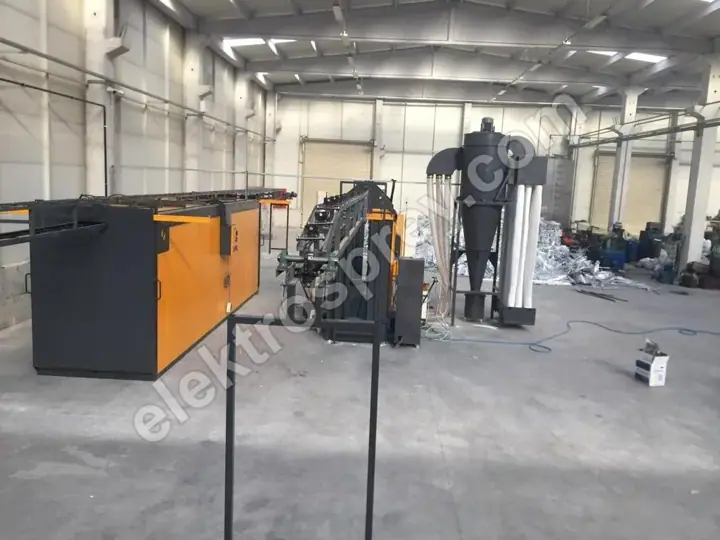
On a tunnel line, dwell time obeys one equation: oven length ÷ conveyor speed. The conveyor is adjustable between 1–6 m/min. If the resin family demands a long cure you have exactly two options — slow the conveyor down (hourly capacity falls) or build a longer oven (investment and floor area rise). There is no third option; raising the temperature to shorten the cure comes back as yellowing, gloss loss and over-bake.
This is why calculating capacity independently of the resin is a mistake. On the lines we design in the 500–5,000 parts/hour range, one of the first things we ask a customer at quotation stage is which resin family they will run. A production programme dominated by polyurethane means a longer oven for the same part count.
Booth and recovery: families do not mix
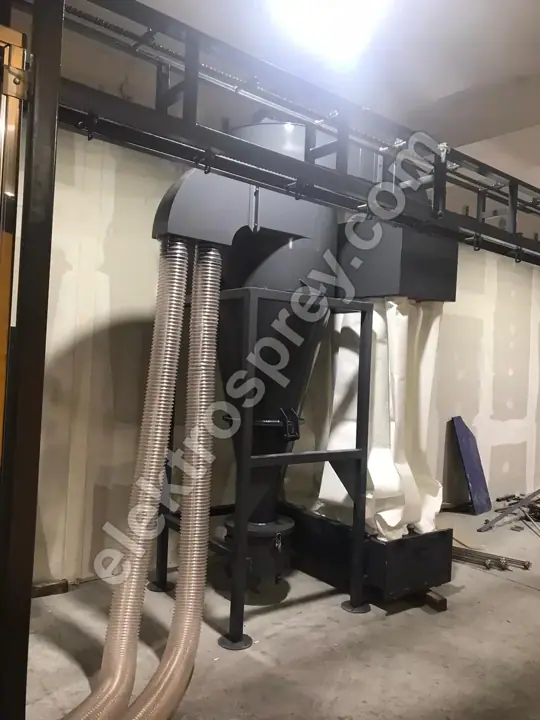
This is the item investors skip most often and pay for most heavily. When epoxy and polyester contaminate each other, the mismatch in curing behaviour produces craters and pinholes. A handful of the previous resin left in the booth, the recovery duct, the cartridge filter or the sieve can scrap the next batch on surface defects alone.
On the equipment side the consequences are clear:
- If you will regularly run two different families, plan either a separate recovery module or an audited full-cleaning procedure.
- Resin changeover time belongs in the capacity calculation just as colour changeover time does.
- 99.9%+ retention in the cartridge filter is normal, but a filter does not separate mixed powder; it only holds it. Separation is the job of the procedure.
- In a booth recovering 95%+ of the powder, the family of the returning powder must also be recorded.
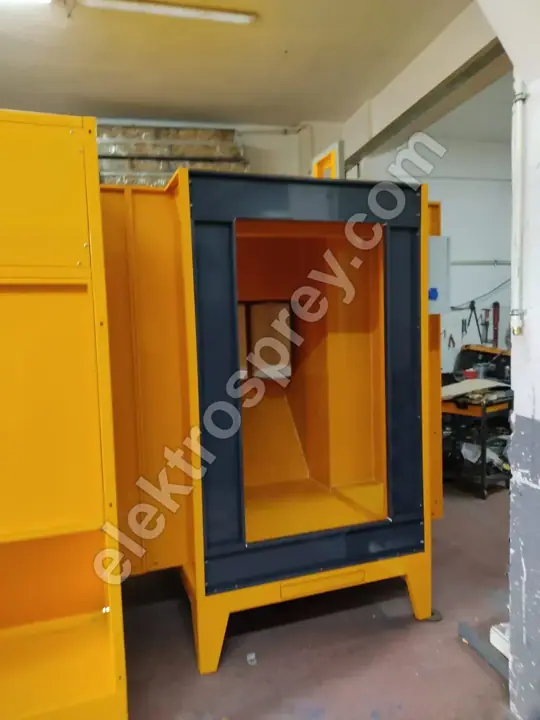
The cartridge filter powder booth we build with 2–12 guns runs at an internal air velocity of 0.5–0.8 m/s and is dimensioned around the customer's largest part; there is no catalogue size. In shops with mixed work we set booth count and recovery layout from exactly this table. On aluminium profile work, the U-type arrangement that brings colour change under 20 minutes makes the same discipline practical for resin changes too.
Ventilation and exhaust: what polyurethane really costs
Polyurethane powders release their blocking agent as they cure, which means vapour inside the oven and odour at the oven exit. Similarly, some TGIC-free polyester systems release water vapour during cure. In both cases the oven's fresh air and exhaust balance must be set higher than on a line running only epoxy and hybrid. Insufficient exhaust produces three results: condensation and dripping on cold surfaces inside the oven, staining on the part surface, and deposit build-up on the oven's inner shell over time.
Insulation and inner shell material matter here too. Our ovens come with an AISI 304 inner shell and 10 cm rock wool insulation as standard; a stainless inner surface is what determines cleaning effort and service life in applications where condensation occurs. For shops entering facade work, we collected the full set of line requirements in super durable powder and exterior line requirements.
Frequently asked questions
Why is epoxy powder not used outdoors?
Epoxy resin is excellent in chemical resistance and adhesion, but its bond structure breaks down under UV; within months the surface dulls, chalks and shifts colour. This is not an application error, it is the nature of the resin, and no line setting corrects it. Outdoors, epoxy is used only as a primer with a polyester topcoat over it.
Can hybrid powder replace polyester?
Indoors yes, outdoors no. Hybrid is an epoxy-polyester blend; it resists yellowing better than straight epoxy and is often the more economical choice for interior work. But its exterior durability never reaches polyester's level. The decision is made by asking "interior or exterior", not by comparing price.
Does polyurethane need a separate oven?
A separate oven is not required, but the same oven has to run a different regime: longer dwell and stronger ventilation. If you can slow the conveyor and the oven's fresh air-to-exhaust balance is adequate, the same oven works. If you do not want to lose capacity, the answer is not a second oven but a longer one.
Can I run epoxy and polyester in the same booth?
You can, provided the cleaning procedure between families is written down and audited. Residual powder in the booth, ducting, cyclone, filter and sieve will produce craters in the next batch. In a shop that switches family several times a week, a separate recovery module pays for itself quickly through lost time and scrap avoided.
How much does a resin change affect conveyor speed?
The size of the effect depends on the dwell-time difference in the data sheets and is found by calculation, not estimate: the required dwell time and your existing oven length give the maximum permissible conveyor speed directly. We run this calculation at project stage; it should be repeated on an existing line before moving to a new resin family.
Summary
Choosing a resin looks like a coating decision; in practice it is a line decision. Epoxy and hybrid are interior work and ask the least of the oven. Polyester and super durable polyester demand stable, documentable temperature at the top of the band, where uniformity is not a nicety but a warranty condition. Polyurethane asks for time and air: longer cure, stronger exhaust. If you will run mixed work, build for the hardest family and treat resin changeover as seriously as colour changeover. If you are planning the whole investment, our pillar guide on setting up a powder coating plant is the right starting point; every line we build is delivered with a 2-year manufacturer's warranty.
Send us the resin families you will run, your largest part dimensions and your target hourly capacity — we will size the oven length, conveyor speed and exhaust capacity around them.