
Which Sheet Metal Belongs Inside an Oven? Galvanised, Aluminised, Stainless
The inner shell of a powder coating oven has to stay stable at curing temperature for years without carrying dirt onto the parts. This article compares galvanised, aluminised and stainless sheet by temperature limit, residue behaviour and cost, and explains why our ovens use galvanised sheet and where its limits lie.
 Enlarge
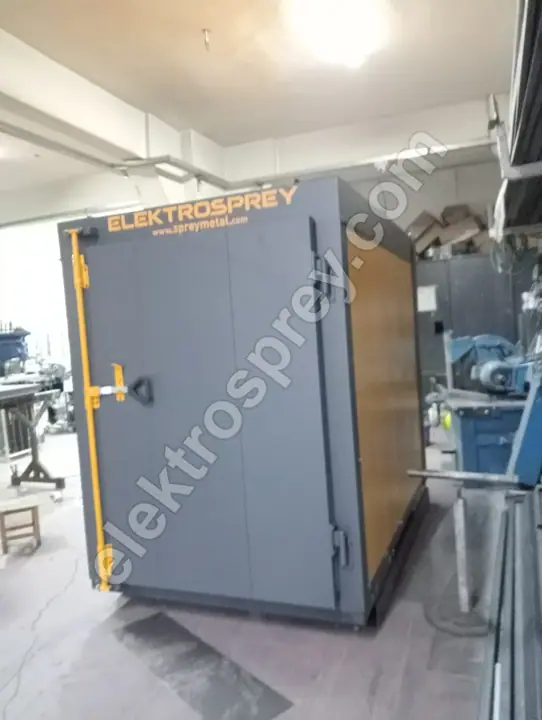
Galvanised or stainless sheet inside a powder coating oven — the short answer is this: in the temperature band where powder cures, galvanised sheet is an adequate and widely used material for the inner shell, and the inner shell of the ovens we build is galvanised. Most powder coatings cure between 160–200 °C. The American Galvanizers Association (AGA) states that a zinc coating remains stable in continuous use up to 200 °C, while above 250 °C the outer zinc layer may begin to separate. In other words, used correctly, galvanised sheet sits inside the curing band. Stainless sheet is a more expensive option that comes up when an oven runs continuously above 220 °C or a special cleaning requirement applies. Aluminised sheet is a class between the two.
The subject starts out looking like a cost debate, but the real question is: at what temperature, and for how many hours a day, will the oven run — and how will the inner surface be cleaned?
What the inner shell does, and why the material matters
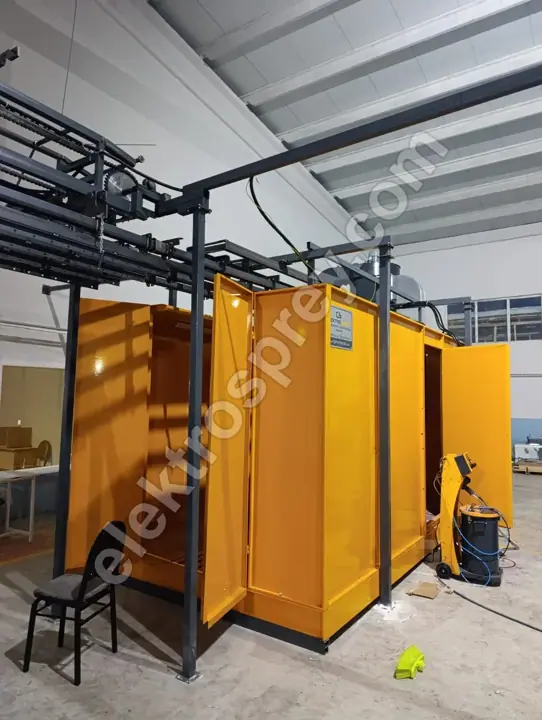
The inner shell is the surface of the oven that faces the part, and it does four jobs: it reflects and distributes heat, it guides the hot air circulation, it protects the insulation pack from paint vapour and mechanical knocks, and a fourth one that rarely makes it into a specification — it must not carry dirt onto the part.
As powder cures, a certain amount of volatiles is released from the resin. These volatiles condense on the coldest surfaces of the oven and leave a thin film on the inner sheet. With every cycle the film bakes a little further and darkens. This build-up happens in every oven and on every sheet class; what decides the outcome is whether it is cleaned regularly. The genuinely risky surface is painted sheet: at high temperature the paint layer flakes over the years, and the particles it sheds stick to freshly coated surfaces. Galvanised and stainless sheet have no paint layer to shed in this way.
Three sheet classes, one comparison
| Sheet class | Temperature behaviour | Surface and residue | Cutting / welding | Cost |
|---|---|---|---|---|
| Galvanised (zinc coated) | Stable in continuous use up to 200 °C; above 250 °C the outer zinc layer may separate | Cleaned by regular wiping; abrasives damage the coating | The coating thins at cuts and welds; these points are monitored | Economical, widespread in the industry |
| Aluminium coated (aluminised) | Withstands higher temperatures than galvanised | Similar to galvanised; if the coating is scratched, the steel beneath is exposed | Coating integrity is broken at cuts and welds | More expensive than galvanised |
| Stainless (e.g. AISI 304) | Stable at much higher temperatures; resistance comes from the material itself | No surface loss during cleaning | Resistance remains even when cut or welded | Markedly more expensive |
The distinction in the table is this: the resistance of galvanised and aluminised sheet lies in the coating; with stainless it lies in the material itself. In the powder curing band the zinc coating of galvanised sheet does its job, which is why galvanised is the most common choice in oven manufacturing. The extra resistance of stainless only pays for its price difference when the temperature or cleaning requirement calls for it.
Why our ovens use galvanised sheet
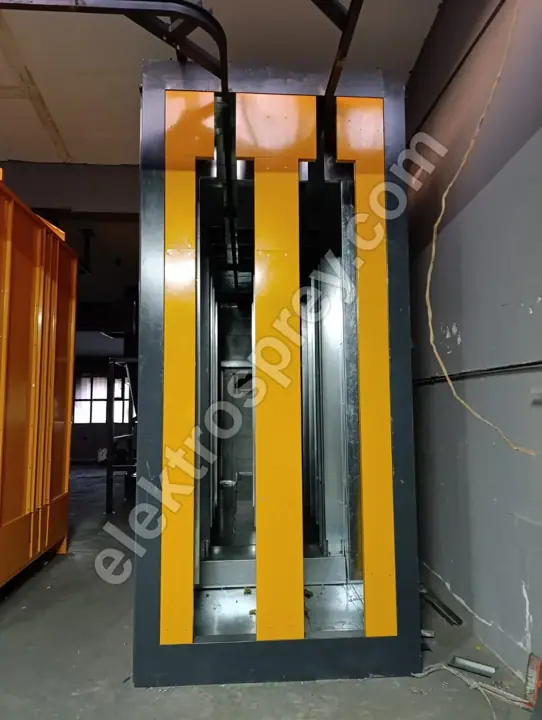
The inner shell of our ovens is galvanised sheet. The reason is simple: our box type electric ovens can work across 80–250 °C, but the real working point of powder curing is mostly between 160–200 °C, and that band lies within the continuous-use limit of the zinc coating. In this band galvanised sheet gives an economical surface that is easy to form and assemble and is protected against corrosion. The result is that, within the same budget, a larger share can go to insulation, circulation and control — the items that actually determine uniform curing.
Let us be clear about the limit of galvanised sheet as well: if the oven will run continuously at 220 °C and above for long periods, or your plant is subject to a special cleaning standard, state this at the quotation stage; the inner shell material is then assessed together against the project requirement.
Is aluminised sheet really a middle ground?
Aluminised sheet is made by coating the steel surface with an aluminium-based alloy, and it is more stable than galvanised at high temperature; that is why it is widely used in exhaust and flue components. Its weak point is the same as galvanised: cut edges, hole openings and weld seams are where the coating is thinnest. In the normal powder curing band it has no clear advantage over galvanised; it comes up on lines that will run continuously at higher temperatures.
A decision table by oven zone
| Zone / equipment | Typical surface regime | Suitable sheet | Reason |
|---|---|---|---|
| Curing oven inner shell (160–200 °C) | Continuous in the curing band | Galvanised | Within the continuous-use limit of the zinc coating; economical |
| Volume running continuously above 220 °C | Continuous at high temperature | Aluminised or stainless | Approaches the limit of the zinc coating |
| Preheating / drying compartment | Below the curing band | Galvanised | The temperature regime does not stress the coating |
| Air ducts and fan housing | Hot, no contact | Galvanised or aluminised | No contact with the part |
| Outer casing and service covers | Close to ambient temperature | Galvanised or painted sheet | The task is corrosion resistance |
Sheet class is decided together with insulation and shell rigidity
The inner sheet is never chosen on its own. In our box type electric ovens the inner shell is galvanised, insulation is 10 cm rock wool, and heating power is set within 3–150 kW to suit the project. If insulation thickness is reduced, the surface regime of the inner sheet changes too: the shell cools faster, more volatiles condense and residue builds up faster. So thin insulation affects not only the energy bill but also the cleanliness of the inner surface. We dealt with this link in numbers in oven insulation thickness and heat loss.
Sheet thickness is a separate topic. Thin sheet is cheap but ripples under thermal stress; a rippled inner surface both disturbs the air flow and makes cleaning harder. The rigidity of the inner shell is determined together with sheet thickness and the stiffening behind it — and because we build every oven to the customer's largest part, these dimensions change from project to project; there is no catalogue size.
Maintenance: how to protect a galvanised inner shell
With a galvanised inner shell, the rule of maintenance is to protect the coating. The residue film is removed with a plastic scraper and a damp cloth, not with a wire brush, sandpaper or abrasive pad. A scratched spot loses its zinc protection. Cut edges, hole openings and weld points are the places to inspect visually at the annual check.
The practical test is simple: wipe the inner surface with a white cloth. If the cloth shows only dark residue, that is normal paint build-up. If a light grey, powdery dust stays on the cloth, or you see a rust stain at any point, that area needs attention. For inspection frequency and what to look at, use the list in oven maintenance schedule and annual inspection.
Where the cost difference goes
A stainless inner shell is markedly more expensive than galvanised on the material line, and that difference shows up in the oven price. The question to ask when deciding is not "which one is more durable" but "at what temperature, and for how many hours a day, will this oven run". In a production oven working in the normal curing band, that difference does more for quality when it is spent on insulation, circulation and control. For the full list of items that make up the price, see powder coating oven prices.
Frequently asked questions
Is an oven with a galvanised inner shell good enough for powder curing?
Yes. Most powder coatings cure between 160–200 °C; according to the AGA, a zinc coating is stable in continuous use up to 200 °C. If the oven will run continuously above 220 °C for long periods, state this at the quotation stage. What really determines the life of galvanised sheet is that no abrasives are used during cleaning.
How do I tell whether the inner sheet has darkened, and is that a fault?
A dark brown-to-black film is normal; it is condensed volatiles released during curing, and it happens in every oven. The sign of a fault is not colour but texture. If the surface leaves a powdery, light-coloured dust when wiped by hand, or you see rust or blistering around a weld seam, that area should be examined. In the first case cleaning is enough; in the second, local renewal is discussed.
Should the inner sheet choice be different in a gas fired top-loading oven?
A gas fired top-loading oven works in the 140–220 °C band at 50,000–500,000 kcal/h capacity and delivers 30–40% lower energy cost than an electric oven. Its working band is close to the continuous-use limit of galvanised sheet; if you will run the oven continuously at the top end of the band, let us discuss it at the project stage.
Does a stainless inner shell change the oven's heat-up time?
In practice, what decides it is not the inner sheet but the insulation pack, the tightness of the shell and the installed power. The thermal mass of the inner shell material is a small share of the total. If heat-up time is a critical criterion, look for the answer in the choice of power and insulation, not in the sheet class.
Can I renew the inner sheet of my existing oven?
Technically it is possible, but it is not a simple re-coating job: removing the inner sheet also opens up the insulation pack, the air ducts and the fan connections. This should not be decided before the remaining life of the oven and the condition of the shell have been measured. If the shell and insulation are sound, an internal renewal can make sense; if the insulation has also become wet or collapsed, the cost of renewal approaches that of a new oven. Send us photos and dimensions of your existing oven, and we will assess it together.
Summary
In the powder curing band, galvanised sheet is an adequate and economical material for the oven inner shell; the inner shell of the box type electric oven we build is galvanised. The zinc coating is stable in continuous use up to 200 °C; what determines its life is protecting the coating during cleaning. Aluminised and stainless sheet come up in projects with continuously higher temperatures or special cleaning requirements. When you decide, weigh working temperature, daily running hours and budget together; inner shell selection belongs on the same table as insulation thickness and installed power. Every oven we build is delivered with a 2-year manufacturer warranty.
Send us the dimensions of your largest part, your target curing temperature and your daily running hours — we will size the oven together against those three figures.
For plants in the UK, North America and beyond
Where your line is installed shapes the paperwork, the power supply and the rules behind the choices described above.
- Gas burners and fuel trains are commonly built to EN 746-2 and EN 676. In North America, expect UL or CSA listed components and a review by the local authority or gas utility; commissioning usually needs the gas supplier's sign-off.
- For the UK, confirm with your importer whether UKCA or CE marking is expected. In the US and Canada, plan for UL or CSA requirements on the electrical side, and check any local documentation rules before shipment.
- For the UK, goods of Turkish origin move under the Türkiye–UK free trade agreement with an EUR.1 certificate or an origin declaration. For other destinations, the origin paperwork depends on that country's trade agreements, so check it with your importer early.
- North America runs at 60 Hz, and 480 V is common in industrial plants, so motors, fans and controls have to be specified for that supply from the start. Confirm the voltage and frequency on site before the line is designed.
Products mentioned: Box Type Powder Coating Oven (Electric) · Tunnel Type Electrostatic Powder Coating System · Overhead Pallet Powder Coating Oven (Gas)
When you ask for a quote, tell us your country, supply voltage and frequency — get in touch.