
Powder Coating Plant Cost: The Line Items Nobody Mentions
The cost of a powder coating plant is not the price of the machines. Transformer capacity, gas connection, stack, floor and compressed air are left out of the budget, which is why most investments overrun in the first three months. This is the full list of items to know before you ask for a quotation.
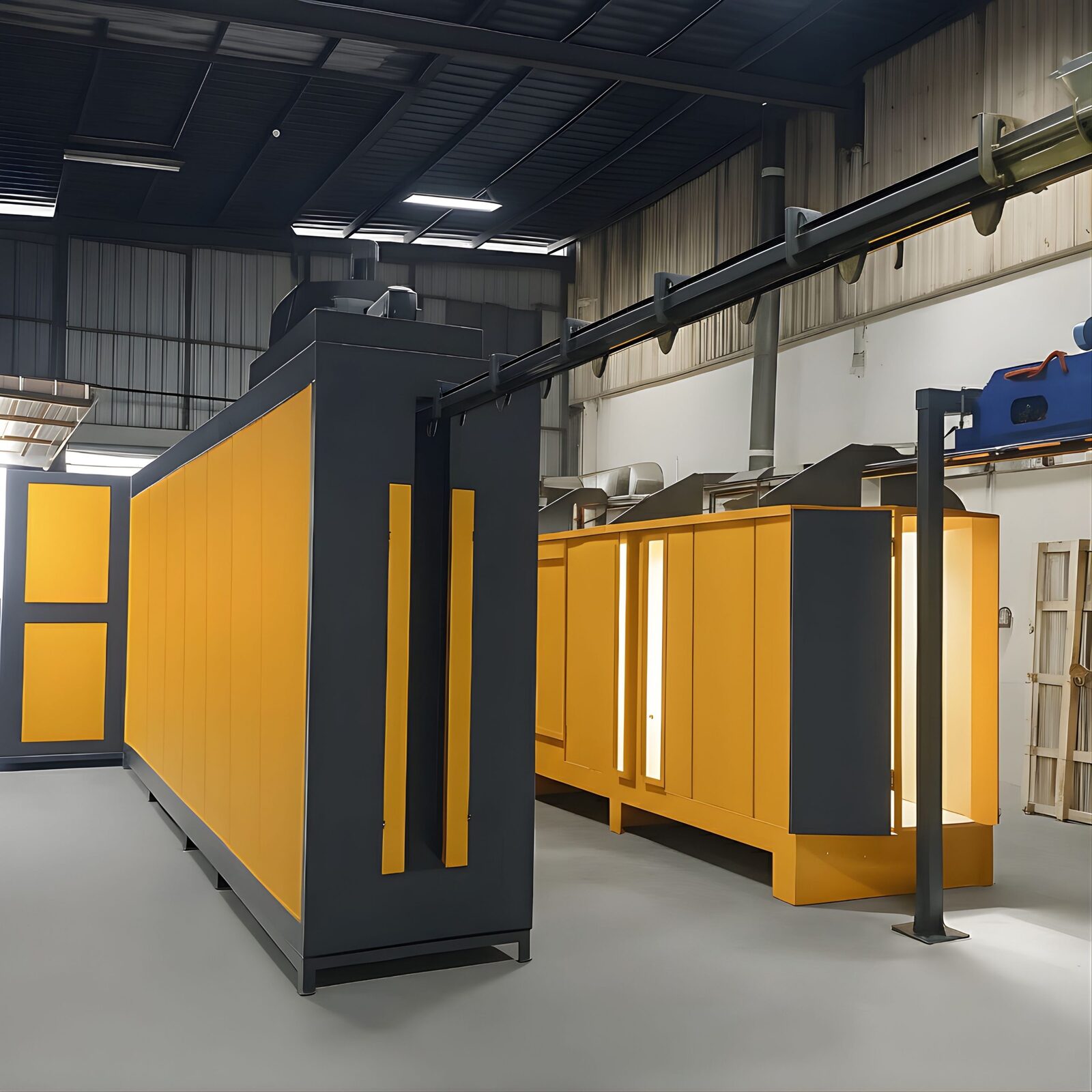 Enlarge
Almost everyone planning a powder coating plant starts with the same question: "How much is the oven, how much is the booth?" The question is not wrong, but it is incomplete. We have been manufacturing these machines for twenty-five years, and what we see is consistent: what breaks the budget is not the price of the machine, it is everything around the machine.
A plant is not installed when the equipment arrives on site. It is installed when power is connected and the first part comes out of the oven. Between those two moments sit the transformer, the gas subscription, the stack, the floor, the air line and the operating permit. This article is the full list of that distance.
Cost comes in three blocks
You cannot budget properly without separating the investment into three blocks:
- Equipment — oven, booth, pretreatment, conveyor, gun.
- Infrastructure — power, gas, air, water, waste, floor, stack. Everything that has to be done to the building so the equipment can run.
- Operating — energy, chemicals, powder, filters, labour. What you pay every month after the investment is finished.
Quotations usually cover only the first block. The second block falls to the customer and is rarely mentioned in advance. The third block determines your return: buy a cheap machine with expensive running costs and the investment looks profitable on paper and loses money on the floor.
1. The equipment block
A powder coating line has four core parts. Whatever the scale, these four exist:
Pretreatment. Paint will not adhere to a surface left with oil, rust or dust. The defect appears after the oven, and at that point the part is reworked — so saving on pretreatment is the most expensive saving there is. Our dip type lines perform degreasing, phosphating, passivation and drying in sequence; in our tunnel type plants pretreatment is built with 3 to 7 stages. The stage count is set by how contaminated the parts are and the corrosion resistance required.
Booth. Where the powder is controlled and recovered. In our filter booths powder recovery is 95% and above, with cartridge filter efficiency of 99.9%+. That figure is a direct material cost: powder that is not recovered goes to waste. Booths are built for 2 to 12 guns, and internal air velocity is held between 0.5 and 0.8 m/s — the range that keeps powder from escaping the booth without extracting it before it reaches the part.
Oven. Where curing happens. Our box type electric ovens run between 80 and 250 °C, hold ±3 °C uniformity with PID control and store 16 curing profiles. Our top-loading gas ovens are built for 140–220 °C at 50,000–500,000 kcal/h, with a heat-up time of 35–45 minutes.
Transport. How the part travels along the line. In a tunnel plant conveyor speed is adjustable between 1 and 6 m/min, and that speed sets capacity directly.
The dimensions of these four come from the largest part you will coat. They are not picked from a catalogue; you give the dimension and the system is calculated around it.
2. The infrastructure block — the missing part of the budget
The items below rarely appear in a plant quotation, but the plant will not run without them.
Electrical power and transformer. Our electric ovens are built between 3 kW and 150 kW. If your current supply contract does not cover that load, you need a transformer and switchgear — an item that sometimes costs more than the oven itself. Find out your contracted power before you request a quotation.
Gas subscription and pipework. If you choose a gas oven, the subscription, meter, pressure regulator and internal pipework are a separate process, and the time from application to gas being supplied is usually longer than the manufacturing lead time of the machine. Start the application in the same week you place the machine order.
Stack and ventilation. Booth exhaust, oven stack and general workshop ventilation. Where forced air circulation is involved, leaving this out means air quality and measurement values become a problem the moment the line runs.
Compressed air. A powder gun needs dry, clean air. A compressor alone is not enough — a dryer and filters are mandatory. Moisture in the air comes back as a surface defect, and the cause is usually looked for in the machine when it is in the air line.
Floor. Load-bearing capacity for conveyor supports, tank loads and oven weight. If a dip line requires a tank pit, that is a separate civil works job.
Water and waste. A pretreatment line consumes water and produces effluent. Discharge permits, treatment or a disposal contract vary by region; this item belongs to the operating permit rather than the investment, and when it is skipped, the plant sits ready and waiting.
Fire and safety. If you will use solvent-based wet paint, the booth is assessed under ATEX; our water curtain booths fall under ATEX Zone 2 with an anti-static grating floor. Our powder booths are manufactured under CE and ATEX.
3. The operating block — this determines your return
How many months the investment takes to pay back is set by the monthly cost table, not the machine price:
- Energy. A gas oven saves 30–40% compared with the electric equivalent. But the ratio is not fixed: it depends on local gas and electricity prices and your daily running hours. The longer you run, the bigger the gas advantage; in a workshop running two or three hours a day, gas infrastructure may never pay for itself.
- Powder. Recovery rate decides this. Over a few years, the difference between a booth with 95% recovery and a setup with no recovery exceeds the price of the booth.
- Chemicals. Depends on the tank count and cycle time of the pretreatment line.
- Filters. Cartridge life and replacement frequency. Automatic pulse-jet cleaning extends filter life and removes the need to stop the line and pull filters out.
- Labour. One operator per gun on a manual line; supervision on an automatic one.
Capacity: the number that actually sets the budget
The answer to "how much will it cost?" is hidden in your answer to "how many m² per day will you coat?" The size of the plant comes from there.
Our tunnel plants are configured for 500–5,000 parts per hour. Real capacity depends on three things: part size, hanger spacing and conveyor speed. Change those three and the same line delivers twice the difference in output.
A practical warning: theoretical capacity and real capacity are not the same. Subtract colour changes, shift-start heat-up, breakdowns and maintenance stops and real output is lower. An investor who budgets on theoretical capacity overestimates monthly revenue.
In aluminium profile coating, colour change becomes critical; on our U-type lines colour change takes under 20 minutes. In production with frequent colour changes, that time is capacity.
Questions to ask when comparing quotations
The price gap between two quotations is usually a scope gap. Before you compare, ask:
- What is the internal oven size, and which part was it calculated for? Custom-built or catalogue size?
- What is the insulation thickness and material? Our ovens have an AISI 304 stainless inner body and 10 cm mineral wool insulation. An oven that saves on insulation returns the difference through the energy bill in the first year.
- What is the temperature uniformity? Two ovens can state the same temperature range and have different uniformity; ±3 °C and ±15 °C are not the same product.
- What is the booth recovery rate and filter efficiency?
- How many pretreatment stages, and which chemistry? Chrome or chrome-free — if you export, the regulations of your target market decide this.
- What is the control system? PID or a simple thermostat? Is there curing profile memory?
- What electrical power and gas capacity are needed? Does your existing infrastructure cover it?
- Are installation and commissioning included? Who handles transport, crane and installation labour?
- Which certifications? CE, ATEX, relevant standards.
- What is the warranty period and scope? Our products carry a 2-year manufacturer warranty.
- How fast do spare parts and service arrive? On an imported line, downtime that takes one day with a local manufacturer can take a week.
- Can it be expanded later? Starting semi-automatic and adding automation is the most common way to split the initial investment.
Second-hand or new?
A significant share of searches in this sector end up in second-hand listings. A used oven can make sense — but the points to check are fixed: whether the insulation has degraded, whether heat distribution is still uniform, whether spare parts for the control system are still available, and whether the oven is the right internal size for your part.
In practice the last one is the most common mistake: the cheap oven does not fit the part, the line is then built around it, and the plant runs with the wrong dimension for its entire life. A saving on the machine turns into a permanent loss in capacity.
Frequently asked questions
How much space does a powder coating plant need?
Space is set by part length and the chosen line type, not by an abstract floor-area figure. A workshop built around a box oven can fit in a single bay, while a tunnel line with a conveyor needs an uninterrupted route where pretreatment, drying, booth and oven follow one another. A U-type overhead line concentrates loading and unloading in the same area, which reduces floor usage for long parts.
Is an electric or a gas oven more economical?
A gas oven saves 30–40% energy compared with an electric one, but if there is no gas infrastructure, subscription and pipework costs are added. If your daily running hours are long, gas makes sense; if they are short and irregular, electric does. The decision is made by calculating unit energy price and daily running hours together.
Can powder coating be done without a pretreatment line?
Technically the powder leaves the gun and sticks to the surface, but it will not adhere on an oily or rusty part. The defect appears after the oven and the part is reworked. Pretreatment is not a step you can skip; it is the step where quality is decided.
What temperature should a powder coating oven reach?
The curing temperature is defined by the technical data sheet of the powder you use, not by the oven. The oven's job is to hold that value steadily. Our box type ovens operate between 80 and 250 °C with ±3 °C uniformity.
How long does plant installation take?
Because every plant is custom built, the schedule depends on the project and the exact date is stated in the quotation. In practice the critical path is usually not machine manufacturing but infrastructure processes such as the gas subscription and the electrical capacity upgrade; these must be started at the same time as the machine order.
Summary
Powder coating plant cost is not a single number; it is the sum of three blocks. The equipment block is settled by the quotation, the infrastructure block depends on your building, and the operating block decides your return. When comparing quotations, read the scope beneath the price: two ovens may state the same temperature range while differing in insulation, uniformity and control system.
Tell us your dimensions, your daily output target and the part you will coat — we will calculate which system fits and quote it.