
The 7 Items That Set the Price of a Powder Coating Oven
Why do two ovens of the same size carry two different prices? The answer is in the insulation, the steel, the control system and the fan. Seven items to check when comparing oven quotations — and what cutting each one does to your energy bill.
 Enlarge
The most honest answer to "how much is an oven?" is this: an oven does not have a price, the size of an oven has a price. It is not a product picked from a catalogue; it is a volume manufactured around your part.
That does not mean the price is unpredictable. The items that set it are known, and they come down to seven. If two quotations for the same internal size differ significantly, the difference is in one of these seven.
1. Internal volume — not the dimension, the air you will heat
The most decisive item is internal volume. But that is not only "how many cubic metres"; it is how far you will heat that volume in every cycle and the mass of the part going into it.
Internal volume comes from the largest part you will coat: part dimension + hanging allowance + the clearance needed for air circulation. That clearance is not generosity; hot air has to reach every surface of the part, otherwise the rear face cures incompletely.
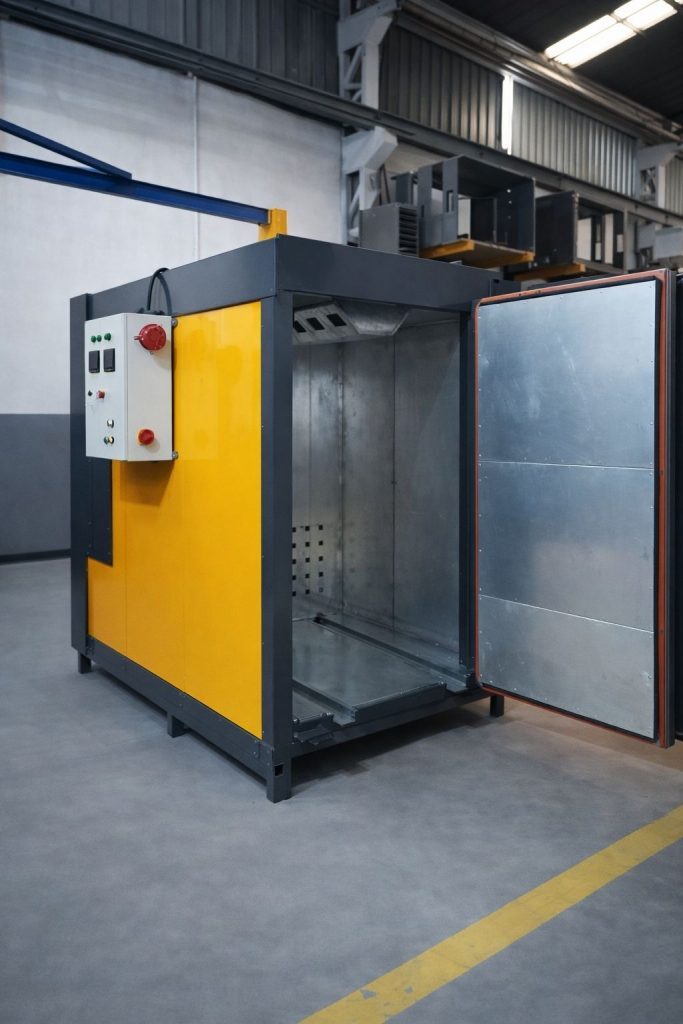
Our box type electric ovens are built to size on exactly this logic. An oven forced into a catalogue size is either bigger than needed (extra energy in every cycle) or smaller (the part does not fit, capacity is lost).
2. Insulation — this is what sets your energy bill
The easiest way to lower an oven's price is to cut the insulation, and it produces the most expensive outcome. When insulation is weak:
- heat-up takes longer and shift-start time is lost,
- in steady state the elements or burner stay on continuously and energy consumption rises,
- the oven's outer skin heats up, adding heat load to the workshop and a safety problem.
Our ovens use 10 cm mineral wool. When comparing quotations, ask for the insulation thickness and material; if that line is missing, the price gap is most likely there. On an electric oven, the money saved on insulation is usually returned through the energy bill within the first year.
3. Inner body material
The inside of an oven is a surface exposed to hot air and, over time, oxidation. Rust and dirt shedding from the inner body land on the wet surface being cured and become a defect.
Our ovens have an AISI 304 stainless steel inner body. Galvanised or painted sheet is cheaper but short-lived at high temperature. This item is the invisible part of the price difference — invisible today, plainly visible in three years.
4. Heating type and power
Electric or gas — this changes both the purchase price and the monthly cost.
Our electric ovens are built between 3 kW and 150 kW. Power is calculated from internal volume, insulation, the heat-up time you want and the number of daily cycles. "More powerful is better" is not true: excess power inflates both the investment and your contracted electrical capacity.
Our gas top-loading ovens are built at 50,000–500,000 kcal/h for a working range of 140–220 °C and heat up in 35–45 minutes. They save 30–40% energy compared with electric — but if there is no gas infrastructure, the subscription and pipework can eat that advantage in the first year.
5. Control system
Two ovens can both state "80–250 °C"; their ability to actually hold that temperature may differ.
Our ovens are controlled by a PID digital controller with ±3 °C temperature uniformity, and store 16 curing profiles — keeping separate programs for different powders and part thicknesses removes operator-dependent error.
In an oven running on a simple thermostat, temperature swings in a wide band around the setpoint. Curing happens under-cured at the bottom of that band and at risk of yellowing at the top. That is the hidden cost of a cheap oven.
6. Air circulation and the fan
Powder does not cure by temperature alone but by temperature × time, and that temperature has to reach every surface of the part. This is why fan convection exists.
Fan capacity and the layout of the air ducts set the oven's uniformity directly. Two ovens built with the same insulation and the same power can deliver ±3 °C and ±15 °C respectively; the difference is in air distribution. This item never appears as a line in a quotation, and its result appears in the first heat distribution test.
7. Transport system, installation and commissioning
The price of an oven is often not the oven itself:
- Transport system: manual loading on a box oven, pallet or conveyor on a top-loading one. The transport system sets the capacity of the line and is a separate cost.
- Freight and crane: unloading a large oven on site is not a trivial item.
- Installation and commissioning: included or separate? Is a heat distribution check performed during commissioning?
- Certification: our gas ovens are manufactured under CE and TS EN 1020, controlled by a PID controller plus a safety thermostat.
- Warranty: our products carry a 2-year manufacturer warranty. What the warranty covers and the service response time are as much part of the price as its duration.
Comparing two quotations
Before you put the prices side by side, put these lines side by side:
| Item to check | Why it matters |
|---|---|
| Internal size and which part it was calculated for | Custom or catalogue |
| Insulation thickness and material | Monthly energy bill |
| Inner body material | Oven life and surface quality |
| Temperature range and uniformity | ±3 °C and ±15 °C are not the same |
| Control system | PID or thermostat; profile memory |
| Power / kcal capacity | Does it fit your electrical or gas infrastructure |
| Installation, freight, commissioning | Included or not |
| Certification and warranty | CE, ATEX, relevant standards; warranty scope |
Once this table is filled in, the gap between two quotations usually reveals itself as a difference in scope, not in price.
Frequently asked questions
What changes the price of a powder coating oven?
Mostly internal volume, insulation thickness, inner body material, heating type (electric or gas), control system and transport system. Because ovens are built to size, there is no single list price; the price becomes clear once you give the dimensions of the largest part you will coat.
Which oven suits a small workshop?
Workshops with a limited part count and a wide part variety are best served by a box type electric oven: parts are loaded manually and the oven runs in batches. When continuous flow and higher capacity are required, a top-loading or tunnel oven takes over.
How many kW should an electric oven be?
Our ovens are built between 3 kW and 150 kW. The requirement is calculated from internal volume, insulation, target heat-up time and daily cycle count. Whether your contracted electrical capacity covers that value should be checked before requesting a quotation.
Why does oven uniformity matter?
Powder cures when temperature and time are held together. If the gap between hot and cold zones inside the oven is large, some parts in the same cycle will be under-cured while others yellow. Our ovens hold ±3 °C uniformity.
Does it make sense to buy a second-hand oven?
It can, but three things must be checked: whether the insulation has degraded, whether heat distribution is still uniform, and whether the oven is the right internal size for your part. The last one is the most common mistake; a cheap oven of the wrong size constrains the line for its entire life.
Summary
Oven price is the sum of volume, insulation, steel, heating type, control, air circulation and installation. Comparing two quotations without knowing which of these seven has been cut is not possible.
Tell us the dimensions of your largest part and your daily output target — we will calculate the oven size and quote it.