
Electric or Gas Powder Coating Oven? A Decision Table
A gas oven saves 30-40% energy compared with an electric one — but that ratio does not apply to everyone. Three things decide it: your daily running hours, your gas infrastructure and your contracted electrical capacity. An honest comparison from a manufacturer that builds both.
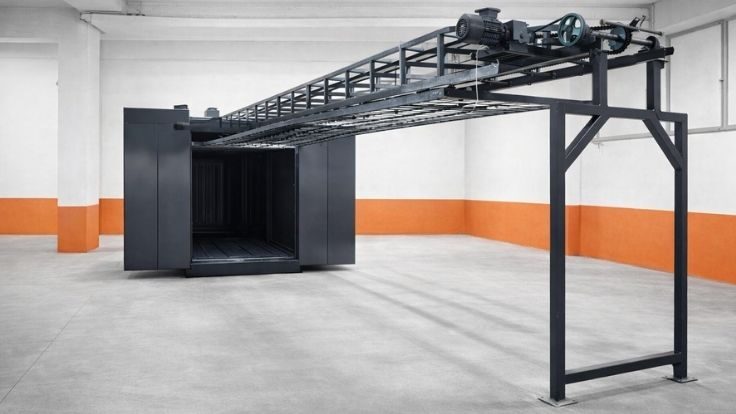 Enlarge
The usual answer to this question is one sentence: "Gas is cheaper." True, but incomplete. We manufacture both ovens, so we have no interest in selling one side — and what we see on the floor is this: the advantage of gas grows with your daily running hours. In a workshop that runs briefly, the cost of gas infrastructure may never pay for itself.
Three questions decide it:
- How many hours a day will the oven run?
- Does your building have natural gas, or will a subscription be needed?
- Does your contracted electrical capacity cover the required kW?
The technical difference between the two
| Box type electric | Top-loading gas | |
|---|---|---|
| Working range | 80–250 °C | 140–220 °C |
| Heating | Fan convection, resistance elements | Natural gas / LPG burner |
| Capacity | 3 – 150 kW | 50,000 – 500,000 kcal/h |
| Heat-up time | By volume and power | 35–45 minutes |
| Control | PID + 16 curing profiles | PID + safety thermostat |
| Uniformity | ±3 °C | — |
| Certification | CE | CE / TS EN 1020 |
| Energy cost | Reference | 30–40% lower than electric |
The electric oven has the wider working range, starting at 80 °C, which is an advantage for work that needs drying or preheating at low temperature. The gas oven concentrates in the curing band (140–220 °C) and is cheap there.
Decision 1: daily running hours
Energy saving is a ratio; what that ratio is worth depends on how much energy you consume.
- A workshop running 2–3 hours a day: total consumption is low anyway. A 30–40% saving stays small in absolute terms. The gas subscription, meter, pressure regulator and internal pipework take years to recover from that saving. The electric oven is usually the right choice.
- A plant running 8 hours or more: the same ratio becomes a large absolute difference. The installation cost of a gas oven is recovered quickly.
- A plant running shifts: gas is almost beyond discussion.
A simple rule: the more hours the oven stays on, the more sense gas makes. If the oven is off for most of the day, there is no consumption to save on.
Decision 2: infrastructure
This is the item that upsets the calculation most often, and it is usually noticed late.
On the gas side: subscription application, meter, pressure reduction station, internal pipework and stack. The timetable is not in your hands; the period from application to gas being supplied is usually longer than the manufacturing lead time of the oven. If you choose a gas oven, start the application in the same week as the machine order, or the oven will sit on site waiting.
On the electric side: the oven is built between 3 and 150 kW. If your current contracted capacity is insufficient, you need a capacity upgrade, switchgear and possibly a transformer. This item sometimes costs more than the oven itself. Find out your contracted capacity before requesting a quotation — the calculation starts there.
Decision 3: part and process
Criteria that come from the process itself, independent of energy:
- If low temperature is needed (drying, preheating, heat-sensitive parts), the electric oven's range starting at 80 °C is useful.
- If you have many curing profiles — different powders, different wall thicknesses — the 16-profile memory in the electric oven reduces operator-dependent error.
- If parts are heavy and flow is continuous, top-loading transport improves both capacity and safety compared with manual loading.
- If you are in a region without a gas grid, LPG is an option; our gas ovens run on natural gas or LPG.
Three things that are commonly believed and wrong
"A gas oven heats up faster." Heat-up time is set by power/capacity, insulation and volume — not by the fuel. Our gas ovens heat up in 35–45 minutes; a correctly sized electric oven heats up in a comparable time.
"An electric oven is more precise." Precision comes from the control system, not the fuel. Both ovens run on PID control. What matters is the quality of the controller and the air distribution.
"Gas is cheaper in every case." Unit energy prices move. The decision has to be made with your current gas and electricity prices and your own daily running hours. We run that calculation with you; since we manufacture both ovens, we have no reason to push either side.
Short decision summary
- Few running hours, wide part variety, low temperature also required → box type electric oven.
- Long running hours, continuous flow, gas available → top-loading gas oven.
- No gas but long running hours → find out the subscription timetable first; if it is long, starting with electric and moving to gas later can make sense.
Frequently asked questions
Does a gas powder coating oven really save 30-40%?
Our top-loading gas ovens save 30–40% energy compared with the electric equivalent. That is a ratio; its monetary value depends on current gas and electricity prices and on your daily running hours. In a workshop that runs briefly, the absolute saving stays small.
Can a gas oven be used where there is no gas connection?
Yes, our gas ovens run on natural gas or LPG. However, the unit cost of LPG and the logistics of cylinders or tanks must be included in the calculation; in that case the cost advantage of gas may narrow.
How much electrical power does an electric oven need?
Our ovens are built between 3 kW and 150 kW. The requirement is calculated from internal volume, insulation, target heat-up time and daily cycle count. Whether your contracted capacity is sufficient is the first item to check before a quotation.
What temperature does a powder coating oven work at?
Our box type electric ovens operate between 80 and 250 °C, and our top-loading gas ovens between 140 and 220 °C. The curing temperature is defined by the technical data sheet of the powder you use; the oven's job is to hold that value steadily.
Can an electric oven be converted to gas later?
They are separate products; an electric oven is not converted to gas. However, the line can be planned so that a second oven is added later. If you are considering a phased investment, saying so at the project stage lowers the cost of the later change.
Summary
A gas oven pays in a plant that runs a lot. An electric oven is the better answer for production that runs briefly, varies widely and also needs low temperatures. The three numbers to check are fixed: daily running hours, the state of the gas infrastructure and the contracted electrical capacity.
Give us those three, and we will calculate which oven is cheap for you — then price it to size.