
How Conveyor Speed Determines Oven Length: The Maths at 1–6 m/min
Dwell time in a powder coating oven is simply the heated tunnel length divided by conveyor speed. This article builds the triangle of speed, cure time and oven length with worked numbers, and shows how many metres of tunnel and building each speed forces on you.
 Enlarge
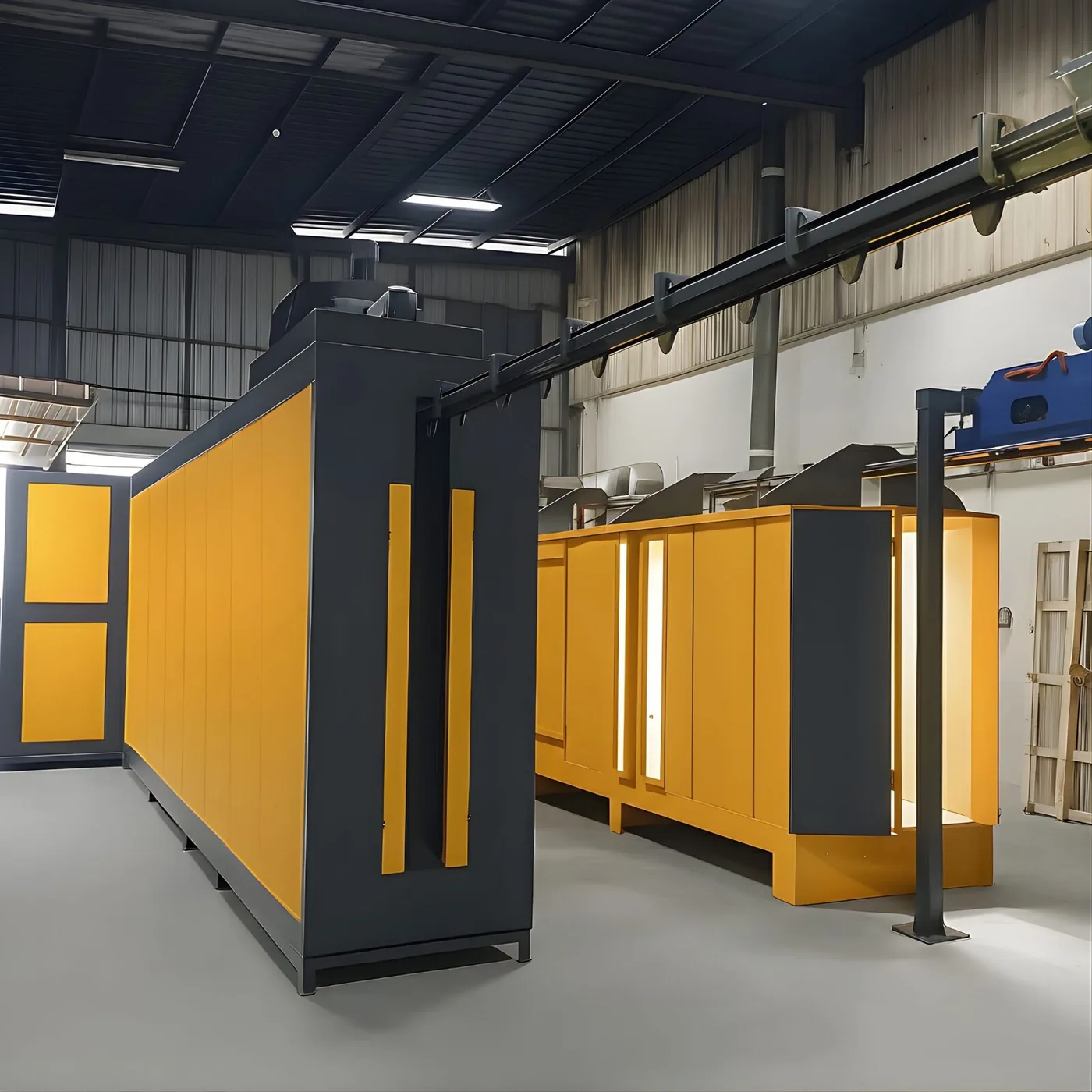
On a powder coating line, the conveyor speed to oven length calculation rests on a single equation: dwell time in the oven = heated tunnel length ÷ conveyor speed. Invert it and the real bill of the investment appears — heated oven length = conveyor speed × required dwell time. Tunnel lines run their conveyors in the 1–6 m/min band, so a 20-minute oven cycle means 20 metres of heated tunnel at 1 m/min, 60 metres at 3 m/min and 120 metres at 6 m/min. Doubling the speed doubles throughput, but it also physically doubles the oven. A capacity study answers the parts-per-hour question; this article converts that capacity into metres and into building length.
Projects that skip this relationship all end the same way: the throughput works on paper, the oven does not fit the building, the oven gets shortened, the conveyor gets slowed down, and the capacity that was paid for never materialises.
The three variables in the equation
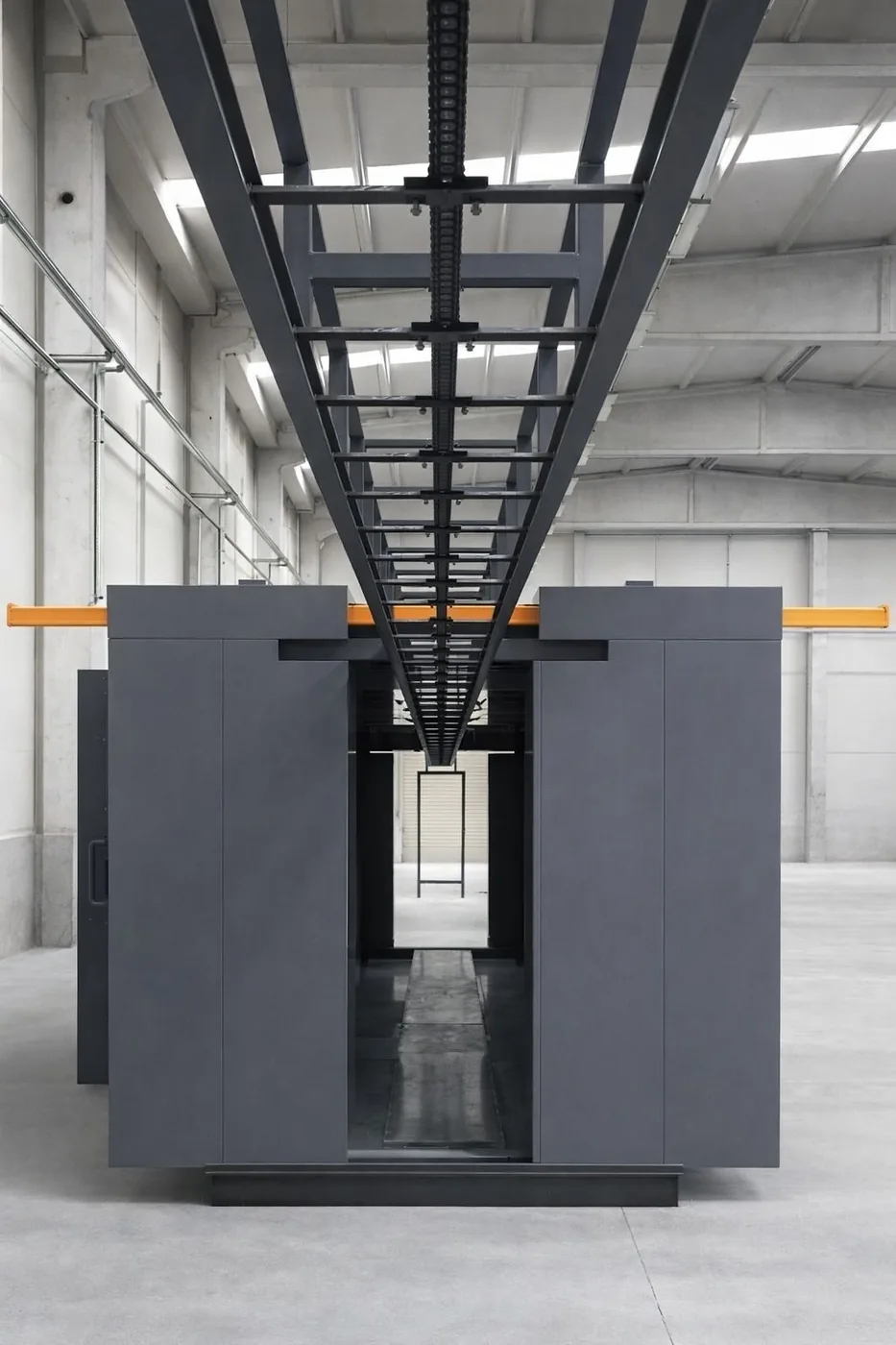
There are only three quantities, and two of them are set by physics and by the coating, not by the buyer.
Dwell time (t). The time between entering and leaving the oven, made up of two parts: the heat-up time the part needs to reach cure temperature, and the cure time printed on the powder data sheet. The critical point is that the data sheet time starts once the metal is at temperature, not when the part crosses the oven threshold. Powder coatings typically cure in the 180–200 °C band, and the times quoted for that band are in the order of minutes — take the exact figure from the data sheet of the powder you will actually use, and never base a line design on a guess.
Heat-up time. This is thermal mass at work. A 1 mm sheet and an 8 mm flat bar do not reach set point together in the same oven. On a line running heavy parts, heat-up eats a substantial share of the total dwell time — and therefore of the heated length of the oven.
Conveyor speed (v). The only free variable, and the one that sets throughput directly. Whoever chooses the speed has already chosen the oven length.
Heated tunnel length by speed and dwell time
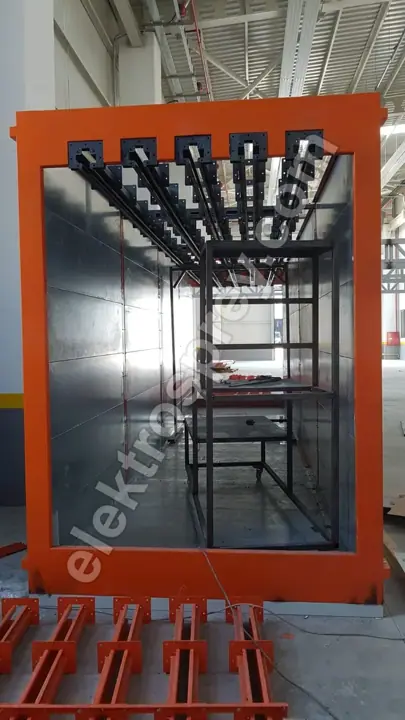
The table below is nothing more than length = speed × time. There are no hidden factors in it. The columns show total dwell time, heat-up plus cure.
| Conveyor speed | 15 min dwell | 20 min dwell | 25 min dwell |
|---|---|---|---|
| 1 m/min | 15 m | 20 m | 25 m |
| 2 m/min | 30 m | 40 m | 50 m |
| 3 m/min | 45 m | 60 m | 75 m |
| 4 m/min | 60 m | 80 m | 100 m |
| 6 m/min | 90 m | 120 m | 150 m |
The conclusion is blunt: anyone asking for 6 m/min with a 20-minute bake is asking for 120 metres of heated tunnel. As a single straight run, that length fits into no ordinary production building. This is why high-speed lines fold the oven — into a U or a serpentine of two, three or four passes.
How heated length turns into building length
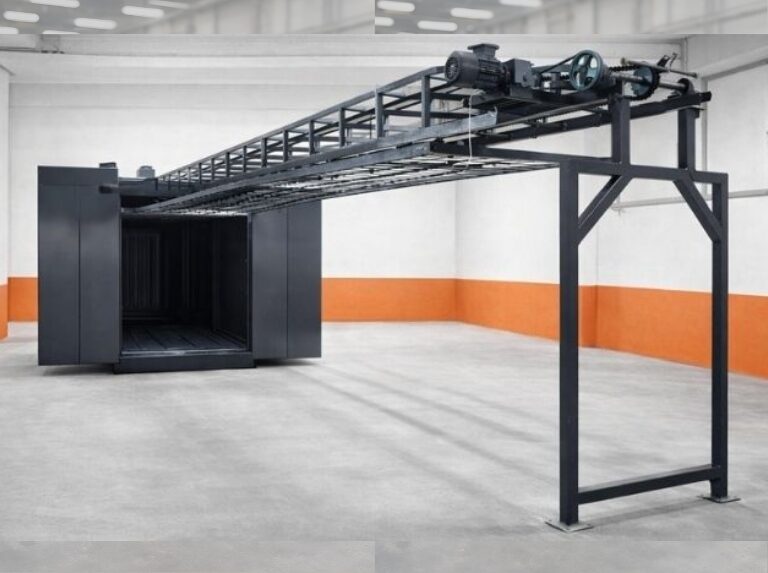
Heated length is not the total length of the oven housing, and the oven housing is not the length of the building. The sequence runs like this:
- Heated tunnel length — the metres the equation gives you.
- Unheated entry and exit throats — the ramps and air seals that keep the heat inside. They add to building length but not to dwell time.
- Number of passes — folding into a U roughly doubles the heated length available, halving the building run, plus an allowance for the turning radius.
- The rest of the line — pretreatment, dry-off oven, spray booth, cooling, and load/unload stations.
| Heated length | Single pass footprint | Two-pass (U) footprint | Note |
|---|---|---|---|
| 20 m | ~20 m + throats | ~10 m + turn allowance | Low speed, small parts, narrow building |
| 40 m | ~40 m + throats | ~20 m + turn allowance | The most common band for mid capacity |
| 60 m | ~60 m + throats | ~30 m + turn allowance | Building height and column spacing start to rule |
| 120 m | Not practical | ~60 m + turn allowance | Three or four passes, or a lower speed |
Folding is not free. Every turn demands a radius for the hangers and the chain, the radius grows with part length, and the lost floor area grows with it. Plants running long extrusions therefore need a different layout altogether: our aluminium U-type coating plant is built around profiles of 3–7 m and is arranged so that a colour change stays under 20 minutes. Floor area and column spacing constraints are covered in detail in plant area and layout.
Raising capacity without raising speed
Throughput is not a function of speed alone. Parts per hour is the product of three things: conveyor speed, hanger spacing, and parts per hanger. The 500–5,000 parts/hour range seen on tunnel lines comes from different combinations of exactly these three.
With the speed held constant, the practical levers are:
- Tightening hanger spacing. The closer the parts, the more of them pass in the same time at the same speed. The limit is electrostatic reach and Faraday shielding.
- Increasing parts per hanger. Multi-row or multi-tier hangers multiply throughput without touching speed or oven length. The limit is gun access and oven uniformity.
- Shortening heat-up. Faster heat-up cuts total dwell time, which allows a higher speed in the same oven length. This is where a gas-fired top-pallet oven, working in the 140–220 °C band at 50,000–500,000 kcal/h, earns its place.
Because these three levers lift throughput without adding metres, they should always be tried first. For the full parts-per-hour arithmetic, see powder coating line capacity calculation.
What you lose as speed goes up
The price of speed is not only metres. As the conveyor accelerates, more heat escapes through the entry and exit throats, holding the internal temperature profile becomes harder, and the human tempo at the load and unload stations starts to cap the line. If the deviation between oven zones widens, parts on the same hanger cure differently; the measurement method for that is set out in oven temperature uniformity.
Low speed has its own price: the line stays full for long stretches, product changeovers slow down, and on small batches the oven runs half empty. The right speed is not the highest speed, but the one that matches the part mix and the shift pattern.
Frequently asked questions
How is oven length calculated?
Heated tunnel length is conveyor speed multiplied by total dwell time. Worked example: 2.5 m/min with an 18-minute total gives 45 metres of heated length. That figure is then converted into building length by adding the entry and exit throats and any turning radii.
What conveyor speed should a powder line run at?
Tunnel lines work in the 1–6 m/min band, and the right value falls out of part size, hanger arrangement and the target parts per hour together. Rather than fixing a speed first and measuring the oven afterwards, put the target capacity and the available building length into the equation at the same time. Most mid-sized plants settle between 1.5 and 3 m/min.
Is shortening the oven and slowing the conveyor a valid answer?
Physically yes, commercially it depends. If you drop the speed to protect dwell time, throughput drops by the same proportion. Where building length is a hard constraint, the correct move is usually not a slower conveyor but folding the oven into a U or serpentine and increasing hanger density.
Can I shorten the oven by shortening the cure time?
Only if the powder data sheet allows it. The trade-off between low temperature with long time and high temperature with short time depends on the chemistry of the coating and is stated on the sheet; cutting the time on your own authority produces under-cure, and with it loss of adhesion and durability. The item that can genuinely be shortened is not the quoted cure time but the heat-up time the part spends reaching set point.
How is speed set when parts of different thickness share one line?
Speed is set by the heat-up time of the heaviest part on the line, which means thinner parts see extra time in that regime. On plants with a mixed workload, the answer is to group parts of similar thermal mass into the same batch and change speed batch by batch. This is exactly why an adjustable conveyor drive is worth far more in line control than a fixed-speed one.
Summary
The link between conveyor speed and oven length is not an arguable design preference; it is a multiplication. Heated length = speed × dwell time. Dwell time is set by the powder data sheet and by the thermal mass of the part, which leaves conveyor speed as the single free variable — and it converts directly into metres, and metres into building. The order of decisions is therefore: target parts per hour first, then dwell time for the actual part mix, then speed, and only then the building. Every tunnel-type powder coating plant we build is manufactured to the customer's largest part and to the building actually available; there is no catalogue size, and delivery carries a 2-year manufacturer warranty.
Send us your internal building dimensions, the size of your largest part and your target parts per hour — and we will work out which speed forces which oven length inside your building.