
Alloy Wheel Coating Line: Why Rotating Hangers and a Second Coat Are Not Optional
A wheel cannot be coated like a flat panel because of its drop centre and bolt holes; every surface has to turn in front of the gun and some areas have to be masked. This article walks through why a wheel manufacturer must order the hangers, booth, coat count, pretreatment and oven differently.
 Enlarge
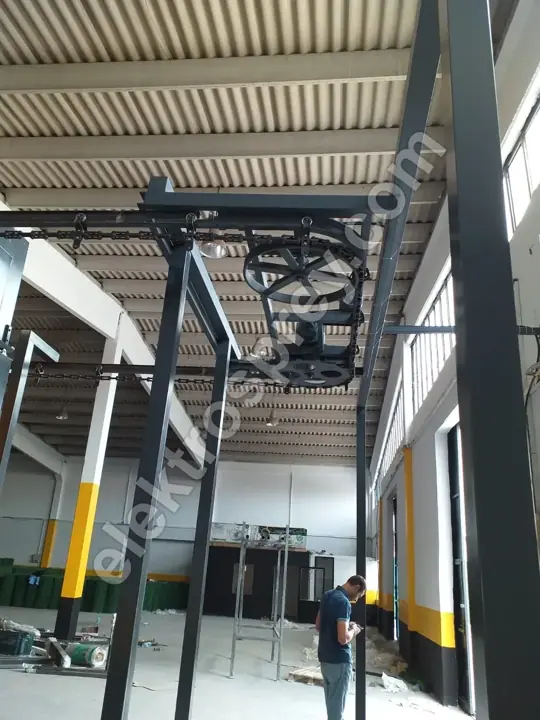
If you are asking how a powder coating line for alloy wheels should be built, the short answer has three parts: the hangers must rotate, the booth must carry more guns, and the line must be laid out for at least two coats. A tunnel-type line is built for 500–5,000 parts/hour with a conveyor running at 1–6 m/min; wheels sit in the lower-to-middle part of that band, because every wheel has to complete at least one full revolution in front of the guns and, on a two-coat line, passes through the oven twice. Losing throughput compared with a flat-panel line of the same footprint is not a design mistake — it is a direct consequence of wheel geometry. Ordering the line with that fact accepted from day one costs far less than adding a booth and re-routing the conveyor two years later.
Elektrosprey does not make wheels and does not coat them; we build the line itself for the plant that manufactures them. The sections below open up the decisions that belong on the table when a wheel line is specified: geometry, hangers, booth, coat count, pretreatment, oven and masking.
What separates a wheel from a flat panel
Electrostatically, a wheel is the opposite of a flat panel. On a panel the distance between gun and surface is nearly constant everywhere; on a wheel the drop centre, the gaps between spokes, the centre bore and the bolt holes all sit at different depths. An electrostatic field does not readily enter deep, narrow recesses — this is the Faraday cage effect — and wherever the powder cannot reach, the film stays thin; wherever it reaches too easily, the film builds up.
| Area | Coating difficulty | What it forces on the line |
|---|---|---|
| Drop centre | Deep, narrow, field does not enter | Part rotation plus dedicated inner guns |
| Bolt holes | Must stay uncoated or thinly coated | Masking station, plug set |
| Gaps between spokes | Build-up on edges, thin film in shadow | Gun count and gun angles |
| Centre bore | Assembly tolerance, film thickness limit | Masking with a sized plug |
| Rim face curvature | Defects show up under raking light | Oven regime and film thickness discipline |
| Bead seat | Sealing surface, thickness is critical | Defined as a measurement point |
Every row in that table turns into an equipment decision. A wheel line is not a flat-panel line with different hangers; dimensions change all the way from booth length to oven entry height.
Rotating hangers: the most critical item on the line
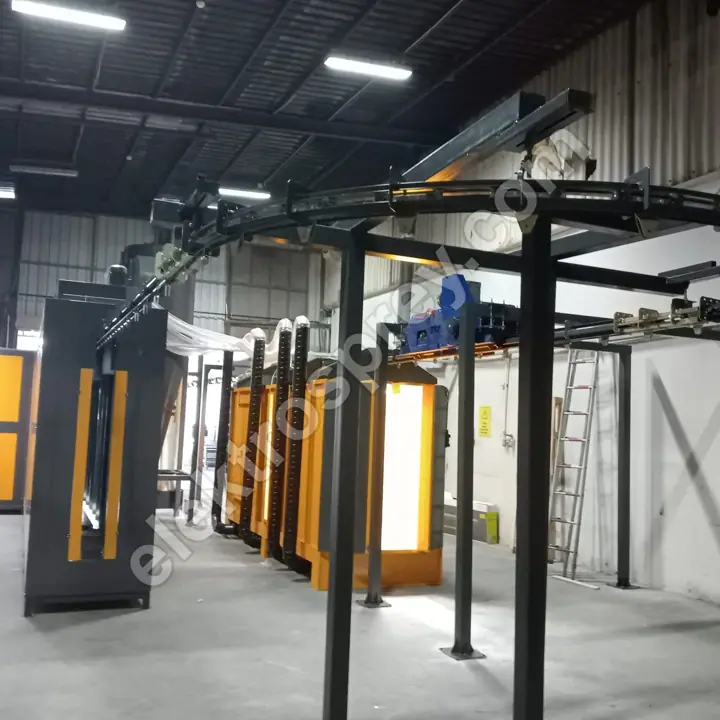
The item most often argued over — and the one that should be negotiated least — is the rotating hanger. On a fixed hanger the face the gun sees gets coated and the far side stays in shadow; adding a second row of guns does not fully solve it either, because the drop centre is still only visible at a shallow angle. A rotating hanger turns the wheel on its own axis and brings each surface in front of the gun in turn.
Two drive arrangements are used in practice: a friction rail running alongside the conveyor that spins the hanger passively, or a separate motorised drive. The friction rail is simple and cheap to maintain; the motorised drive lets you control speed, but brings power distribution along the line and more maintenance points. Rotational speed is calculated per project from part diameter and conveyor speed — a wheel must complete enough full turns during its time in the booth. There is no catalogue speed.
The second function of the rotating hanger is usually overlooked: earthing. A rotating joint is a weak point for electrical continuity. If coating builds up on the hanger contact surface, resistance rises, powder transfer degrades, deposition efficiency drops, and the defect keeps appearing at the same station on the line. The 98.5%+ deposition efficiency our tunnel lines are designed around only holds when hanger cleaning and conductivity are written into a maintenance rule. Plan the hanger stripping and cleaning station on the first day of the project; adding it later means finding floor space you no longer have.
Booth and gun layout
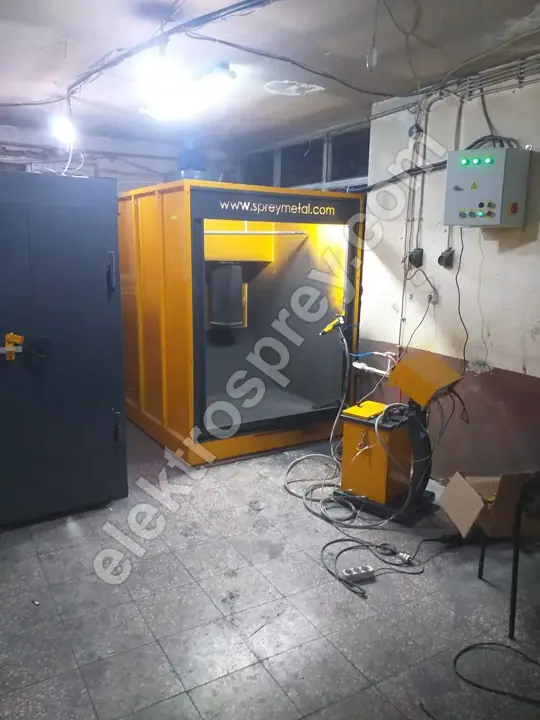
A wheel booth is longer and carries more guns than a flat-panel booth of the same nominal capacity. The reason is simple: because the part is coated while it rotates, each surface needs time to pass in front of a gun. Our cartridge booths are built with 2–12 guns; wheel lines typically use the upper half of that range, plus guns positioned specifically for the drop centre.
Internal air velocity is held in the 0.5–0.8 m/s band. That band matters even more on wheels, because at the top end the freshly deposited layer on the shadowed side of a rotating part gets stripped away and the drop centre starts to run thin. Recovery is 95%+, cartridge filter output 99.9%+; pulse-jet cleaning, CE and ATEX conformity are part of the standard scope. Booth dimensions come from the customer's largest wheel diameter and the hanger envelope — there is no catalogue size. We compared booth type, gun count and colour change expectations in detail in choosing a powder booth; the cartridge powder booth ordered for a wheel line is the outcome of that comparison.
Why a second coat becomes mandatory
On wheels, a second coat is a durability requirement rather than an aesthetic preference. A wheel meets road salt, brake dust, stone impact and wash chemicals at the same time. A single film does not carry all of those loads; established practice is primer plus topcoat, very often with a clear coat on top.
| Coat | Function | What it means on the line | Effect on investment |
|---|---|---|---|
| Primer | Corrosion resistance, cushion against stone impact | Extra booth plus extra cure (or a second pass) | Increases booth/oven scope |
| Topcoat (colour) | Colour, opacity | Main booth, multi-gun | Base investment |
| Clear coat | Gloss, UV and chemical protection | Third booth or third pass | Increases floor area and conveyor length |
| Clear over diamond cut | Stops the machined face oxidising | Separate prep plus clear booth | Requires its own flow |
The decision point is this: will the coat count be covered by separate booths or by a second pass through the same booth? Separate booths need more floor area and a higher initial investment, but the line flows in one direction, cross-contamination risk drops and throughput is preserved. A second pass is cheap, but roughly halves hourly output and leaves part tracking to the operator. We handled multi-coat flow with the same logic in two-coat lines for marine environment parts; for wheels the only difference is that coat count is driven by impact and cleaning chemicals rather than by corrosion alone.
Pretreatment: aluminium wheels demand their own chemistry
An aluminium wheel needs different pretreatment from a steel part. Feeding wheels into a degreasing–phosphating line designed for ferrous parts produces adhesion failures fairly quickly. Our dip-type pretreatment lines carry degreasing, phosphating, passivation and drying stages; for aluminium the passivation stage and conductivity control of the rinse water become the critical points.
Stage count is set per project within the 3–7 stage range. Two things push it upward on wheels: cutting fluid residue from machining and surface porosity in the casting. We set out the criteria behind stage count in how many pretreatment stages you need. On recessed parts like wheels, a spray tunnel always leaves surfaces it cannot reach, which is why wheel lines favour a dip surface treatment line — the part goes fully into the bath, so the drop centre and bolt holes are treated too.
Oven and conveyor: the thermal mass problem
A wheel is far heavier than a sheet part of the same surface area, and on the oven side that produces one single consequence: the part reaches set temperature late. The oven panel reading 200 °C does not mean the wheel body is at 200 °C. Cure time is calculated from the part surface temperature curve, not the air temperature, and that curve is measured with a data logger during commissioning.
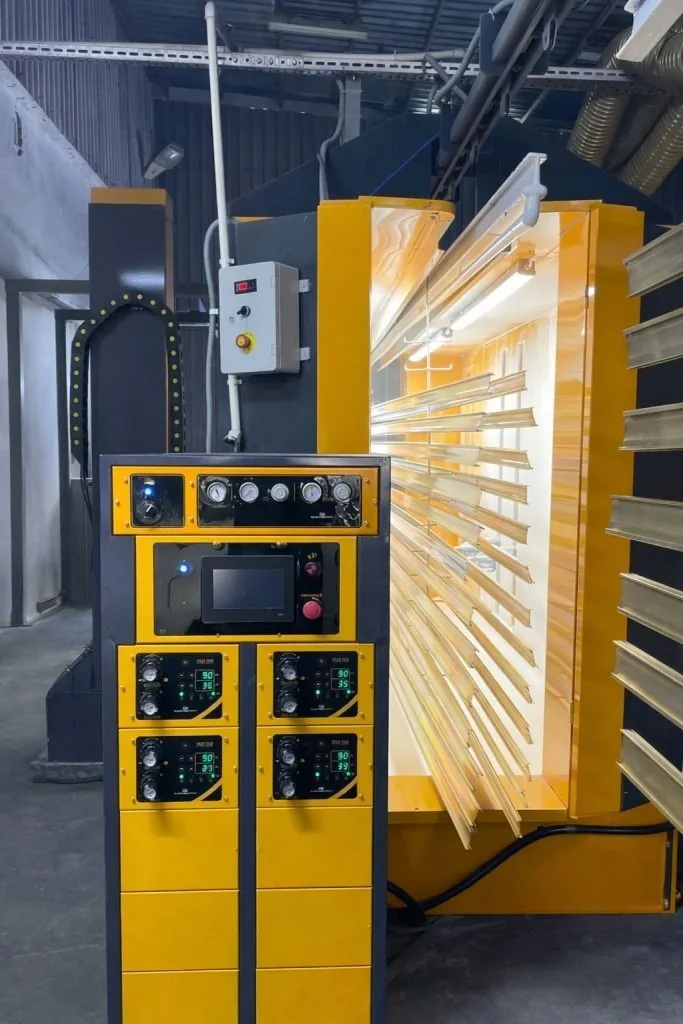
That is why wheel lines get either a longer oven or a slower conveyor than a flat-panel line. Our top-loading gas-fired ovens run at 140–220 °C with 50,000–500,000 kcal/h capacity, reach operating regime in 35–45 minutes, and give a 30–40% lower energy cost than the electric equivalent. On a wheel line that runs continuously, that difference is one of the most visible items in the annual operating budget. We built the arithmetic between throughput and oven length step by step in powder line capacity calculation; for wheels the only change is adding thermal mass per part and the second pass to the same calculation.
Masking: the hidden capacity ceiling
On a wheel line, throughput is usually set by masking rather than by the booth. Bolt holes, centre bore, balance face and bead seat — which of them get masked is dictated by the customer's assembly tolerances, and every wheel model needs its own plug set. Masking and de-masking are manual work; if enough operator space is not provided before and after the line, the conveyor stops.
The arithmetic is straightforward: measure the masking time for one wheel, divide by the target hourly output, and the result tells you how many masking stations you need. Draw the space for those stations into the layout with the same seriousness as the booth. We described a comparable labour-versus-line balance in sheet metal coating lines for automotive suppliers; on wheels the difference is that masking is mandatory rather than optional.
Frequently asked questions
Do the hangers on a wheel line really have to rotate?
In practice, yes. On a fixed hanger the drop centre and the gaps between spokes do not receive enough powder; adding a second row of guns does not fix the thickness distribution, it only adds cost. The alternative to a rotating hanger is turning the part by hand and sending it through the booth twice — which halves throughput and leaves repeatability to the operator.
How many wheels per hour can such a line handle?
Quoting a single figure would be misleading. Tunnel lines are built in the 500–5,000 parts/hour band, but wheels run in the lower part of it because of rotation time and the second coat. The real number comes from three inputs: required time in the booth, cure time and masking labour. A capacity commitment given before those three are measured will not hold.
Is one booth enough, or do I need two?
If your target is a single colour coat, one booth is enough. If you want primer plus topcoat, or a clear coat on top, the decision sits between floor area and throughput: separate booths enlarge the footprint and the initial investment while preserving output; a second pass through one booth is cheap but roughly halves it. Your measured hourly target tells you which option is right.
How many pretreatment stages should an aluminium wheel line have?
Somewhere in the 3–7 stage range, decided by the condition the parts arrive in. Cutting fluid residue after machining and casting porosity push the count up and bring passivation and extra rinsing into play. Cutting stages and then blaming adhesion failures on the powder is the most expensive route available: scrapped wheels cost more than the stage you removed.
Does a diamond-cut wheel need a different line?
Yes, the flow changes. A diamond-cut wheel is coated first, then machined on a lathe, leaving bare aluminium exposed; a clear coat is required to stop it oxidising. That forces the line to work in sync with the machining shop and to provide a separate booth and oven pass for the clear coat. Draw the layout with that second loop already accounted for.
Summary
A wheel line is not a scaled-up flat-panel line. The differences are specific: rotating hangers with reliable earthing, a multi-gun booth that also sees the drop centre, at least two coats for durability, dip pretreatment suited to aluminium, and an oven/conveyor balance stretched to match thermal mass. Masking is the invisible capacity ceiling and belongs in the layout from the start. If you are only beginning to shape the investment, our umbrella guide how to set up a powder coating plant is the right starting point, and the sizing logic for the full coating and curing line is set out on the tunnel-type powder coating plant page. Every line we build is manufactured around the customer's largest part and delivered with a 2-year manufacturer's warranty.
Send us your largest wheel diameter, your target hourly output and your expected coat count — we will work out the hanger, booth and oven dimensions with you.