
Defence and Military Vehicle Coating Systems: What the Line Must Deliver
What separates a military coating from a civil one is not the paint chemistry but the list of properties demanded from it. Chemical agent resistance, controlled low gloss, infrared signature and salt spray life all land directly on the coating line. Which clause forces what in pretreatment, in the booth and in the oven.
 Enlarge
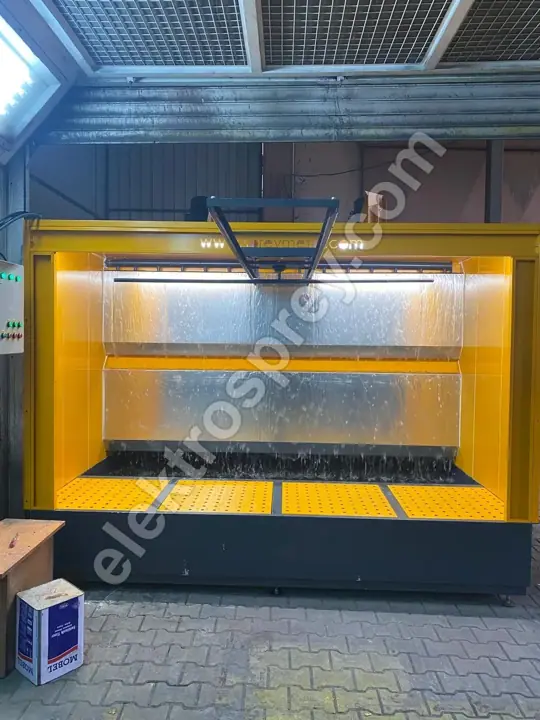
A military part's coating differs from a civil one not in chemistry but in the list of properties demanded from it: resistance to chemical agents and decontamination fluids, gloss held inside a narrow band, controlled reflectance in the infrared (IR) region, long salt spray life, and repairability in the field. That list lands directly on the line. Where a civil job runs on 3 pretreatment stages, a military specification pushes to the 5–7 stage end; ±3 °C oven uniformity stops being a comfort figure and becomes an acceptance condition; and because exterior topcoats are usually two-component wet systems, the booth has to be a water curtain type holding 99% of overspray, rated ATEX Zone 2.
Elektrosprey does not manufacture paint and does not offer contract coating. We build the line that can meet these specifications. Every line below reads the same way: the specification asks for this, therefore the line must be able to do that.
Why is coating different in defence manufacturing?
Why is coating different in defence manufacturing?
On a civil product the coating has two jobs: appearance and corrosion protection. On a military product three more are stacked on top.
First, signature management. The part is painted not only against the eye but against sensors: a camouflage pattern and low gloss in the visible band, reflectance close to the surroundings in the infrared. A glossy surface produces a specular flash in sunlight — a marker visible from kilometres away. That is why gloss in military specifications is not a preference but a measured value with a tolerance.
Second, chemical durability. The coating must not absorb chemical warfare agents and must not degrade when cleaned with decontamination fluid. Hence the acronym CARC: Chemical Agent Resistant Coating. The logic is simple — the less porous and the more fully cured the film, the less the agent penetrates and the more completely it is removed.
Third, field repairability. A vehicle body leaving the factory will be scratched in service, so the system needs a touch-up version applied by brush or spray without the part returning to the plant.
The combined result: in military coating the process record matters as much as the coating itself. Inspection does not stop at the painted part; it asks which batch was cured under which oven profile.
What does each specification clause demand from the line?
The table below is the core of this article: the left column in the language of the specification, the right column in the language of the machine.
| Specification requirement | Why | What the line must provide |
|---|---|---|
| Chemical agent resistance (CARC logic) | A porous or under-cured film absorbs the agent | Full degreasing plus phosphating/passivation in pretreatment (5–7 stages), a completely dry surface after the drying stage, particle control in the booth |
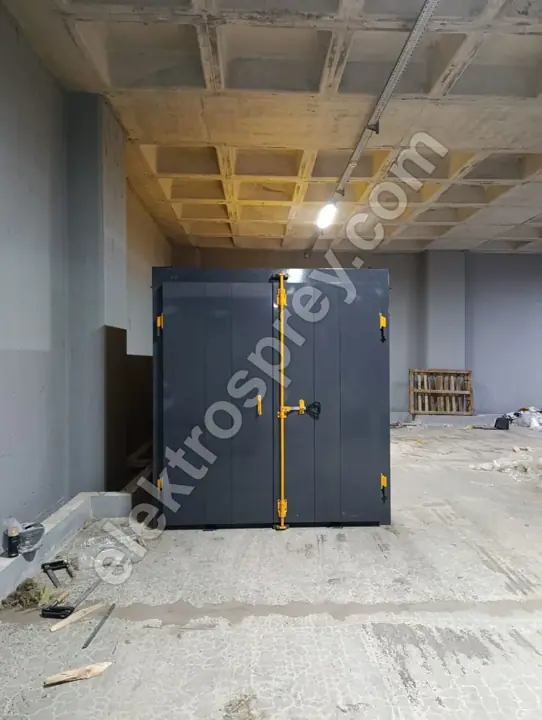
| Controlled low gloss | Gloss shifts with cure temperature and film thickness | ±3 °C uniformity in the oven, PID control and 16 cure profiles so each batch runs a fixed recipe |
| Infrared (IR) signature control | Reflectance depends on pigment arrangement and film thickness | A narrow thickness tolerance: fixed gun distance, drift-free conveyor speed within the 1–6 m/min range |
| Long salt spray life | Corrosion starts at edges and at surface residue | The upper end of pretreatment: double rinse, demineralised rinse, drying; dip line or a multi-stage tunnel |
| Decontamination fluid resistance | Incomplete cure leaves a soft film | A recorded time–temperature curve; locking onto the paint data sheet's cure window inside the 80–250 °C range |
| Colour and batch repeatability | The same vehicle must look identical across batches | Complete booth cleaning at colour change; 95%+ recovery in a cartridge powder booth, a dedicated colour line or fast colour change |
| Field touch-up capability | The part cannot come back to the plant for repair | A small touch-up and drying station on site, with a low-temperature product compatible with the main system |
| Process traceability | Acceptance inspection asks for evidence | Time–temperature records per batch, plus thickness and gloss measurement points |
The first row is the one most often skipped. Cutting pretreatment to afford a bigger oven is a mistake even in civil work; under a military specification it is a direct cause of rejection. We opened the stage logic bath by bath in how many pretreatment stages you need.
Which coating layers are used on military vehicles?
What types of paint are used on military vehicles?
A military coating is not a single coat but a layered system. Each layer has its own job and its own counterpart on the line.
| Layer | Function | Typical application | Counterpart on the line |
|---|---|---|---|
| Surface preparation | Removing oil, rust, scale and salt residue | Blasting and/or chemical baths | Dip pretreatment line or a 5–7 stage tunnel |
| Corrosion primer | Adhesion to metal and a corrosion barrier | Two-component wet spray | Water curtain booth plus drying/curing oven |
| Intermediate coat / filler | Surface levelling, thickness build (not in every project) | Wet spray | Same booth, extra flash-off time |
| Signature-controlled topcoat | Camouflage colour, low gloss, IR behaviour, chemical resistance | Mostly two-component wet spray | ATEX Zone 2 water curtain booth, controlled air |
| Powder coating (internal parts) | Enclosures, consoles, racks, covers, generator housings — non-signature parts | Electrostatic powder | Cartridge filter powder booth plus 80–250 °C oven |
| Touch-up layer | Repair after field use or assembly | Brush, aerosol, small gun | Separate small booth and drying area |
Honesty is required here: powder coating is not a general equivalent for the signature-controlled exterior topcoat. Those layers are commonly two-component wet systems, and which product meets a specification is decided by the paint manufacturer and the procuring authority — not by the machine builder. Powder's real place in defence work is metalwork carrying no signature criterion, and there it is a genuine advantage: no solvent, 95%+ recovery, 98.5%+ coating efficiency.
How does CARC logic dictate the air in your line?
What changes in my line if I apply a CARC-type coating?
If a CARC-class topcoat is going to be applied, the part of the line that changes most is the air. In three places.
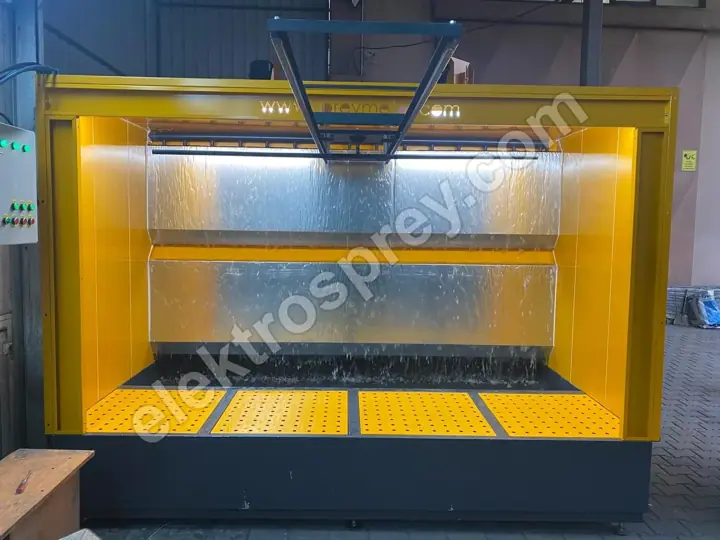
Booth air. In two-component wet application, capturing overspray is a quality issue as much as an environmental one; particles left hanging settle on the next part. A water curtain wet paint booth handles this with 99% overspray capture and closed-circuit water. Because of solvent vapour, ATEX Zone 2 classification and an antistatic grid floor are standard.
Supply air. Unfiltered booth air puts dust on the surface and breaks film continuity — in CARC logic a direct source of porosity. The same holds on the powder side: in a cartridge filter powder booth internal air velocity is held at 0.5–0.8 m/s and the filter runs at 99.9%+ efficiency.
Personnel air. With isocyanate-containing systems, fresh-air-fed respirators and booth ventilation are mandatory. The safety data sheet of the product is an input to the ventilation design; ventilation is finalised after the paint is chosen, not before.
We compared booth types across all the options in choosing a powder coating booth.
Which line configuration suits which part?
How do you choose a military coating system?
Reverse the selection order and the investment comes out wrong. The correct order has four steps: (1) the procuring authority's specification, (2) the paint manufacturer's data sheet — cure temperature and time, film thickness, pretreatment requirement, (3) part geometry and the size of your largest part, (4) line configuration. The most common mistake we see is buying the line first and reading the specification afterwards.
| Production scenario | Pretreatment | Application | Cure |
|---|---|---|---|
| Armoured/tactical vehicle body, large panels | Dip line or wide-section tunnel | Water curtain wet booth, ATEX Zone 2 | Low-temperature drying / curing oven |
| Mid-size metalwork, enclosures, consoles | 5–7 stage tunnel pretreatment | Powder booth, 2–12 guns | Box type or tunnel oven, 80–250 °C |
| Series production, high volume | Tunnel, 500–5,000 parts/hour | Automatic powder booth | Continuous oven, conveyor 1–6 m/min |
| Prototype, small batch, many colours | Manual or dip | Manual unit, 0–100 kV | Box type electric oven |
| Touch-up and post-assembly repair | Local cleaning | Small gun or brush | Air dry or low heat |
Can powder coating be used on military parts?
It can, but not on every part. On metalwork with no signature criterion, powder is both cleaner and cheaper. Its limits are clear: heat-sensitive assemblies, parts with elastomer seals and composite bodies do not belong in a powder oven. The second limit is colour management — with a multi-colour camouflage palette, every colour change means booth cleaning time; on our aluminium profile lines that is brought under 20 minutes, but it is not zero. The third: treating powder as an equivalent for a signature-controlled exterior coat is an assumption, and that call belongs to the specification and the paint manufacturer.
Does military touch-up coating need its own station on the line?
In series production, yes. Touch-up breaks the rhythm of the main booth and conveyor: parts arrive one at a time, a small area is coated, and it has to dry fast. Doing that in the main booth stops the line. The practical answer is a small touch-up booth near the line exit with a box type electric oven beside it — built between 3 and 150 kW by part volume. Compatibility of the touch-up product with the main system, plus thickness and gloss measurement on the repaired area, are part of the acceptance criteria.
Does the machine builder issue the specification compliance certificate?
No, and that should be said plainly. Compliance of the coating is qualified by the paint manufacturer; acceptance of the coated part is decided by the manufacturer's quality organisation and the procuring authority. The machine builder delivers the process capability that lets compliance be produced repeatably: measured and recorded ±3 °C oven uniformity, stable conveyor speed, filtered booth air, and a 2-year manufacturer's warranty. How uniformity is measured, and why it is decisive, is in oven temperature uniformity.
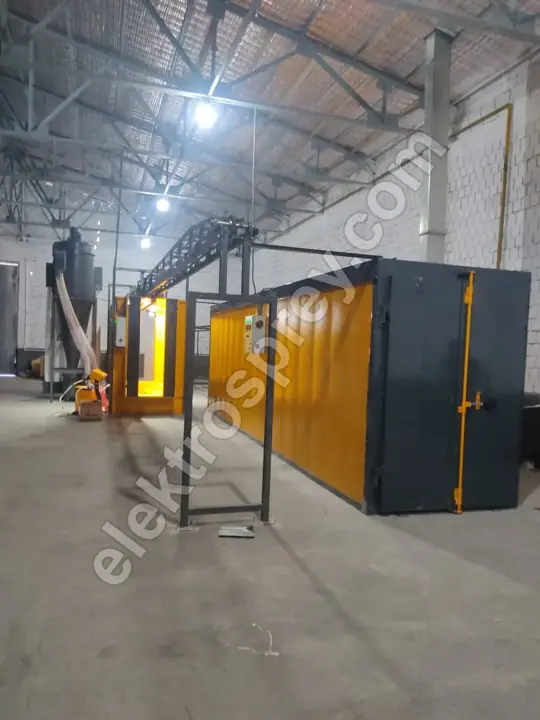
Summary
A military coating specification is not a paint list, it is a process list. Chemical agent resistance pushes pretreatment to 5–7 stages. Gloss and IR signature demand ±3 °C oven uniformity and a narrow thickness tolerance. Solvent-borne topcoats force the booth to ATEX Zone 2 with 99% overspray capture. Powder is strong on non-signature metalwork but is not an automatic equivalent on the exterior coat. Above all: inspection asks for evidence, and that evidence comes out of the oven's record.
How a complete line is planned end to end is in the powder coating plant setup guide; for pretreatment on large bodies, see the dip pretreatment line page.
Send us your specification, your paint manufacturer's data sheet and the dimensions of your largest part — we engineer the line around those three documents.