
What Temperature Should a Degreasing Bath Run At? Heat, Time and Energy
Bath temperature is never a single setting; it is a balance struck together with contact time and chemical concentration. This article explains how to pick the band from the soil type, what low-temperature chemistry really costs, and how lids, insulation and heater sizing decide your annual energy bill.
 Enlarge
The working answer to what temperature a degreasing bath should run at is a narrow band: 50–70 °C for conventional alkaline chemistry, 35–45 °C for low-temperature formulations, and 20–30 °C, close to ambient, for a few specialist products. What selects the band is not the supplier's brochure but the type of soil sitting on the part. On steel carrying deep-drawing oil or a protective grease film, dropping below 60 °C usually means losing cleanliness; running an extruded profile with light machining oil at 65 °C is money burned directly. The decision only comes out right when temperature is set together with contact time and concentration, never on its own.
This is the largest continuous energy item in pretreatment. An oven draws load as parts arrive; a degreasing tank is held hot through the whole shift and, in most plants, outside the shift as well. That is why a 5–10 °C decision on bath temperature shows up bigger at the end of the year than any oven setting does.
What temperature actually buys you in the bath
Heat does three jobs at once: it drops the viscosity of the oil so it releases from the surface, it accelerates saponification in alkaline chemistry, and it improves the emulsifying power of the surfactants. The rough rule that reaction rate roughly doubles for every 10 °C is a general approximation, and a degreasing bath behaves that way too — which means trading temperature for time is genuinely possible for most soils.
But there is also a ceiling, and it is the part most plants underestimate:
- Evaporation loss does not rise linearly with temperature; above roughly 70 °C the open tank surface becomes the dominant heat and water loss point.
- Chemical breakdown: some surfactants pass their cloud point when overheated, so cleaning power falls instead of rising.
- Steam and condensation: mist in the building, condensation on the roof, corrosion on hangers and conveyor.
- Aluminium and thin gauge steel: risk of over-etching and a dulled surface at high temperature.
- The next stage: a part leaving too hot heats the rinse tank and shifts its chemical balance.
Raising the temperature does not automatically mean cleaner. Past a certain point it only means more expensive.
Heat, time and concentration: a three-lever balance
The same cleaning result can be reached by three different routes. Which one you take depends on the physical length of the line and on your energy price.
| Lever | What raising it gains | What it costs | Practical limit |
|---|---|---|---|
| Temperature | Reaction and emulsification speed, the fastest result | Continuous energy cost, evaporation, make-up water | Cloud point of the chemistry, sensitivity of the substrate |
| Contact time | Cleaning without any extra energy | Longer tank or slower conveyor, so throughput falls | Available floor area and target parts per hour |
| Concentration | Clear gain on heavy soils | Chemical consumption, rinse load, effluent cost | Rinse capacity and discharge limits |
| Mechanical action | The cheapest lever for lowering temperature | Pump energy, nozzle maintenance, foaming risk | Spray pressure and nozzle layout |
The most overlooked line in this table is the last one. Mechanical action — as turbulence, circulation or spray pressure — offsets roughly a 10 °C drop on most soils, and pump energy is cheaper than tank heating. How the chemistry itself shifts this balance is covered separately in alkaline or acidic degreasing, and the relationship between stage length and contact time is the subject of pretreatment stage length and contact time.
Starting bands by soil type
The bands below are a starting point; the final value is confirmed on a sample part with a water-break test. There is no catalogue figure, because the same steel with the same oil still arrives with a different storage history.
| Soil type | Typical bath temperature | Immersion contact time | What to watch |
|---|---|---|---|
| Light machining / rolling oil | 40–55 °C | 3–6 minutes | Best candidate for low-temperature chemistry |
| Deep-drawing and press oil | 55–70 °C | 5–10 minutes | Trading heat for time alone rarely covers it |
| Protective grease / rust preventive | 60–70 °C | 8–15 minutes | Without a pre-wash stage the main bath loads up fast |
| Laser or plasma cut dross and oxide | 50–65 °C | 5–10 minutes | Degreasing alone is not enough; a mechanical or acidic stage is needed |
| Aluminium profile and castings | 40–60 °C | 3–8 minutes | Over-etching risk; alkalinity choice and time are critical |
| New steel, short storage time | 30–45 °C | 2–5 minutes | The most realistic case for running genuinely cold |
If a value that works for one batch fails on the next, the problem is not in the bath but in the supply chain: different oil, different storage time, different handling.
Where the energy bill is actually created
The energy consumption of a degreasing tank is two separate items, and confusing them leads to the wrong equipment. Initial heat-up is the energy needed to bring a cold tank to working temperature; it sets heater rating and shift start time. Loss compensation is the energy spent continuously to hold that temperature, and it is what really writes the annual bill.
| Loss item | Weight in the total | Most effective countermeasure |
|---|---|---|
| Evaporation and radiation from the open surface | Usually the largest item | Lid, floating cover, extraction volume kept no higher than needed |
| Conduction through tank walls and floor | Moderate | External insulation, tank lifted off the slab |
| Heat carried out on parts and hangers | Grows with throughput | Drain time, hanger design, heat recovery |
| Fresh water and chemical make-up | Small but continuous | Cutting evaporation also cuts this item |
| Holding hot outside shift hours | The item most plants never see | Reduced standby setpoint, timer-controlled regime |
The cheapest gain here is almost always the lid. An uncovered, uninsulated tank loses more heat from its open surface than from all its walls together. The line item deferred at purchase as "we can fit a lid later" is the one that pays for itself in its first year. The equivalent calculation on the oven side is set out in powder coating oven energy consumption; pretreatment and oven energy should be budgeted separately.
Is low-temperature chemistry really a saving
Usually yes, but not for free and not for every plant. The honest picture: dropping a bath from 60 °C to 40 °C cuts heat loss noticeably, reduces evaporation and make-up water, and clears the mist out of the building. Against that:
- Concentration usually rises — chemical cost goes up and the rinse load grows with it.
- Soil tolerance drops. The bath saturates faster on heavy oil, so dumping frequency and effluent cost increase.
- Contact time lengthens. On an existing line that means slowing the conveyor; on a new line it means building a longer stage. Energy saved by cutting throughput is not a saving.
- Control discipline becomes mandatory. A cold-running bath has a far narrower tolerance when concentration and pH monitoring slip.
The decision rule is simple. If the soil is light, running hours are high and the line layout allows a longer contact time, low-temperature chemistry makes sense. On a line running heavy press oil with fixed stage lengths and throughput already under pressure, it usually does not.
Sizing the heater and the heat-up time
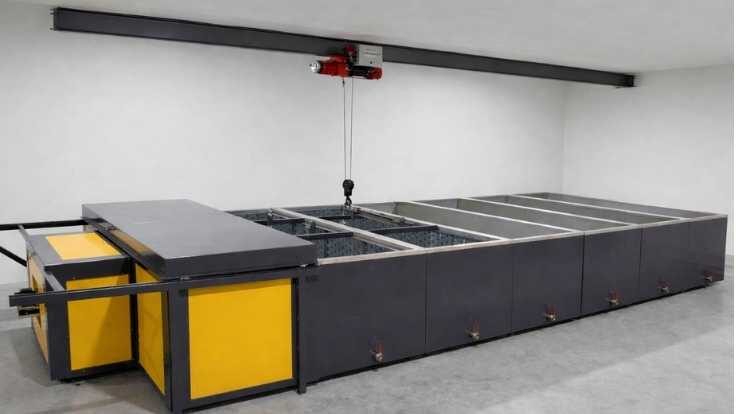
Heater rating is not picked from a catalogue; it is sized from tank volume, target temperature rise, the heat-up time you want and the calculated continuous loss. Two plants with identical tank volumes buy different heaters because one of them wants to be production-ready thirty minutes after switch-on. In the immersion pretreatment line tanks we build, the degreasing, phosphating, passivation and drying stages are each dimensioned around the customer's largest part, and heater rating follows from that volume.
An undersized heater costs you in the calendar rather than the bill: the shift starts late, the first parts pass through a bath below target temperature, and the adhesion problem people later blame on the booth actually originates here. An oversized heater is simply wasted capital and wasted connected load.
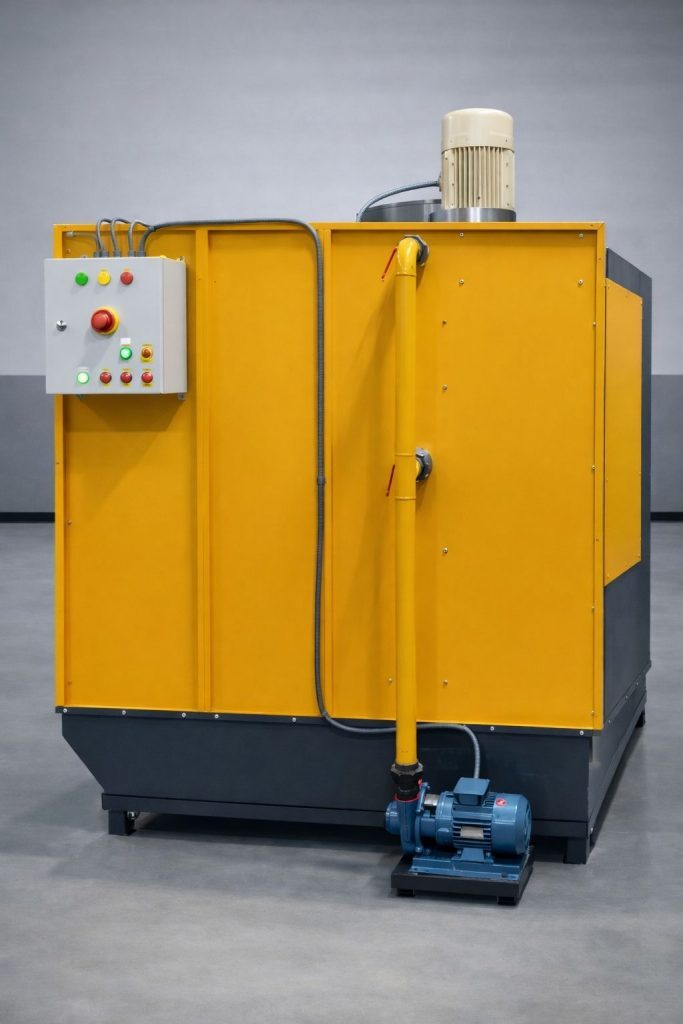
On spray-based tunnel lines the balance shifts. Mechanical action is high, so the same cleanliness comes at a lower temperature — but every stage carries its own pump and its own heating. On a tunnel type powder coating plant built with 3–7 stages, conveyor speed is adjustable across 1–6 m/min, so contact time moves with line speed; the temperature decision cannot be made independently of it.
Frequently asked questions
What temperature should a degreasing bath run at?
The soil decides. Light machining oil sits at 40–55 °C, deep-drawing oil and protective grease at 55–70 °C, and dedicated low-temperature formulations at 30–45 °C. The exact value is found inside that band with a water-break test on a sample part: if water sheets across the surface in an unbroken film, the bath is doing its job; if it beads up, one of temperature, time or concentration is short.
What do I lose if I drop the bath by 10 °C?
Expect the reaction rate to roughly halve. There are three ways to compensate: lengthen contact time, raise concentration, or increase mechanical action. Dropping temperature without doing any of them degrades cleaning invisibly, and you see the result not in the booth but in a corrosion complaint from the field a few months later.
How do I know when the bath needs dumping?
By soil load, not by temperature. Free oil floating on the surface, a water-break test that fails while concentration reads correct, and staining after rinsing are the decisive signs. Once a bath is saturated, raising the temperature buys a brief illusion and no real cleaning. Adding an oil separator or a pre-wash stage is the durable way to extend bath life.
Should I let the bath cool down completely over the weekend?
In most plants, no. A large tank allowed to go fully cold takes hours to recover and eats the first shift. The usual approach is a reduced standby temperature over the weekend with timer-controlled heat-up before the shift. The way to settle it is straightforward: compare the energy lost at standby against the energy of a full reheat. With an insulated, covered tank, holding wins almost every time.
Does low-temperature chemistry work on aluminium profile too?
Generally it works well, because soils on extruded profile are mostly light and the over-etching risk falls at lower temperature anyway. The formulation must still be confirmed as aluminium-suitable in writing by the chemical supplier. On aluminium the decisive variables are contact time and alkalinity control rather than bath temperature.
Summary
Temperature in a degreasing bath is not a standalone setting but one arm of a three-lever balance. The correct order is: identify the soil type, choose the band, set contact time and concentration to match that band, and only then use mechanical action to pull the temperature back down. On the energy side the first item of capital is not the heater but the lid and the insulation; without those, low-temperature chemistry will not deliver the saving you expect. Every pretreatment line we build is manufactured around the customer's largest part, its heater sized from tank volume, and delivered with a 2-year manufacturer's warranty.
Send us your soil type, your daily part count and the dimensions of your largest part — we will calculate bath temperature, stage length and heater rating together.