
How Much Energy Does a Powder Coating Oven Use? Cost per Part
The installed power of an oven is not its consumption. Real consumption comes from three items: heat-up, holding the set temperature, and the thermal load of the part itself. Here is how those separate — and how the energy cost per part is actually calculated.
 Enlarge
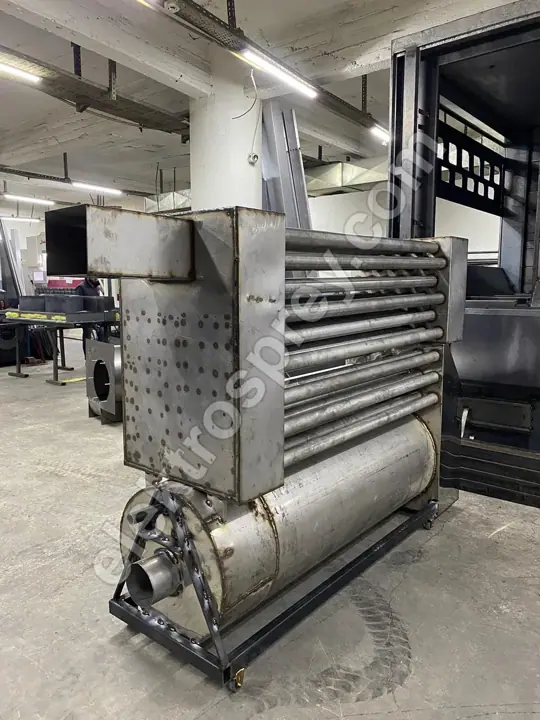
The installed power on an oven's nameplate — 3–150 kW on our electric ovens, 50,000–500,000 kcal/h on our top-loading gas ovens — is not the energy the oven uses; it is the maximum it can draw. The oven pulls that figure only during heat-up, and only briefly. Real consumption is made of three items: (1) heat-up — bringing a cold oven to working temperature, a price paid once a day; (2) holding the set temperature — replacing the heat escaping through the shell and the door, a continuous load for as long as the oven stays on; (3) the part's own thermal load — raising the incoming metal and its hanging fixture from room temperature to curing temperature. Discussing whether an oven "eats a lot" without separating these three leads to the wrong conclusion.
The ratio between the three is not fixed either. In a workshop running two hours a day, most of the total is heat-up; in a plant running twelve hours, heat-up shrinks into insignificance and the part thermal load becomes dominant. Both the investment decision and any saving effort change depending on which side that ratio sits.
The four items of consumption and what drives each
| Item | When it is paid | What determines it | How it is reduced |
|---|---|---|---|
| Heat-up (one-off) | At every cold start | Internal volume, mass of the shell and rack steel, target temperature, installed power | One heat-up per shift; running without breaks; not buying a bigger oven than needed |
| Holding load (continuous) | Every minute the oven is on | Insulation thickness, shell surface area, door sealing, ambient temperature | Not compromising on 10 cm rockwool insulation, gasket maintenance, automatic door control |
| Part thermal load | With every part entering | Part mass, material, hanger/pallet mass, parts per hour | Lighter hanging fixtures, never running a half-empty oven, taking parts straight from the pre-treatment dryer while still warm |
| Door and conveyor loss | At every opening / continuously | Number and duration of door openings, tunnel entry-exit opening size, presence of an air curtain | Batch loading, air curtains, narrowing the tunnel opening to the part envelope |
The item most often overlooked on the floor is the third. A part's thermal load is physics and does not fall by changing oven brands: mass × specific heat × temperature difference. For steel the specific heat is roughly 0.46 kJ/kg·K; every kilogram of steel raised from 20 °C to 200 °C needs about 0.023 kWh. That figure is identical in the most efficient oven ever built. What oven selection can reduce is heat-up, holding load and door loss — the part thermal load improves only by lightening the hanging fixture and running the oven full. A half-loaded oven means double the holding cost per part.
Electric or gas, seen from the energy side
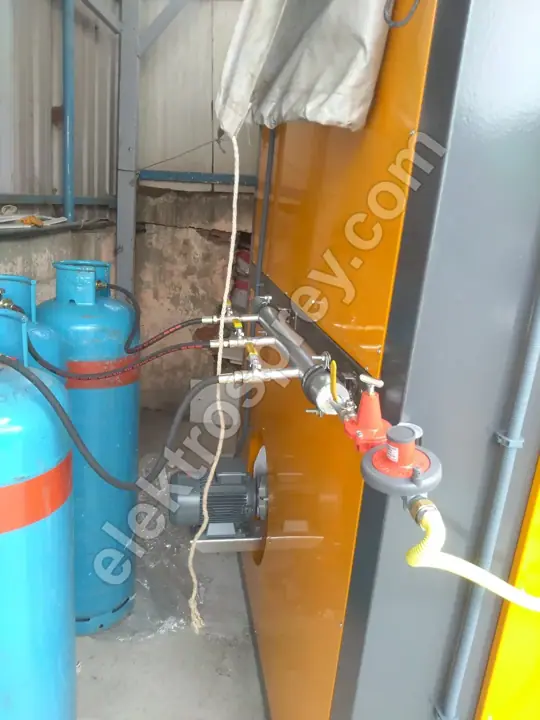
| Box type electric oven | Top-loading gas oven | |
|---|---|---|
| Working range | 80–250 °C | 140–220 °C |
| Capacity | 3–150 kW | 50,000–500,000 kcal/h |
| Heat-up time | By volume and power | 35–45 minutes |
| Energy cost | Reference | 30–40% lower than electric |
| Control | PID + 16 curing profiles | PID + safety thermostat |
| Uniformity | ±3 °C | — |
| Infrastructure requirement | Sufficient contracted capacity, switchgear, transformer if needed | Gas subscription, pressure reduction, internal pipework, stack |
| Certification | CE | CE / TS EN 1020 |
| Disadvantage | Higher unit energy cost; contracted-capacity problems at high kW | Long subscription and stack process; unsuitable for work below 140 °C; stack and ventilation mandatory for combustion products |
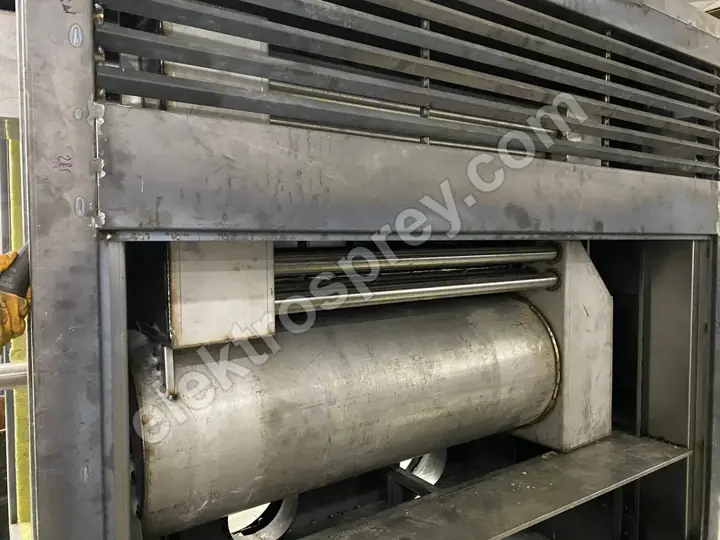
The 30–40% advantage of gas is a ratio; what it is worth in money depends on how much energy you consume. In a workshop running few hours it stays small in absolute terms, and the subscription, pressure reduction station, internal pipework and stack take years to pay back. In a plant running long hours the same ratio becomes a large difference. For the full decision, see our electric versus gas oven comparison.
One warning: the stack requirement of a gas oven is not only a cost item, it is a layout constraint. If there is no façade or roof access for the flue, or if permission cannot be obtained in a rented building, the energy advantage of gas becomes irrelevant.
Why is the insulation 10 cm rockwool?
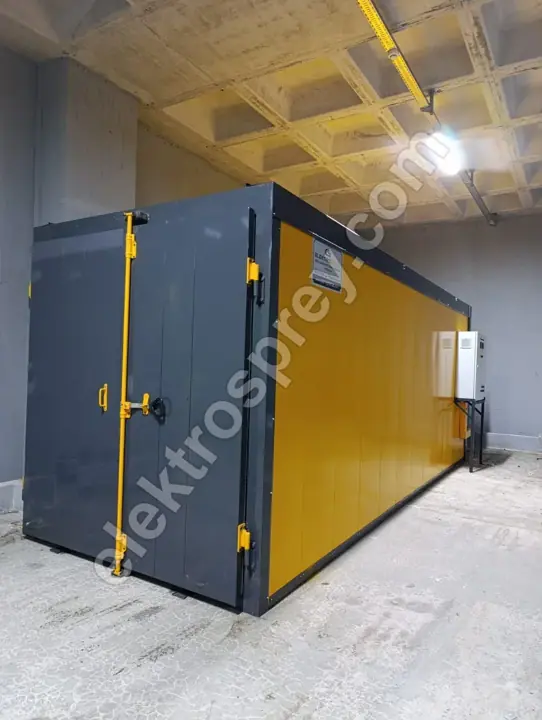
The holding load is the heat leaking out through the shell, and it is inversely related to insulation thickness. 10 cm rockwool is standard on our ovens; that is the thickness that brings the loss in the curing band (140–220 °C) down to a level where the outer shell stays touchable by hand.
When insulation is cut back, this is what happens:
- The holding load rises. The loss grows noticeably; the oven fires its elements or burner more often just to stay at temperature. This is a cost spread across every minute of the day — not a one-off.
- Temperature uniformity degrades. Zones near the wall cool faster and a gradient forms inside the chamber. Holding ±3 °C is not possible without proper insulation; we covered this in detail in oven temperature uniformity.
- The outer surface heats up. The working area around the oven warms, shop temperature becomes a problem in summer, and a contact risk appears.
- The sheet-metal shell fatigues thermally. The shell starts carrying the heat, and long-term deformation shows up around welded areas.
Insulation is a small item in the price of an oven and a lifetime item in the cost of running it. When comparing quotations, always ask for the insulation thickness — it is often the real source of a price difference between two ovens.
How does daily running time change the decision?
The same oven is a different machine under a different working pattern.
| Working pattern | Dominant item | Right choice |
|---|---|---|
| 2–3 hours a day, intermittent | Heat-up | Electric oven, volume not oversized; a small chamber that heats fast |
| 8 hours a day, single shift | Holding load and part load balanced | Gas if the infrastructure exists; otherwise electric with good insulation |
| 2–3 shifts, continuous flow | Part thermal load | Gas oven or a tunnel type continuous line |
In a workshop running two hours a day the oven shuts down shortly after reaching temperature; the heat-up energy is lost back through the shell almost without being amortised. Here the address of saving is not the fuel type but batching the work: collecting parts and running the oven full in one go lowers the cost per part more than switching fuel ever will.
In a plant running three shifts the oven never cools; heat-up is paid once a day and becomes negligible in the total. Saving there comes from the part thermal load and door/conveyor loss: lighter hangers, conveyor speed matched to loading density, a narrower tunnel opening.
How is the energy cost per part calculated?
We do not publish figures — unit energy prices move, and a number written today misleads in six months. But the logic is fixed. Find the daily total energy, divide by the daily part count, multiply by the unit energy price:
Daily energy (kWh)
  = Heat-up energy (kWh, once per day)
  + Holding power (kW) × daily running hours
  + Part thermal load (kWh/part) × daily part count

Energy per part = Daily energy ÷ Daily part count
Cost per part   = Energy per part × unit energy price
The part thermal load is found like this:
Part thermal load (kWh) = [ (part kg + hanger kg) × 0.46 × (curing °C − ambient °C) ] ÷ 3600
(0.46 kJ/kg·K is the approximate specific heat of steel; for aluminium it is roughly double — on lines coating aluminium profiles this item is larger than people expect.)
For a gas oven, build the same calculation in kcal instead of kWh; convert with 1 kWh ≈ 860 kcal, then divide by the calorific value of gas per cubic metre.
What this formula really says is that the part count in the denominator is stronger than any item in the numerator. Filling the oven produces results faster than buying the most efficient oven in the world. If you want the capacity planning set up correctly, our powder coating plant setup guide explains how this calculation spreads across the whole line.
Contracted capacity: the item most often skipped when choosing an electric oven
The most common accident in electric oven projects is this: the machine is ordered, manufactured, shipped to site — and the building's contracted electrical capacity cannot carry it. At that point a capacity upgrade application, new switchgear, cable cross-sections and sometimes a transformer enter the picture. This item occasionally costs more than the oven itself, and it requires an application process whose timetable is not in your hands.
Before requesting a quotation, find out three things:
- What is your current contracted capacity in kW? It is printed on your electricity bill.
- How much of it is already used? Compressor, pre-treatment line, booth fans and lighting included.
- Is an upgrade possible, and how long does it take? Ask your distribution company; the answer varies by region.
The kW requirement of an oven is calculated from internal volume, insulation, target heat-up time and daily cycle count. That is why we build the box type electric oven anywhere between 3 and 150 kW, sized to the customer's largest part and existing capacity — we do not work from catalogue sizes. If your contracted capacity is tight but your volume is high, a top-loading gas oven is usually the more realistic answer.
Frequently asked questions
How many kW does a powder coating oven draw per hour?
The installed power on the nameplate (3–150 kW) is not a continuous figure; it is a short peak during heat-up. Once at working temperature the oven draws only enough to cover its losses, and in a properly insulated oven that is a small fraction of installed power. Real average consumption is that fraction plus the thermal load of the parts.
Does a gas oven really save 30-40%?
Our top-loading gas ovens run at 30–40% lower energy cost than the electric equivalent. That is a ratio; its value in money depends on current gas and electricity prices and on your daily running hours. In a workshop running few hours the absolute saving stays small and may never cover the stack and subscription investment.
Is it cheaper to keep the oven on or to shut it down and reheat?
The length of the break decides. If the break is shorter than the oven's own reheat time (35–45 minutes on our gas ovens), keeping it on is cheaper; if it is clearly longer, shutting down is cheaper. In practice, shutting down for a lunch break does not pay; shutting down at the end of a shift does.
Does a larger oven volume increase energy cost?
Yes, in two ways. A larger volume increases both the heat-up energy and the holding loss — and neither of those depends on how many parts you put inside. Oversizing the oven "for the future" creates a cost paid every single day. The correct approach is to size the oven to your largest part and to increase capacity through cycle count.
Does it make sense to cut insulation thickness to lower the oven price?
No. A saving made on insulation is won once on the machine price and repaid every day in running cost; it also degrades temperature uniformity and shell life. 10 cm rockwool is standard for us, and we do not treat it as a negotiable item.
Summary
Installed power is a capacity figure, not a bill. The bill is written by heat-up, holding load, part thermal load and door loss — and the weight of those four shifts with your daily running hours. In a workshop running few hours, the address of saving is filling the oven; in a plant running long hours, it is the fuel type and the mass of the hanging fixtures. On the electric side, the first step of the decision is not the oven but your contracted capacity.
Send us the dimensions of your largest part, your daily part count and your current contracted capacity, and we will work out together how many kW the oven needs to be and what the energy load per part actually is.