
What Must a Line Provide to Promise Exterior Durability?
On projects that carry an exterior durability commitment, the deciding factor is not the coating class but the discipline of the line applying it. This article explains how pretreatment stage count, oven uniformity, colour consistency and record keeping translate into plant investment.
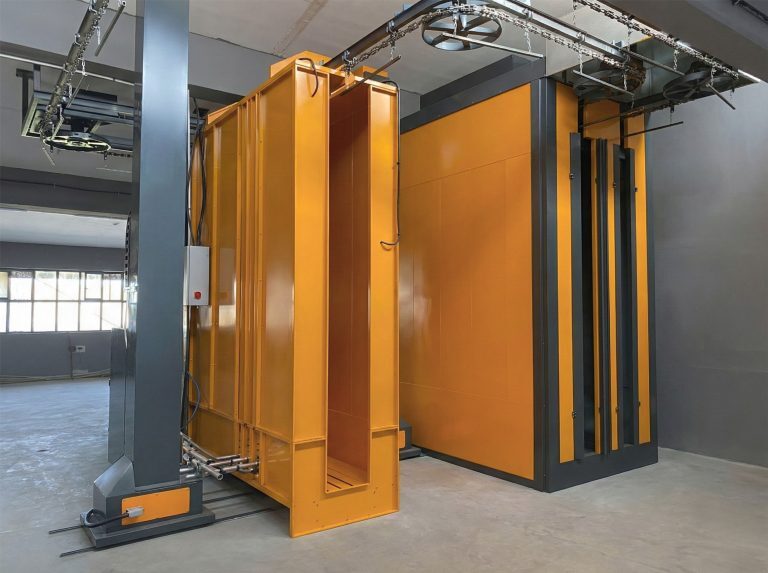 Enlarge
Superdurable powder coating for facade work imposes three line requirements: pretreatment moves to the top of the 3–7 stage band, the oven has to deliver a measurable cure window with ±3 °C uniformity and 16 baking profiles, and production has to be recorded batch by batch. Without those three, exterior work cannot be committed to at all — whatever the coating class — because approval schemes such as Qualicoat and GSB audit the line and the process, not the powder. That is the distinction to keep in mind when planning the investment: of two plants coating the same part, one does interior work and the other wins facade work, even when their equipment lists look alike.
This article is not about which coating to buy. It is about what a plant must satisfy before it can commit to exterior work. How the resin families behave relative to one another is a separate question, covered in the difference between epoxy, polyester, hybrid and polyurethane. Here we look at what a single commitment level adds to the cost of the line.
Which part of the line does a facade commitment squeeze?
Interior work is forgiving. A thin oil film left on the surface, a few degrees of temperature drift, a small colour difference between batches — once the part is installed, none of it usually reaches anyone's agenda. On a facade the same deviations become measurable over the years: edge corrosion, gloss loss, a visible tone difference between two panels sitting side by side.
That is why exterior work tightens four points on the line at the same time.
| Line section | Interior work | Facade commitment | Investment impact |
|---|---|---|---|
| Pretreatment | Stage count can stay low | Moves to the top band, bath monitoring required | High |
| Oven | Set point is considered enough | Part-mounted temperature curve required | Medium |
| Colour management | Batch variation tolerated | Batch and coat records required | Low–medium |
| Records / traceability | Usually absent | The core subject of the audit | Low, but continuous |
The last column may be surprising: the expensive item is not the oven but pretreatment. On the oven side, correctly specified equipment already covers most of the requirement; on the pretreatment side, adding a stage means another tank, more floor area, more chemistry and more waste water.
Pretreatment: the stage count is not negotiable here
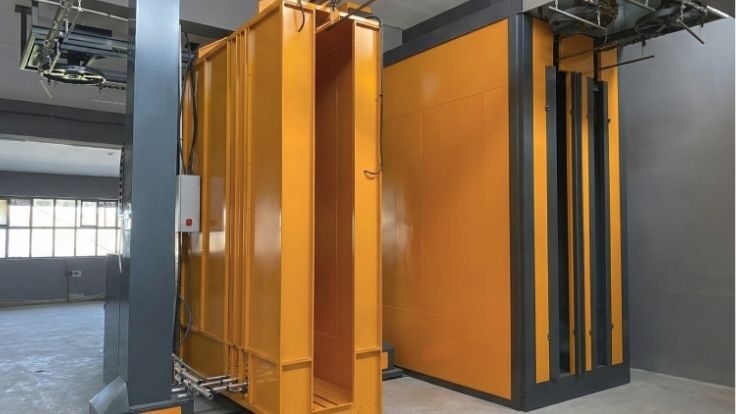
Most of the exterior durability is decided underneath the coating. A line that stops at degreasing and one rinse may cause no trouble for years on an interior part; outdoors, the interface where the coating grips the metal is the first thing to break down under moisture and salt load.
Dip or tunnel pretreatment is engineered in the 3–7 stage range. A line that will carry a facade commitment is in practice built at the top of that band, with the stages kept separate: degreasing, rinse, second rinse, conversion coating (phosphating, or the chrome-free alternative on aluminium), a final rinse with demineralised water, and drying. How the stage count is determined, and which contamination type calls for which stage, is set out step by step in how many pretreatment stages you need.
The hidden cost of adding a stage is bath monitoring. If concentration, temperature, pH and conductivity are not recorded every shift, the stage counts for nothing in an audit even though it physically stands there in the line. So an investment plan should place the measurement and recording routine right next to the tanks of the dip surface treatment line; tank fabrication is a one-off, record discipline is permanent.
How many pretreatment stages does facade work require?
Naming a single number would be misleading, because the stage count depends on the substrate and on how dirty the incoming part actually is. On aluminium profile, conversion coating and a demineralised rinse are non-negotiable; on oily steel sheet, the degreasing and rinsing stages multiply instead. The general rule: interior work can be built at the low end of the band, a facade commitment asks for the high end. Have the stage count set from the measured contamination of your real parts, not picked from a catalogue.
Oven: a narrow cure window must be measurable
The durable formulations used outdoors share one property — a narrower cure window. Under-cure costs mechanical strength and adhesion; over-cure shifts colour and gloss. On a facade both eventually become visible in the field.
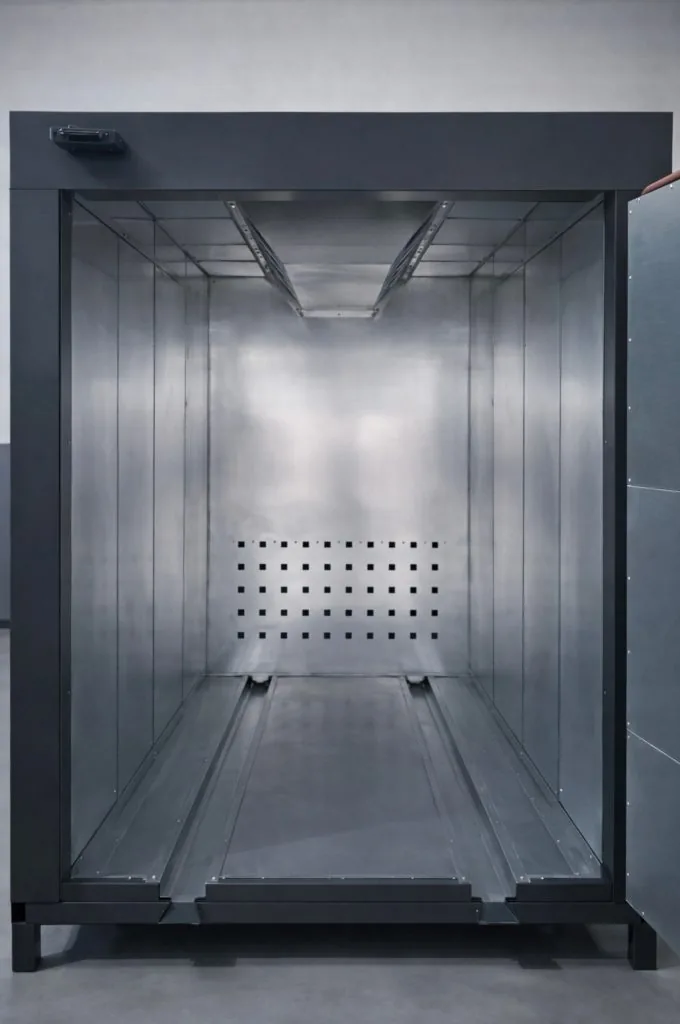
So what a facade line needs from its oven is not high temperature but repeatability. On the box-type electric oven, the 80–250 °C working range, PID control, ±3 °C uniformity and 16 baking profiles answer exactly this need: a heavy aluminium profile and a thin sheet part are not baked on the same profile, they get separate ramps. On the top-loading gas oven, the 140–220 °C band and the 50,000–500,000 kcal/h range are selected to the project capacity, with 30–40% lower energy cost than electric; but on facade work the decision is driven by the measured temperature curve, not by energy alone.
Producing the oven report is a discipline of its own. What is asked for is not the set point but a record of the temperature the part surface actually sees; the method is collected in oven temperature uniformity. On a line carrying a facade commitment this measurement is not a once-a-year formality — it is repeated every time the oven loading pattern changes.
How does oven uniformity affect an exterior warranty?
Directly. If one zone of the oven runs a few degrees cooler than the rest, the parts in that zone are systematically under-cured. The defect is invisible at the exit; two or three years later it surfaces as gloss loss or an adhesion failure on one specific section of the facade. A measured, recorded uniformity report is the easiest part of the commitment to defend.
Colour deviation: why is the tolerance so tight outdoors?
Facade panels sit side by side. A tone shift nobody would notice on interior parts becomes an outright rejection when two different batches end up as neighbours on the same elevation. Colour consistency is therefore a line requirement, not a coating requirement.
| Source of deviation | Symptom | What it means on the line |
|---|---|---|
| Different powder batch | Tone difference between panel groups | Batch-to-project matching and records |
| Film thickness distribution | Local tone difference on one part | Gun layout, conveyor speed |
| Over / under baking | Gloss shift and yellowing | Separate baking profile, oven curve |
| Residue at colour change | Unexpected tone contamination | Fast colour change layout, cleaning |
| Reclaim ratio | Surface appearance drifting over time | Virgin/reclaim ratio rule |
On aluminium profile work, colour change is also a capacity issue. An aluminium U-type coating plant running 3–7 m profiles is designed so that a colour change stays under 20 minutes; since small batches and many colours are normal in facade work, that figure sets the delivery schedule directly.
Can the same colour be held across different batches?
The way to guarantee a matching finish is to produce the parts destined for one elevation from the same powder batch and the same baking profile wherever possible. That requires the line to be able to match batch to project — a record of which part was coated from which batch and baked on which profile. Without records, when a difference does appear, there is no way to find which variable moved.
What determines capacity on facade work?
A tunnel line is engineered in the 500–5,000 parts/hour and 1–6 m/min conveyor range according to the project, but that is rarely the binding constraint on facade work. The constraint is usually dip time in the pretreatment stages and the number of colour changes. When you run the capacity calculation, enter the daily colour-change count from the start; otherwise the paper capacity and the real output diverge badly.
What exactly does an audit look at?
Approval schemes look at the process, not at equipment brands: pretreatment bath records, oven temperature curves, film thickness measurement records, adhesion and durability tests, powder batch traceability. So when the plant investment is planned, measurement equipment and the recording routine belong on the list as well — adding them later always costs more.
Summary: facade work is a line decision, not a coating decision
The picture in front of a company taking on facade work is clear. Pretreatment is built at the top of the 3–7 stage band and its baths are measured on a routine. The oven delivers ±3 °C uniformity, its 16 baking profiles let different thermal masses be managed separately, and the temperature curve is taken from the part itself. On the colour side, batch-to-project matching and a fast colour-change layout are set up. On top of all that sits a simple but continuously running discipline that records the lot.
If you are planning the investment as a whole, our umbrella guide how to set up a powder coating plant is the right starting point. Every line we build is manufactured to the customer's largest part — there is no catalogue size — and delivered with a 2-year manufacturer warranty.
Send us your facade project's part dimensions, substrate and daily colour-change count, and we will work out together which stages and which oven layout it calls for.