
Compressed Air for a Powder Coating Line: What Capacity and What Air Quality?
Guns are not the only consumers on a powder coating line; pulse-jet cleaning of the cartridge filters, pneumatic doors and the fluidising hopper all draw from the same supply. This article explains how the air demand is calculated, why the dryer and oil separator chain is not negotiable, and what moist air leaves behind on the coated surface.
 Enlarge
"How many litres of compressor do I need for a powder coating gun, and is oil-free air really required?" has no single answer: the required flow is calculated by adding up the number of guns (we build lines with 2 to 12), the pulse-jet cleaning frequency of the cartridge filters, the number of pneumatic doors and valves, and the continuous draw of the fluidising hopper. The quality side, however, has a clear answer that is not open to negotiation: the air must be dry and oil-free. An unsized air supply will make a correctly chosen booth and a correctly tuned oven useless — a large share of the surface defects we see on site originate not in the equipment but in the air line feeding it.
Compressed air is the most underestimated item on a powder coating line. The investor prices the oven, the booth and the conveyor one by one, then leaves the compressor off the list because "we already have one". That existing compressor was usually bought for the general needs of the workshop and does not cover the simultaneous draw of a coating line.
Who consumes compressed air on a powder coating line?
Before any calculation, write down the consumer list. Four separate groups draw air on a powder line, and they run at the same time:
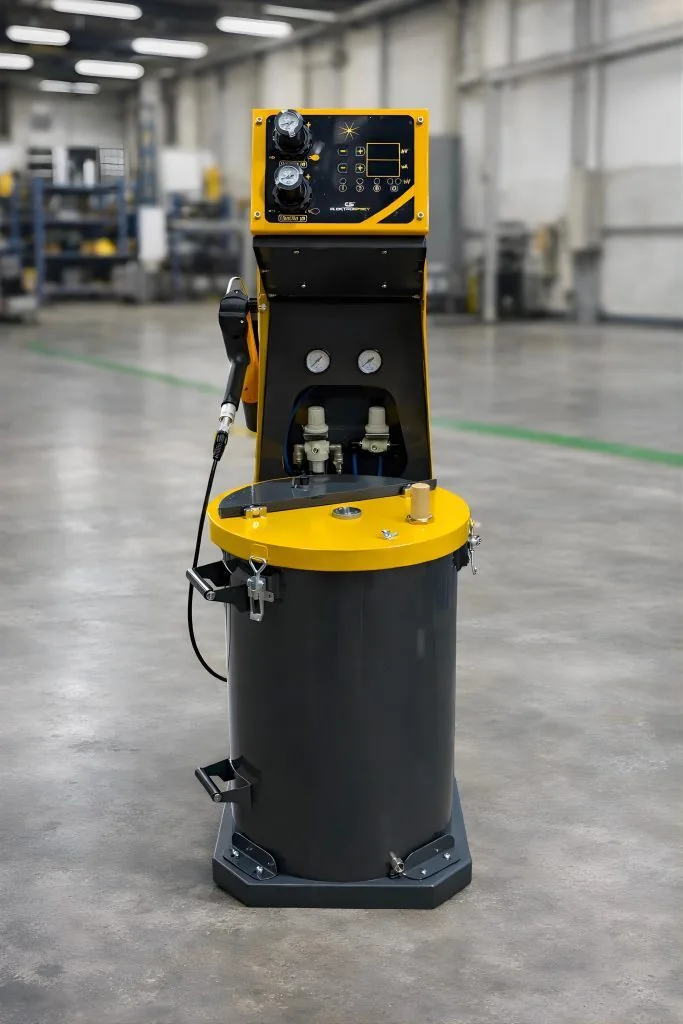
- Guns: They draw through two separate circuits — powder transport air and atomising/shaping air. Consumption per gun is fixed and grows linearly with gun count. On a manual unit the powder output is adjusted in the 0.5–10 l/min band; that is the flow of powder, not of air — do not confuse the two.
- Pulse-jet filter cleaning: The reverse pulses that clean the cartridges are short but demand a high instantaneous flow. It is not continuous consumption; it depends on the triggering frequency. As the filters load, the interval between pulses shortens, so the calculation must use the line at its most loaded condition.
- Fluidising: Low-flow air passes continuously through the porous plate at the bottom of the powder hopper. It never stops, and when it does, powder delivery breaks down.
- Pneumatic movements: Booth doors, colour change valves, conveyor stops, dosing pumps on the pretreatment line. Individually small, surprisingly large in total.
How is the air flow calculated?
The correct method is not picking a number from a catalogue but filling in a consumer table and adding it up. The table below is the data set we ask the customer for during engineering:
| Consumer | Draw type | Variable in the calculation | Note |
|---|---|---|---|
| Guns (2–12 units) | Continuous | Gun count × unit consumption | Automatic and manual guns counted separately |
| Pulse-jet filter | Pulsed | Pulse duration × valve count × trigger frequency | Taken for the dirty-filter scenario |
| Fluidising hopper | Continuous | Hopper area and powder type | Multiplied if there is a hopper per colour |
| Pneumatic valves/doors | Instantaneous | Movements per hour | Grows if colour changes are frequent |
| Pretreatment dosing pumps | Intermittent | Number of stages | Reviewed per stage |
| Losses and future margin | — | Safety margin on the total | Raised if line expansion is planned |
Once the total is known, two more things are decided: working pressure and simultaneity. On pressure the rule is simple — the pressure a gun needs must also be available at the furthest point of the line; what matters is the reading at the gun inlet, not at the compressor outlet. If the pipe diameter is undersized, the compressor looks adequate on paper while pressure collapses at the end of the run.
Simultaneity answers this question: can a pulse-jet burst and a colour change valve operate at the same moment? On a powder coating line the answer is usually yes. That is why sizing on "average consumption" is wrong; peak demand must be met, and the gap between peak and average must be buffered by the receiver tank.
Why must the air be dry and oil-free?
Powder coating material is a dry medium carried by an electrostatic charge. Two contaminants in the air transfer straight onto the surface:
Moisture. Condensed water agglomerates the powder particles, disturbs the even boil in the fluidising hopper and collects in the gun hose to produce erratic delivery. Worse, damp powder cannot hold its electrostatic charge; transfer efficiency falls and the behaviour of reclaimed powder changes. The insidious part is that moisture condenses not at the compressor outlet but at the far end of the cooling pipe run — so if you look for the problem in the compressor room, you will not find it.
Oil. Oil vapour from a lubricated piston compressor spreads through the whole network as sub-micron droplets. Oil reaching the substrate contaminates in an instant even a panel that has just passed the degreasing stage, and shows up as craters after curing. Building a 3–7 stage pretreatment line and then oiling the surface with your own compressed air is the most expensive way to sabotage yourself; for the pretreatment layout see how many pretreatment stages you need.
In what order is the dryer and filter chain built?
Air preparation is not a single device but a chain, and the order matters. Coarse contamination must be trapped before it reaches the fine filter, and the dryer must be protected from receiving liquid water:
| Order | Element | Function | What happens if skipped |
|---|---|---|---|
| 1 | Receiver tank | Buffers peak demand, collects first condensate | Compressor load-unloads constantly, moisture travels on |
| 2 | Aftercooler / water separator | Removes liquid water | Dryer is flooded, efficiency drops |
| 3 | Coarse particulate filter | Rust, dirt, solid particles | Fine filter clogs early |
| 4 | Dryer | Lowers the dew point | Condensation at line end, agglomerated powder |
| 5 | Oil separator / coalescing filter | Oil vapour and aerosol | Craters on the surface, adhesion loss |
| 6 | Activated carbon (if needed) | Residual oil vapour and odour | Staining risk on sensitive colours |
| 7 | Point-of-use regulator + filter | Final check at the gun inlet | Pressure differences between guns |
The dryer type depends on the ambient temperature of the plant and on where the pipe run passes. In buildings where the pipework runs along an outer wall or through a cold bay, the outlet dew point of a refrigerated dryer may not be enough, and a desiccant dryer comes into the picture. Let us state its downside too: a desiccant dryer costs more and consumes air for regeneration — meaning it must be added to the flow calculation as a consumer in its own right. Projects that skip this find the compressor undersized within a year.
How does wet or oily air show on the coated surface?
The symptoms that speed up diagnosis on site are well known. If the defect concentrates on a particular shift or on rainy days, the first suspect is the air line — not the booth and not the oven.
- Craters / fisheyes: Almost always oil. Point-like uncoated pits on the surface.
- Uneven film thickness: Damp powder disturbing fluidisation. The micron spread across one part widens.
- Interrupted delivery at the gun: Water pooled in the hose. The operator says "the gun keeps blocking"; in fact the line is wet.
- Falling reclaim efficiency: Agglomerated powder stays on the sieve, and the 95%+ reclaim expected from a filtered booth is not achieved.
- Longer colour change: Damp powder sticks to the booth walls and cleaning takes longer.
These are supply-line problems, not booth selection problems; but to separate the two you also need to know the normal values on the booth side — the 99.9%+ retention of the cartridge filter and the 0.5–0.8 m/s internal air velocity band. For that comparison, use the criteria list in choosing a powder coating booth.
How should the compressor room and distribution network be laid out?
The compressor is as much a layout question as the line itself. A compressor drawing intake air in a space with powder escape blocks its own filter quickly, so the compressor room is kept away from the booth and from any grinding or blasting area, and intake air is taken from the clean side. If the room ventilation is poor, intake temperature rises, the moisture load at the outlet increases and the dryer's job gets harder.
Three practical rules for the distribution network: run the main line with a slight fall in the direction of flow and put drains at the low points; take gun branches from the top of the main pipe (a branch taken from below carries accumulated water straight to the gun); and give every point of use its own regulator-filter set. These three rules cost nothing and solve half of the moisture problems on most installations.
If you are planning the layout as a whole, draw the compressor room together with the line; hunting for space afterwards lengthens pipe runs and creates pressure loss. For the overall approach, our umbrella reference is the powder coating plant setup guide.
Frequently asked questions
Will my existing workshop compressor be enough for a powder coating line?
Only a calculation will tell. Workshop compressors are usually chosen for intermittent use — hand tools, blow guns — while a powder coating line draws continuously. Count the guns, the pulse-jet valves and the trigger frequency, then compare the total against the real free air delivery of your existing machine. If it falls short there are two routes: a second compressor feeding in parallel, or a larger receiver tank to buffer the peak — which one is right depends on whether the shortfall is continuous or momentary.
Is an oil-free compressor mandatory?
No; what is mandatory is oil-free air, and you can achieve that either with an oil-free machine or with a lubricated compressor plus a correct coalescing filter chain. The second route is cheaper to install but demands discipline: if the filter elements are not replaced on schedule, the protection disappears and crater defects come straight back. If you are not confident about maintenance discipline, the oil-free type is the lower-risk decision over the life of the line.
Can we run without a dryer?
In the short term it may appear to work, especially in a dry season. But moisture in a powder coating booth reveals itself not immediately, but on the first warm humid day or at the far end of a cooling pipe run. A line without a dryer makes production dependent on the season. Treat the dryer not as a cost item but as the investment that keeps the scrap rate stable.
If I add more guns, do I have to enlarge the compressor as well?
Usually yes, because gun consumption grows linearly. The real surprise, however, is not on the gun side but on the filter side: more guns mean more powder entering the booth, the cartridge filter loads faster and the pulse-jet triggering frequency rises. Adding two guns therefore means slightly more air than two guns' worth. For our filtered powder coating booth, built in the 2–12 gun range, we work out the air demand together with the booth dimensions at the project stage.
Does air quality matter less when working with a manual unit?
The opposite — it becomes more visible. In workshops using a manual powder coating unit the operator feels interruptions and agglomeration in the powder flow instantly, whereas on an automatic line the problem is only caught at quality control. Putting a small water separator and regulator set at the very end of the line is one of the lowest-cost improvements available in manual application.
Summary
The compressed air requirement of a powder coating line is not selected from a catalogue; it is calculated by filling in a consumer table: gun count, pulse-jet trigger frequency, fluidising and pneumatic movements are added up, then simultaneity and a growth margin are applied. On the quality side there is no debate — the air must be dry and oil-free, the preparation chain must run receiver, water separator, coarse filter, dryer, oil separator, and every point of use must carry a final filter-regulator set. A plant that builds this chain makes moisture-driven defects independent of the calendar. If you want the whole line sized together, in our tunnel type powder coating plant projects we draw the compressor room and the air preparation network as part of the layout; every system we build is delivered with a 2 year manufacturer warranty.
Send us your gun count, your booth dimensions and the nameplate data of your existing compressor — we will work out the air demand together.