
Why Does Powder Recovery Drop Below 95%?
In a cartridge-filter powder booth, 95%+ recovery is the design figure; when the shop floor measures less, the cause is leakage, air velocity outside the band, filter condition or powder quality. This article covers how to measure the loss, the diagnostic order that separates the five causes, and how each fix shows up in the annual powder bill.
 Enlarge
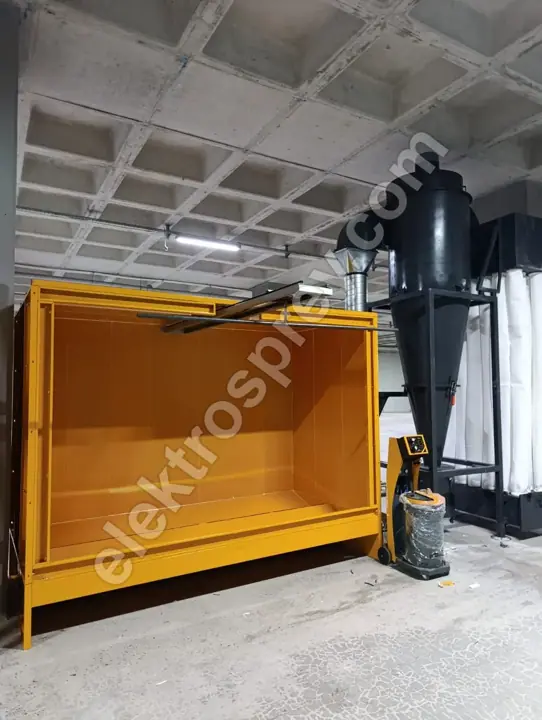
The reasons a powder coating recovery rate runs low are almost never the booth shell itself; they sit in four items around it: a leak path, booth air velocity drifting outside the 0.5–0.8 m/s band, a blinded or punctured cartridge filter, and reclaimed powder returned to the circuit without sieving. A cartridge-filter powder booth is designed for 95%+ recovery, with 99.9%+ capture at the cartridge. If the measured figure sits below that, the fault is in one of those four headings. Worked through in order, most cases close within a single shift without replacing any equipment.
One distinction first: recovery rate and filter efficiency are not the same number. Filter efficiency is how much of the powder in the extracted air the cartridge captures — 99.9%+. Recovery rate is how much of the sprayed powder returns to the circuit in a reusable state. Your filter can be capturing 99.9% while powder that missed the part escapes through an oversized booth opening into the shop. That is why, when the complaint is "recovery has dropped", the first place to look is the booth boundary, not the filter.
Why you should not touch anything before measuring the loss
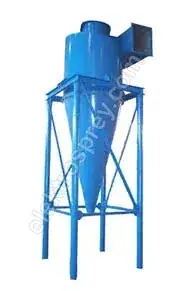
Recovery rate is not a number to be estimated. The simplest workable field method is a mass balance: weigh the virgin powder added to the circuit over one shift, then calculate theoretical consumption from the surface area coated and the average film thickness. The difference is what leaves the system. The exercise takes a day and gives you a hard figure in kilograms rather than the sentence "we are using too much powder".
The second measurement is booth air velocity. Take anemometer readings at no fewer than five points across the opening, not one, and compare the average with the 0.5–0.8 m/s band. Those two numbers — kilograms lost per shift and average velocity — carry the whole diagnosis. The measurement layout is set out in booth air velocity and powder escape.
Five causes and the order to check them
| Order | Cause | Field symptom | How to confirm | Cost to fix |
|---|---|---|---|---|
| 1 | Leakage | Powder settling on the floor and walls around the booth, on operator clothing | Smoke test, visual check of doors and seals | None – low |
| 2 | Velocity outside band | Reading above 0.8 m/s or below 0.5 m/s | Five-point anemometer survey | None – low |
| 3 | Filter condition | Differential pressure permanently high, or abnormally low | Differential pressure log | Low – medium |
| 4 | Powder quality / sieve | Reclaimed powder will not flow, lumps present | Sieve mesh and fluidisation check | Low |
| 5 | Colour change routine | Loss spikes at specific colour transitions | Powder discarded per colour change | Medium |
Do not break this order. The most common mistake is skipping items one and two and going straight to a new filter cartridge — a new cartridge does not bring back powder escaping through the opening.
1. Leakage: the largest and least visible loss
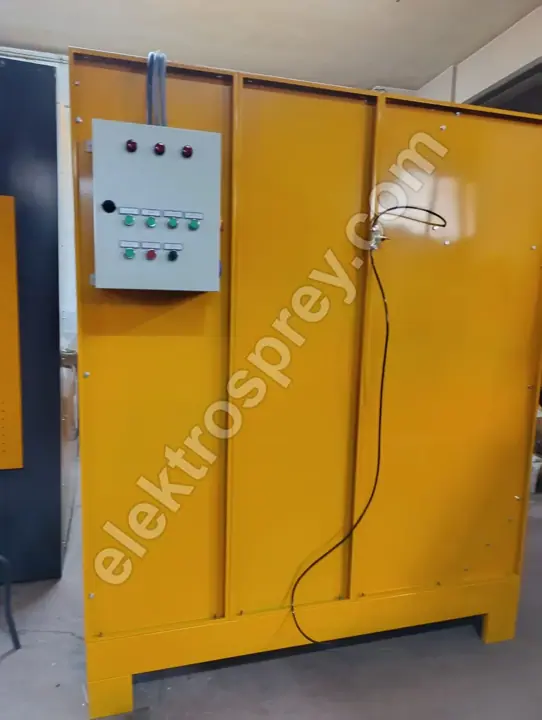
Every gram that leaves the booth comes straight off the recovery rate. The leak points are almost always the same: a part opening larger than the work requires, a worn door seal, a service hatch not fully closed after maintenance, a slack clamp on the reclaim duct, and the hopper lid. Powder settling on the floor and on horizontal surfaces outside the booth is the most honest indicator you have.
Opening size is a design decision, not a running adjustment. The booth is built around the customer's largest part; an opening far bigger than the work makes life easy on day one and loses powder every shift thereafter. Openings enlarged later do the same. If you are still selecting a booth, decide the opening, the gun count (2–12 guns) and the part geometry together; the criteria are listed in choosing a powder coating booth.
2. Air velocity drifting out of the band
The 0.5–0.8 m/s band is not arbitrary: the lower limit is set to keep powder inside the booth, the upper limit to avoid stripping freshly deposited powder off the part. Deviating from either end has a different consequence, and both lower recovery.
| Deviation | Typical cause | Effect on recovery | Side effect |
|---|---|---|---|
| Below 0.5 m/s | Blinded filter, slack fan belt, blocked duct | Powder escapes the booth into the shop | Safety and ATEX exposure |
| Above 0.8 m/s | Fan setting left up after a filter change, damper left open, oversized fan | Fresh powder pulled off the part, gun efficiency falls | Thinner film, higher consumption |
| Uneven across points | Some filters blinded, duct balance lost | One side of the booth leaks continuously | Local film thickness variation |
If velocity sits at the top of the band, the job is not to throttle the fan but first to find why it rose. Forgetting to restore the fan setting after a filter change is the single item we see most often on site.
3. Filter condition: two different faults, one result
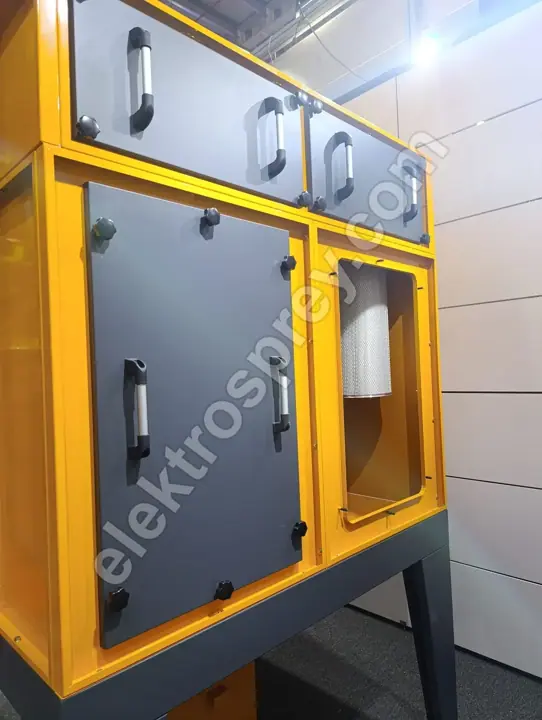
A cartridge filter captures 99.9%+, but only while it is intact. Filter-related recovery loss comes in two forms. The first is blinding: differential pressure permanently high, flow down, velocity falls below the band and powder escapes the booth. The second is a puncture or badly seated gasket: differential pressure is abnormally low, air passes freely, but powder carries to the clean side and the fan — the loss goes straight up the stack. Powder traces in the clean-side duct confirm the second case.
This is why a differential pressure log beats guessing when to touch the filter. Setting the pulse-jet cleaning itself is a separate subject; what matters in this diagnosis is not the setting but whether the cartridge is intact and correctly seated. To assess the booth shell and filter group together, the checklist in choosing a powder coating booth is the right starting point.
4. Powder quality and sieve discipline
Reclaimed powder does not flow like virgin powder. With each pass the fine fraction rises a little, moisture and oil in the compressed air cause lumping, and a blocked sieve lets coarse particles back into the circuit. The result is uneven fluidisation, unstable output and powder that will not hold on the part — meaning a larger share of what is sprayed goes back to the circuit rather than onto the work, degrading a little further each turn.
The practical rule: put the virgin-to-reclaim mix ratio in writing, check the sieve mesh at the start of each shift, and add the compressed air oil and moisture traps to the maintenance list. To compare how the feed arrangement affects consumption, see box-fed or box-free powder feed.
5. Colour change and cleaning losses
In some plants the loss is not daily but concentrated at colour transitions. If powder left in the hopper and lines is discarded at every change, the annual average recovery rate falls even when the booth is faultless. This item is a design matter: a booth built for fast colour change loses less, and on a multi-colour line simply sequencing from light to dark makes a measurable difference on its own. For volume production we account for this from the start when planning a tunnel type powder coating plant.
Turning the loss into money
Until the percentage becomes kilograms, you cannot decide which fix comes first. Roughly: every point lost from the recovery rate raises the powder you must buy for the same output by that proportion. A system that has slipped from 95% to 85% consumes visibly more powder for identical work, and that difference dwarfs the cost of closing a leak or replacing a seal. This is why items one and two always pay back fastest: neither usually requires any material spend at all.
Frequently asked questions
How is the recovery rate measured on the shop floor?
By mass balance. Weigh the virgin powder added over one shift and calculate theoretical consumption from the coated surface area and the average film thickness; the difference is the loss. One shift is not enough — average at least three. Any intervention made without this measurement is guesswork.
If the cartridge captures 99.9%, why is recovery below 95%?
Because the two figures measure different things. Filter efficiency is the share of powder captured from the air that reaches the filter. Recovery rate is the share of sprayed powder returned to the circuit in usable condition. Powder escaping through the opening, discarded at a colour change or held back at the sieve never reaches the filter at all; it reduces recovery, not filter efficiency.
What happens if booth air velocity sits above the 0.5–0.8 m/s band?
The booth pulls harder, so leakage falls — but freshly deposited powder is stripped off the part. The result is thinner film, more passes and higher powder consumption. Raising velocity solves the escape problem while enlarging the consumption problem. The correct approach is to hold velocity inside the band and close the leaks mechanically: seals, opening size, hatches.
What ratio of reclaimed to virgin powder should I run?
There is no single correct ratio; it depends on the powder type, the colour and the part geometry, and is set together with the powder manufacturer's data sheet. The deciding factor is discipline rather than the number: never return powder to the circuit unsieved, keep the ratio recorded, and review the mix whenever fluidisation turns uneven.
Will a new booth raise the recovery rate?
Yes if the measurements say so, no if they do not. Where the existing shell is sound, the openings suit the part and velocity sits inside the band, the problem is not the booth — it is a seal, a filter or powder discipline. Replacement is the right call only when openings are far larger than the work, when the shell geometry structurally prevents recovery, or when capacity has grown. Every cartridge filter powder booth we build is dimensioned around the customer's largest part; there is no catalogue size, and it ships with a 2-year manufacturer warranty.
Summary
Recovery rate is not a figure on a nameplate; it is the operating discipline of the whole system. When it falls below the 95%+ design value the order is fixed: leakage first, then the 0.5–0.8 m/s velocity band, then filter integrity, then powder quality and sieving, and last the colour change routine. The first two items close most cases and cost close to nothing. Replacing a filter, or a booth, belongs on the table only when a measured loss figure refuses to close with those fixes.
Send us your powder consumption per shift, your air velocity readings at the booth opening and your differential pressure log — we will work out together which item the loss is coming from.