
How to Set Pulse-Jet Cleaning Pressure and Interval
Reverse-pulse filter cleaning is set by three values together: tank pressure, pulse duration and trigger interval. Get one of them wrong and you either blow the cartridge out early or run the plant with a blinded filter. This article explains which measurement sets each value and in what order to commission them.
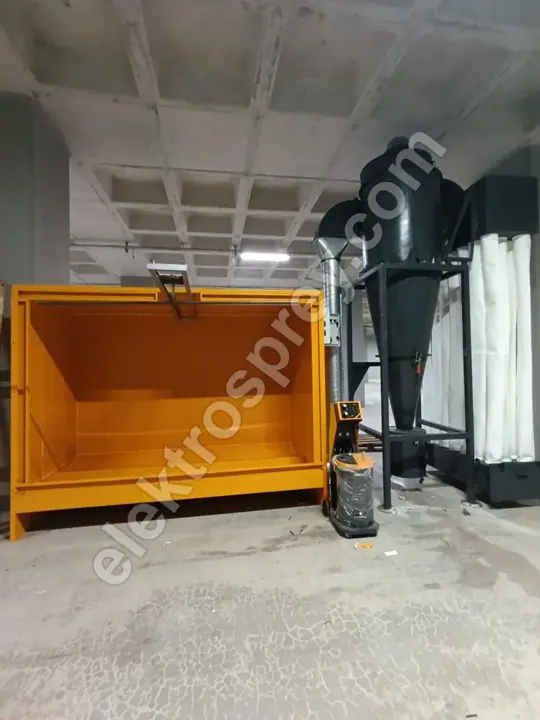 Enlarge
Pulse jet filter cleaning pressure in a powder coating booth is never set from a catalogue figure; tank pressure, pulse duration and trigger interval are established together. Our starting point on site is 4–6 bar on the tank side and a pulse duration in the 80–150 ms band, with triggering driven by the differential pressure across the cartridge rather than by a clock. Set correctly, a booth holds its cartridge filter at 99.9%+ capture efficiency for its whole service life and never drops below 95%+ recovery. Set wrongly, it ends at one of two extremes: the cartridge is punctured early, or the plant runs blinded and internal air velocity falls below the 0.5–0.8 m/s band.
This article is not about when the filter should be replaced but about the mechanism that keeps it clean. Replacement timing is a separate, measurement-driven decision, covered in cartridge filter life and replacement timing.
What a pulse-jet actually does
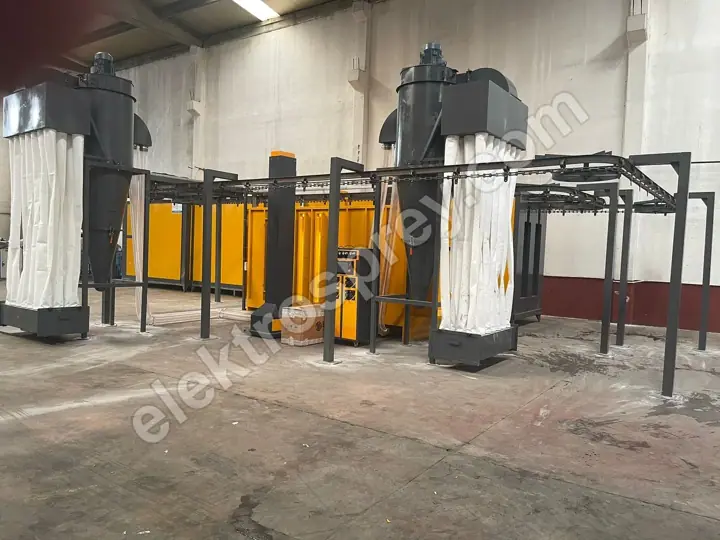
Reverse-pulse cleaning does not "blow the filter out". The solenoid valve opens for a few milliseconds, tank air propagates from inside the cartridge outwards as a sudden pressure wave, and the media flexes for an instant in reverse. The dust cake cracks with that movement and falls. The work is done by the rate at which pressure rises, not by air volume.
That distinction decides everything. A long, low-peak pulse wastes air, fails to crack the cake, and throws the released powder back into the booth instead of the recovery hopper. A short, steep pulse moves the media properly on far less air. Your target is not "more air" — it is keeping the pulse steep.
There is also no single correct number. The optimum changes with cartridge count, tank volume, header diameter, valve type and the character of the powder, so we set these values by measurement during commissioning; we build no catalogue sizes, and the cleaning regime is built to the booth's own dimensions.
Tank pressure: where in the band to run
| Tank pressure | Cake release behaviour | Effect on the cartridge | When it is appropriate |
|---|---|---|---|
| Below 3.5 bar | Cake partly stays, ΔP climbs | Almost none | Only with fine, dry, non-tacky powder |
| 4–5 bar | Sufficient for most powder formulations | Low fatigue, long life | Default band in standard production |
| 5–6 bar | Effective on heavy cake, high throughput | Seam and gasket fatigue rises | Intensive shifts, high powder load |
| Above 6 bar | Almost no gain | Media rupture, early failure | Not used outside a setting error |
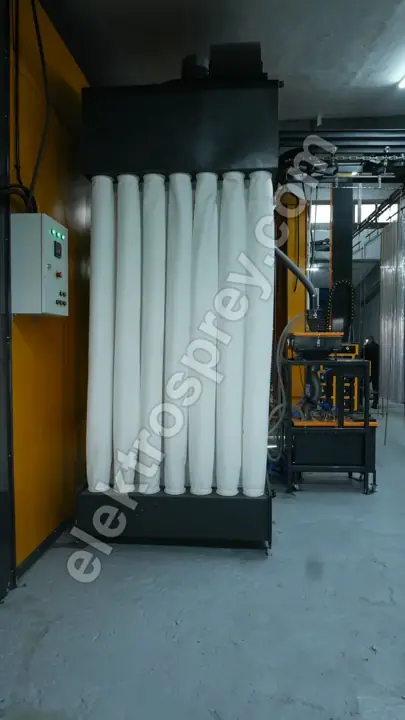
Before climbing to the top of the band, check one thing: sagging pressure usually points not at the tank but at the air preparation. Compressor capacity, line diameter, pressure loss along a long header, the state of the moisture trap — until those four are corrected, raising the bar setting only tires the filter. Every pulse through a line that passes oil leaves a film inside the cartridge, and after that the cake never releases at all.
Pulse duration and interval are two different settings
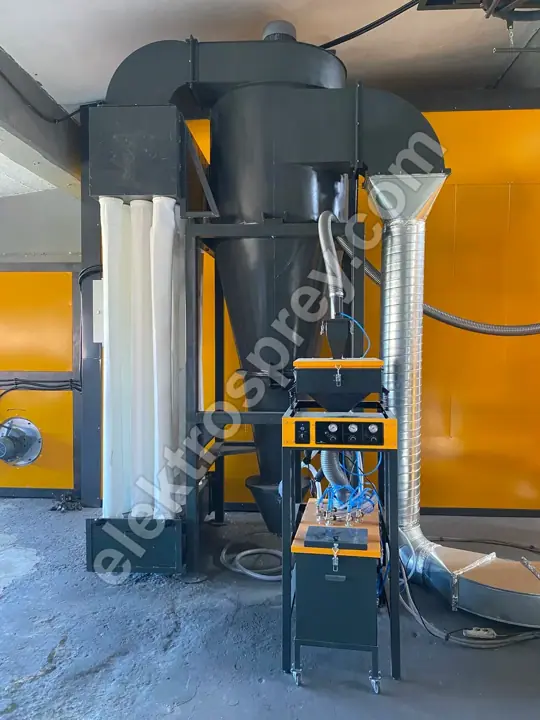
These two are most often confused on the shop floor. Pulse duration is how long the valve stays open, in milliseconds; the typical band is 80–150 ms. Interval is the wait between pulses, in seconds. Extending the duration does not improve cleaning, only air consumption; the interval is the variable that matters.
| Parameter | Typical band | Increasing it | Decreasing it |
|---|---|---|---|
| Pulse duration | 80–150 ms | Air consumption rises, no gain | Cake not fully cracked, ΔP climbs |
| Valve-to-valve interval | 6–30 s | Cake thickens, ΔP rises | Media fatigues, powder thrown into the booth |
| Cycle repetition | Tied to the ΔP threshold | Filter stays blinded longer | Virgin powder is recirculated for nothing |
| Tank recovery time | Measured per valve | — | Next pulse weak, cleaning half done |
Watch tank recovery time. If the tank cannot refill while valves fire in sequence, the third pulse does half the work of the first. Watch the gauge during a cycle: if pressure drops several bar per pulse and does not recover, lengthen the interval or enlarge the air preparation.
Trigger logic: clock or differential pressure
What starts the cleaning cycle is a more important decision than the pressure value itself.
| Trigger method | How it works | Strength | Weakness |
|---|---|---|---|
| Fixed timer | Fires on a constant interval | Simplest to commission | Fatigues a clean filter, wastes air |
| Differential pressure (ΔP) | Runs between a low and a high threshold | Extends filter life the most | Requires a calibrated ΔP sensor |
| Hybrid | ΔP led, with a safety timer behind it | Line keeps running if the sensor fails | Wrong thresholds erase the benefit |
| End-of-shift (offline) | Full cycle, fans stopped | Drops the cake into the hopper | Not sufficient alone |
The correct set-up is usually hybrid: clean until ΔP falls to the low threshold, restart when it crosses the high one, and add a full cycle at end of shift with the fans off. Part of the cake released while the fan runs simply re-attaches to the cartridge — that is what the offline cycle is for. Setting those thresholds and taking the day-one baseline is covered in tracking booth filter differential pressure.
The two extremes of a wrong setting
A setting error shows up as two opposite pictures, and the remedies are the reverse of each other.
Over-cleaning: pressure high, interval short. Symptoms are early wear at the bottom of the cartridge, a visible powder cloud in the booth, rising air consumption and a ΔP lower than it should be. The cartridge never gets to hold the protective first layer of cake — and that thin layer is part of the filter. An over-cleaned filter drives more powder into the pores and, paradoxically, blinds faster.
Under-cleaning: ΔP permanently high, the fan straining, powder escaping the booth opening, internal air velocity below the 0.5–0.8 m/s band. Operators report this as "the extraction got weaker". Check the ΔP thresholds and whether the valves fire at all — usually the culprit is a failed coil or diaphragm, not the cartridge.
Commissioning order
- Verify compressed air quality: moisture trap, oil separator, line diameter, compressor capacity.
- Set tank pressure mid-band and start pulse duration at the short end.
- With the booth empty and fans running, record the baseline ΔP — your reference for the life of the filter.
- Follow the ΔP curve through a full shift of normal production and place the thresholds on that curve.
- Fire each valve individually and note the drop on the tank gauge; a valve that does not fire is not idle — it loads its neighbour.
- Put the settings in writing on the booth. A setting changed between shifts cannot be measured.
The sequence is identical in a single-booth workshop and in an automatic booth inside a tunnel type powder coating plant; only there the line cannot stop mid-production, so the offline cycle moves to end of shift.
Frequently asked questions
What pressure should a pulse-jet run at?
For most powder formulations the starting band is 4–6 bar, and 4–5 bar is usually enough. The exact value is set by measurement against cartridge count, tank volume and powder tackiness. Going above the band does not improve cleaning; it fatigues media and gaskets. If the cake is not releasing, look first at air preparation and at whether the valves fire.
How often should the cleaning cycle be triggered?
Quoting a fixed number of minutes is wrong, because production intensity sets the interval. Tie triggering to differential pressure and start the cycle at the high threshold. On a busy shift that may be several times an hour; on a slow one, once every few hours. Both are correct, because the decision rests on a measurement.
Why does a cartridge fail in its first year?
Three causes dominate: pressure held above the band, an unnecessarily short interval, and moisture or oil in the compressed air. All three fatigue the cartridge mechanically and chemically. Failure is usually not a product defect but a cleaning-regime setting error, and the wear pattern at the bottom of the cartridge is the clearest evidence.
Should cleaning run while the booth is working or after it stops?
Both are needed. Short ΔP-controlled cycles during production keep the filter usable; a full cycle at end of shift with the fans stopped is what actually drops the cake into the hopper. Where booths rely on online cleaning alone, powder leaves one cartridge and attaches to the next, and ΔP eventually stops recovering.
Does a colour change alter the cleaning settings?
It does not alter them, but it adds a cycle. The aim during a colour change is not to thin the cake but to leave no trace of the previous colour on the cartridges or the booth surfaces, so a full cycle with the fans off is combined with a body clean-down. On lines that change colour often, cartridge layout and booth geometry are chosen for that need too; the criteria are collected in choosing a powder coating booth.
Summary
Setting a pulse-jet means establishing three numbers together: tank pressure in the 4–6 bar band, pulse duration in the 80–150 ms band, and triggering by differential pressure rather than by a clock. Over-cleaning punctures the cartridge, under-cleaning chokes the line, and the point between them is only found with a baseline ΔP measurement. Put the settings in writing, verify the valves one by one, run an offline cycle at end of shift. The cartridge filter powder booth we build takes 2–12 guns and is dimensioned to the customer's largest part; its cleaning regime is established during commissioning from that booth's own measurements, and it carries a 2-year manufacturer warranty.
Send us your booth's ΔP log, tank pressure and valve firing sequence — we will work out where the regime has drifted.