
Building a Powder Coating Plant From Scratch: The Order of Decisions
Building a plant does not start with choosing machines. The order is: part, capacity, space, pretreatment, oven, booth, shipping and commissioning. This guide shows which decision locks which, and sends you to the article where each calculation is worked out in full.
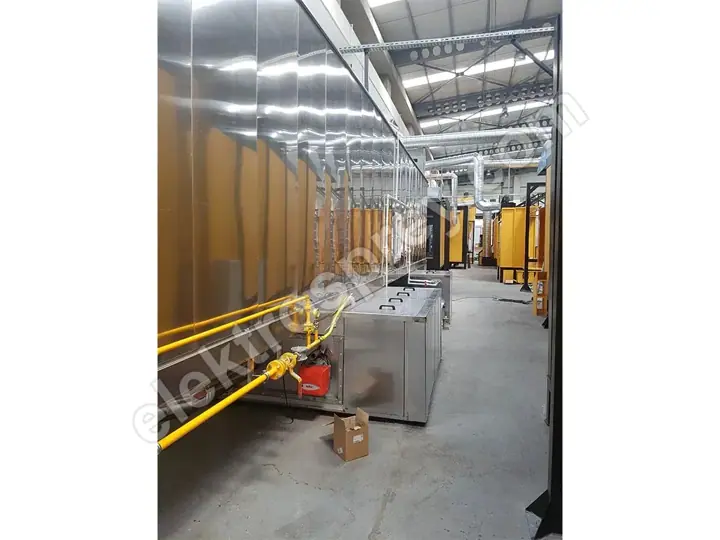 Enlarge
Building a powder coating plant does not start with choosing machines. The order is: (1) part, (2) capacity, (3) space, (4) pretreatment, (5) oven, (6) booth, (7) shipping and commissioning. The reason, in one sentence: every decision on this list sets the size of the one after it and cannot change the one before it — an investor who breaks the order and buys the oven first later finds out that the part does not fit it, or that the building's ceiling is too low, and pays a second time.
We have been manufacturing these machines for twenty-five years, and almost every failed investment we see on site fails for a sequencing reason, not a technical one. This article is a map, not an encyclopaedia: for each step, the decision to make, the mistake most often made there, and the article where the full calculation lives.
The order of decisions
| # | Step | Decision to make | If taken out of order | Detail |
|---|---|---|---|---|
| 1 | Part | Largest part, heaviest part, thickest section, material, how it hangs | Every dimension is calculated from the wrong base; the whole plant is resized | This article |
| 2 | Capacity | Parts per hour/shift, conveyor speed, hanger spacing | The line either runs half empty or hits a bottleneck; oven length does not match | capacity calculation |
| 3 | Space | Layout, turning radius, ceiling height, service clearance | The machine fits, the maintenance space does not; a building cannot be raised | space and layout |
| 4 | Pretreatment | Stage count, dip line or spray tunnel, water and effluent | Coating does not bond; the defect arrives in month six, lifting from the edge | how many stages |
| 5 | Oven | Volume, electric or gas, kW / kcal, uniformity | Contracted capacity or gas supply falls short; the energy bill becomes permanent | electric or gas |
| 6 | Booth | Filter or cyclone, gun count, colour change | Colour changes eat the shift; coating efficiency drops | booth selection |
| 7 | Shipping and commissioning | Module split, crane, door opening, infrastructure readiness | The truck waits on site; installation stops until services are ready | shipping and transport |
1. Part: every dimension comes from here
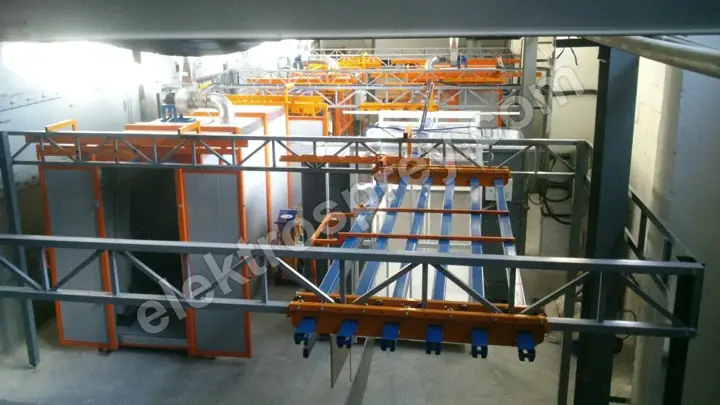
The decision here is not a machine but a set of dimensions: the length-width-height of the largest part you will coat, the weight of the heaviest one, the thickest section, the material (steel or aluminium), and whether the part hangs horizontally or vertically. We have no catalogue sizes; oven, booth and pretreatment are all manufactured on top of that set.
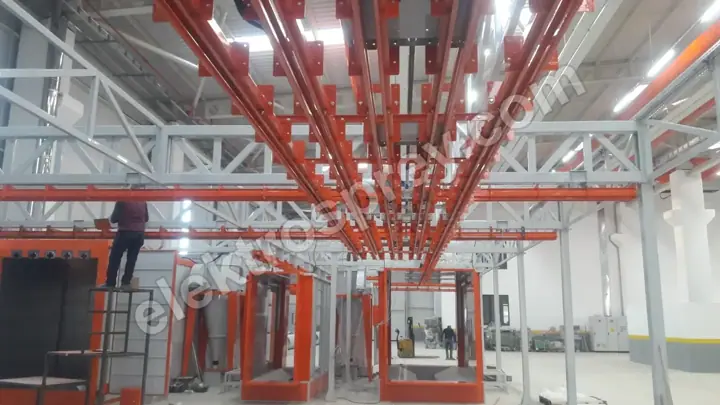
The most common mistake is writing down "whatever I coat today". A plant is a ten-year investment; a line sized to today's part is the reason you turn away the longer job that arrives two years later. The right basis is not the current part but the largest part of the work you intend to move into — an extra metre of oven volume is cheap at the point of investment and impossible afterwards.
The second mistake is skipping material. Aluminium profile demands a completely different line concept from sheet metal parts: 3–7 m profiles, vertical hanging, colour change under 20 minutes. For that work the right address is the aluminium U-type powder coating line; for mixed sheet metal, the tunnel type powder coating line.
2. Capacity: the part sets the speed of the line
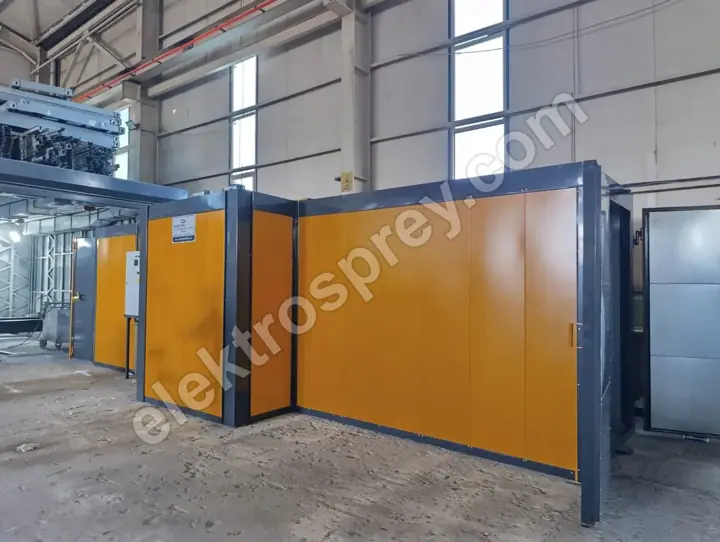
The decision is not "how many parts per hour" but how many of which part per hour. The same line gives one number when four parts fit on a hanger and a quarter of it when only one does. Our conveyors run at 1–6 m/min and our tunnel lines cover 500–5,000 parts/hour — and where in that range you land is decided by your part, not by the line.
The most common mistake is trying to solve capacity by raising conveyor speed. Raise the speed and the part's time in the oven shrinks; a part that falls off the curing curve is under-cured. The real ceiling on capacity is not conveyor speed, it is oven length. How conveyor speed, hanger spacing, parts per hanger and oven dwell lock each other — with worked examples for three part sizes — is set out step by step in powder coating line capacity calculation; the whole calculation is there.
3. Space: the constraint is usually ceiling, not floor area
The decision here is the layout: the route of the line, the conveyor's turning radius, the distance between sections and the service clearance around every machine. The output is not a drawing but an answer about your building: is it enough, and if not, what has to change.
The most common mistake is drawing the layout to machine dimensions. A machine's dimension is not the dimension it works in; it needs room around it for filter changes, fan maintenance, tank cleaning and door swing. The second and more expensive mistake is leaving ceiling height to the end: the moment a part hangs vertically the requirement turns from square metres into metres, and a building can be extended sideways but not raised. Section-by-section area tables, the difference between a box oven and a tunnel line, and why a U-type layout saves floor are in powder coating plant space and layout.
4. Pretreatment: where quality is actually decided
The decision is stage count and method: 3 stages or 7, dip line or spray tunnel. It comes not from your budget but from how dirty the part arrives and how long the coating has to survive. Clean sheet metal staying indoors and profile going out into salt and moisture do not want the same line.
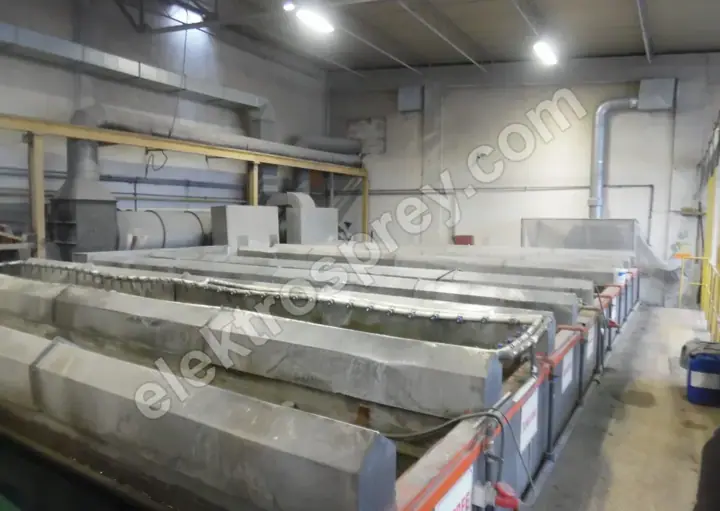
The most common mistake is cutting pretreatment to afford a bigger oven. The oven cannot rescue coating that has not bonded to the surface — it blisters in a perfectly cured state. The deceptive part is that the bill does not arrive on day one; it arrives in month six, at the edge where the paint lifts. What each stage does, what a skipped stage costs and how stage count relates to salt spray resistance is in pretreatment: 3 stages or 7; for the system itself, the dip type surface treatment line.
5. Oven: volume, energy source, uniformity
Three decisions here: volume (part plus circulation clearance), energy source (electric or gas) and the quality side (uniformity and control). Our box type electric ovens are built at 80–250 °C, 3–150 kW, ±3 °C uniformity and 16 curing profiles; our top-loading gas ovens at 140–220 °C and 50,000–500,000 kcal/h.
The most common mistake is reducing the decision to the electric-versus-gas argument alone. Gas really does run at 30–40% lower energy cost than electric, but that ratio does not apply to everyone; what decides it is your daily running hours and your infrastructure. The second mistake is choosing an electric oven without checking contracted electrical capacity — if the transformer is short, that cost lands inside the investment. The third is treating uniformity as a detail: defects that cluster in one region of the load have the oven as their address.
Three separate depths: for the choice, electric or gas; for running cost, oven energy consumption; for quality, ±3 °C uniformity. Before comparing quotations, read the 7 items that set oven price. Product side: box type electric oven and top-loading gas oven.
6. Booth: the number of colours decides it
The decision starts with the type: filter, cyclone or combined. One question settles it — how many colours will you change per day. A single-colour workshop is fully served by a filter booth with 95%+ recovery and 99.9%+ cartridge filtration; in a plant changing colour more than once a day the deciding factor is not coating performance but colour change time. Gun count (2–12) and booth opening are calculated after that decision.
The most common mistake is assuming a cyclone is automatically better. It costs more, takes more floor and needs a bigger fan; in a single-colour workshop that investment never returns. The second mistake is ignoring internal air velocity: a booth outside 0.5–0.8 m/s either fails to contain powder or pulls it off the part. Comparison tables and the ATEX/CE side are in choosing a powder coating booth; products are the cartridge filter powder booth and, if you will also do wet paint, the water curtain wet paint booth. Starting small, a manual powder coating unit can be the first step.
7. Shipping, installation and commissioning
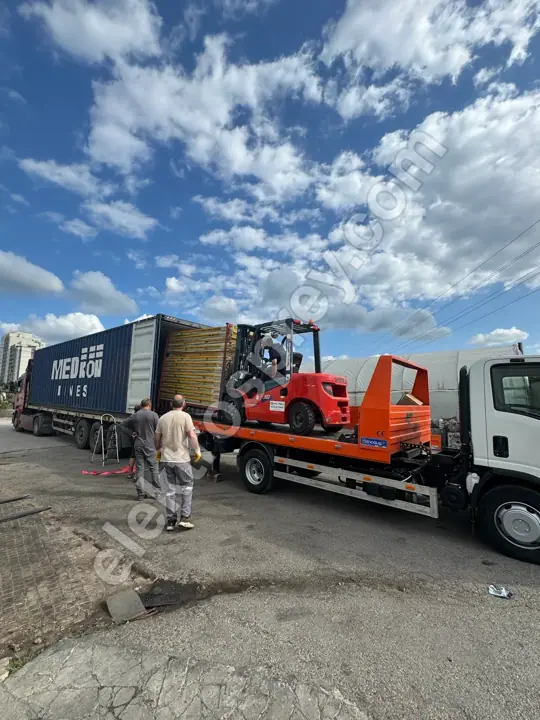
The decision here is really a readiness list: how the modules will be split, what crane capacity comes to site, whether the building's entrance opening is wider than the largest module, and whether power, gas and water will be ready before installation starts. A plant is never shipped in one piece; it is split into modules, numbered, and rebuilt on site with the same numbers.
The most common mistake is treating shipping as something to think about once the machines are finished. If the entrance opening does not fit, the module split plan changes before shipping, not after. The second mistake is starting infrastructure work after the installation team lands — that means a truck waiting on site and an installation standing still. Container versus flat rack, routes, the A.TR certificate and what the Incoterm changes are in shipping a powder coating plant.
Project timeline
Durations vary with project size, part dimensions and above all site condition; we do not put weeks or months here. What does not vary is the order and who prepares what.
| Stage | What happens | What is expected from whom |
|---|---|---|
| Dimensions and requirement | Part dimensions, capacity target and building drawing are collected | Customer: largest/heaviest part, daily quantity, building dimensions and ceiling height |
| Technical clarification | Stage count, oven volume, booth type and line route are settled | Manufacturer: layout plan and technical specification · Customer: approval |
| Manufacturing | Bodies, control cabinets and conveyor are built and assembled in the factory | Customer: starts site preparation in parallel |
| Site preparation | Floor, power and contracted capacity, gas line, water/effluent, stack, crane access | Customer: infrastructure works — these are not inside the machine quotation |
| Shipping | Modules numbered, ISPM 15 packed, loaded into container or onto flat rack | Customer: entrance opening, crane, interim storage area |
| Installation | Modules joined on site, conveyor and services connected | Manufacturer: installation team · Customer: ready infrastructure and access |
| Commissioning | Heat-up test, uniformity and air velocity measurement, first part | Manufacturer: measurement record and curing profiles |
| Training and warranty | Operator training, maintenance plan, 2-year manufacturer's warranty | Customer: a settled operator team |
When should budget be discussed?
Budget is not outside the seven steps; it is discussed immediately after steps one and two. The reason is simple: the price of the machines is not the cost of the plant. Alongside equipment sit the transformer and contracted capacity, gas subscription, stack, floor, compressed air line and effluent connection; these do not appear in the quotation, and they are usually the items that break the budget in the first three months. The full list and the questions to ask when comparing quotations are in powder coating plant cost.
Frequently asked questions
Where do I start when building a plant?
With the part. Until the dimensions of your largest part, the weight of your heaviest one and your daily quantity are settled, no machine can be sized correctly. Starting machine research before those three exist means making the most expensive decision to reverse at the earliest possible moment.
Should I choose the oven or the booth first?
The oven. The oven locks both the building and the budget — through volume and through infrastructure (contracted capacity or a gas line) — while the booth stays flexible according to colour count. And because oven dwell sets the ceiling on capacity, booth gun count is calculated after the oven decision.
Can I start with a small workshop and scale up later?
Yes, provided you say so at step one. Starting with a manual unit and a box oven and moving to a continuous line later is a common path; the condition is that the layout plan reserves the route the future line will take. What makes scaling difficult is never the machine — it is the space that was not left empty.
How long does plant installation take?
It varies with project size, part dimensions and, most of all, site preparation; giving a fixed duration would be dishonest. What usually sets the schedule is not manufacturing but the customer-side infrastructure work — installation cannot start before power, gas, floor and stack are ready.
Can powder coating be done without pretreatment?
Technically the coating sticks; in practice it does not stay. On an oily or oxidised surface it lifts within months. Even at minimum you need a 3-stage line with degrease, rinse and dry; anything below that produces work you cannot give a warranty on.
Summary
The order is this, and it does not reverse: part → capacity → space → pretreatment → oven → booth → shipping and commissioning. Each step sets the size of the next; a skipped step is always paid for twice. This guide is a map — under every heading, the full calculation sits in the article we link to.
We have no catalogue sizes: oven, booth and pretreatment are all manufactured around your largest part and delivered with a 2-year manufacturer's warranty.
To start, send us three things: the dimensions of your largest part, the weight of your heaviest part and your daily part quantity. With those we can work out capacity, oven volume and whether your building is enough.