
Which Booth Design Detail Decides Your Colour Change Time?
Colour change time in a powder coating booth is set by the enclosure itself, not by operator speed: internal surface finish, corner radius, floor slope and filter access decide it. This article explains which design details to specify at order stage and how each one shortens the changeover.
 Enlarge
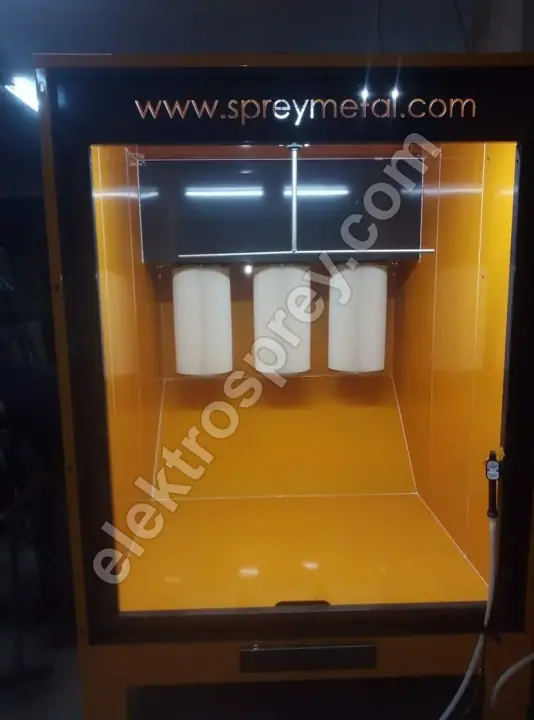
How many minutes a powder coating booth colour change takes is decided long before the operator picks up an air gun: by four details fixed on the drawing — internal surface smoothness, corner radius, floor slope and access to the filter and cyclone. On our aluminium profile U-type lines the colour change is completed in under 20 minutes. Attempt the same job in a booth with blind square corners, a flat floor and a filter reachable only after unscrewing a panel, and the time multiplies. The difference comes from questions that were never asked on the order form, not from a brand name.
Colour change is not a catalogue feature; it is a consequence of geometry. Wherever powder can cling, cleaning takes that much longer. So this article does not claim "this booth cleans in X minutes". It explains which way each design decision moves the clock and why. The right target depends on your colour count, batch size and shift pattern.
Why changeover time is a capital decision
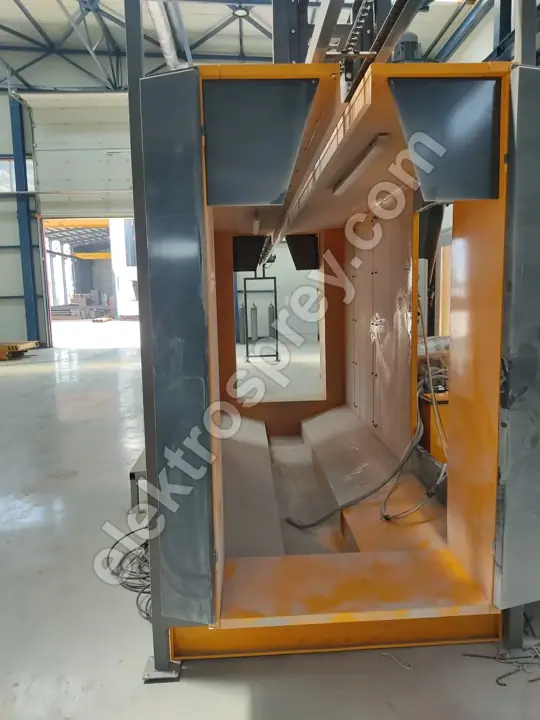
A colour change is time the line stands still without producing. A plant changing twice a day stops a few hundred times a year; a profile line changing six times a day approaches a thousand. A detail waved through at order stage because "the operator will manage" turns into a serious capacity loss across a ten-year service life.
Put changeover into your capacity model as its own non-productive line item. Capacity plans that ignore it do not survive contact with the shop floor; the method is built step by step in powder coating line capacity calculation. In short: as the number of colours rises, booth design outranks line speed as a priority.
The four design decisions that set the clock
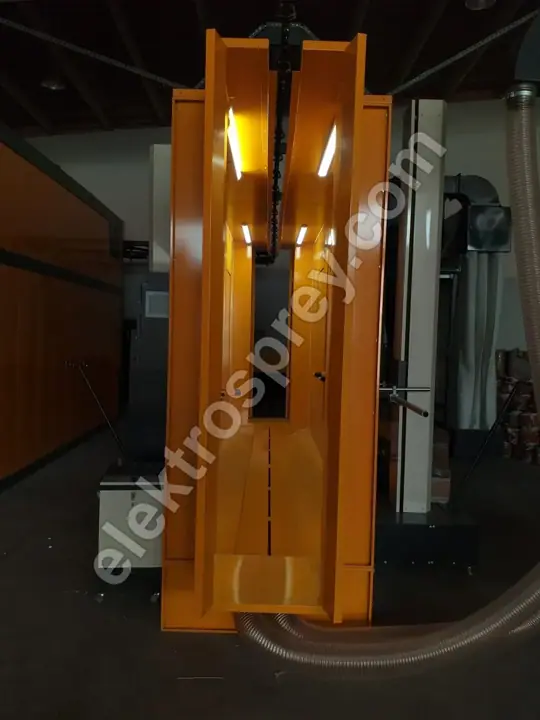
| Design detail | Poor solution | Good solution | Effect on time |
|---|---|---|---|
| Internal surface | Painted sheet, exposed weld seams | Smooth, seamless or ground surface, antistatic plastic panel | Wipe-down time drops noticeably |
| Corner geometry | 90° sharp corner | Wide radius transitions, no blind spots | Powder build-up is eliminated |
| Floor | Flat floor, swept by hand | Sloped or V-shaped floor directed to extraction | Manual collection step largely disappears |
| Powder separation | Single stage straight to the cartridge filter | Pre-cyclone (monocyclone) plus cartridge | Faster transition to a virgin colour |
| Filter access | Bolted cover, tools required | Quick-release frame, clamps, latches | Removes minutes of tool time |
| Feed hopper | Fixed hopper wired into the line | Separate hopper on a trolley, one per colour | Hopper cleaning no longer holds the line |
This is a checklist, not a ranking. All six can be solved in the same booth — but none of them appear on their own unless they are written into the order.
Surface finish and corner radius
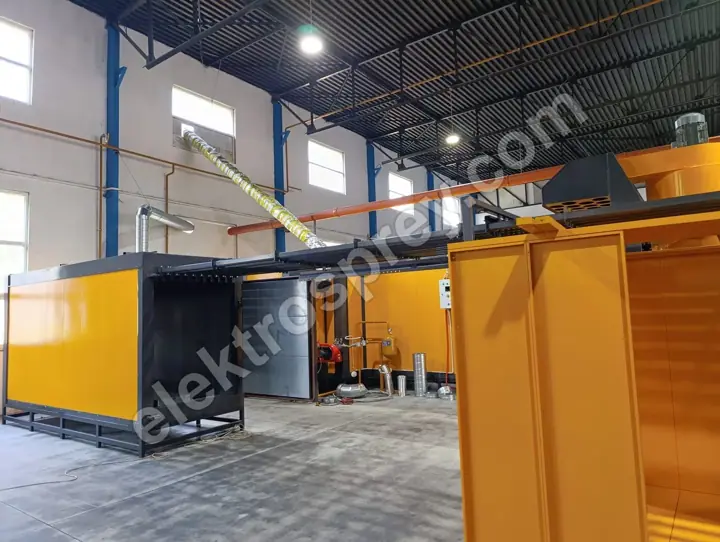
Powder adheres electrostatically, not mechanically. A rough surface, a proud weld bead or a bolt head makes it harder for powder to release. The more continuous the internal surface, the shorter the clean-down with compressed air and a cloth.
The same logic governs corners. A sharp 90-degree internal corner creates a dead zone in the airflow and resists mechanical cleaning: the operator has to climb in, bend down or reach for a separate tool. A wide radius makes cleaning a single sweep. That is why we draw the enclosure around the customer's largest workpiece; you cannot add a radius to a body built to a standard size after the fact.
Booths with antistatic plastic panels have an advantage here, because powder is less inclined to cling to the surface. In exchange, plastic panel is not as resistant to impact and scratching as sheet steel; on a line handling heavy parts with sharp edges, a steel body may be the sounder choice. This is not a decision without a downside — it follows the character of the parts you run.
Floor slope, air velocity and cyclone layout
The booth floor consumes more changeover time than any other area. In a flat-floored booth, settled powder is swept and collected by hand. With a sloped or V-shaped floor, powder migrates to the extraction point on its own; the operator's task shifts from collecting to blowing off what remains.
Internal air velocity is the balance point here. In cartridge filter booths the 0.5–0.8 m/s band is chosen because it is high enough to contain powder inside the enclosure and low enough not to strip freshly deposited powder off the workpiece. Pushing the fan above that band to speed up cleaning degrades surface quality during production. The correct approach is a separate fan regime defined for cleaning mode.
The separation layout ties directly to reclaim. In a cartridge filter booth, reclaim runs at 95%+ and the cartridge captures at 99.9%+. In a single-stage arrangement all powder reaches the cartridge, so a colour change means either cleaning or replacing it. Add a pre-cyclone (monocyclone) and the bulk of the powder is separated before it ever reaches the cartridge, which then holds only fine residue. That layout shrinks the surface that has to be cleaned at every changeover.
Quick-release cartridges and a separate feed hopper
The quiet part of changeover time is tool time. Unbolting a filter cover, refitting it without damaging the gasket and verifying the seal can take longer than the cleaning itself. A quick-release frame, latch or clamp arrangement removes that step entirely. The sentence "cartridge access shall be tool-free" written into the order form buys more time than any later retrofit can.
The second quiet item is the feed hopper. Where the hopper is fixed to the line, every colour change waits for it to be emptied and cleaned in place. With a separable hopper on a trolley, one hopper is assigned per colour: the full one rolls out, the next colour rolls in, and cleaning happens off the line while production continues. On multi-colour lines this single detail is the highest-return decision on the cartridge filter powder coating booth side.
If the colour count is very high — say more than five a day — the question stops being an internal booth detail and becomes "separate booth or quick colour change kit". The cost and floor space comparison of the two options is set out in separate booth or quick colour change kit.
Frequently asked questions
How many minutes should a colour change in a powder coating booth take?
Quoting a single target figure would be wrong; the time depends on enclosure volume, colour count and design detail. Our concrete reference is this: on our U-type lines coating aluminium profile, colour change is completed in under 20 minutes. A realistic target for your own line follows from the booth dimensions and how many of the six details above are actually met.
Does a separate feed hopper really make a difference?
Yes, particularly on lines changing more than twice a day. With a fixed hopper, cleaning holds the line; with a separable one, changeover reduces to unplugging and plugging a hopper while cleaning happens off-line. The downside is that you need one hopper per colour and somewhere to store them.
Does buying a larger booth make colour changes harder?
Yes. As enclosure volume grows, both the surface to be cleaned and the air volume grow with it. That is why booth dimensions are set from the real size of the largest workpiece and its hanging arrangement, not from a "we might need it one day" margin. The sizing criteria are collected in powder coating booth selection.
Can I shorten colour change on the booth I already own?
Partly. Geometric decisions such as floor slope and corner radius cannot be changed after the fact. A quick-release filter frame, a separate feed hopper, a dedicated fan regime for cleaning mode and a hose set assigned per colour can all be retrofitted. Apply those four first, and only discuss replacing the booth if the time is still above target.
Does the number of guns affect colour change time?
Directly. In the booths we build with 2–12 guns, every gun is a separate circuit that must be cleaned together with its hose and injector. Keeping more guns than throughput requires gives back in changeover what it never earned in production. If you will run many colours, a hose set assigned per colour reduces that burden considerably.
Summary
Colour change time is not an operating habit you can improve after purchase; it is a design outcome locked in on the drawing. A smooth internal surface, radiused corners, a sloped floor, pre-cyclone separation, tool-free cartridge access and a separable feed hopper — if these six items are not written into the order, adding them once the booth arrives is either impossible or expensive.
For multi-colour, short-batch work such as aluminium profile, our reference point is the under 20 minute colour change on aluminium U-type powder coating plant lines. Every plant is built around the customer's largest workpiece, there is no catalogue size, and it is delivered with a 2-year manufacturer's warranty.
Send us your colour count, batch size and largest workpiece dimensions — we will set the booth geometry against your colour change target together.
For plants in the UK, North America and beyond
Where your line is installed shapes the paperwork, the power supply and the rules behind the choices described above.
- Powder–air mixtures can form an explosive atmosphere. In the US, spray application areas generally fall under NFPA 33, and electrical equipment is usually expected to carry UL or CSA listing. In the UK, EN 16985 and EN 50050-2 are widely referenced.
- For the UK, confirm with your importer whether UKCA or CE marking is expected. In the US and Canada, plan for UL or CSA requirements on the electrical side, and check any local documentation rules before shipment.
- For the UK, goods of Turkish origin move under the Türkiye–UK free trade agreement with an EUR.1 certificate or an origin declaration. For other destinations, the origin paperwork depends on that country's trade agreements, so check it with your importer early.
- North America runs at 60 Hz, and 480 V is common in industrial plants, so motors, fans and controls have to be specified for that supply from the start. Confirm the voltage and frequency on site before the line is designed.
Products mentioned: Aluminum Profile U-Type Powder Coating System · Filtered Electrostatic Powder Coating Booth · Tunnel Type Electrostatic Powder Coating System
When you ask for a quote, tell us your country, supply voltage and frequency — get in touch.