
Second Booth or Quick Colour-Change Kit for a Multi-Colour Line?
On lines that switch colours several times a day the decision is not about booth brand but arithmetic: is the lost production hour more expensive, or the floor space and capital the second booth demands? This article shows where to set the threshold using colour count, batch size, floor area and downtime cost.
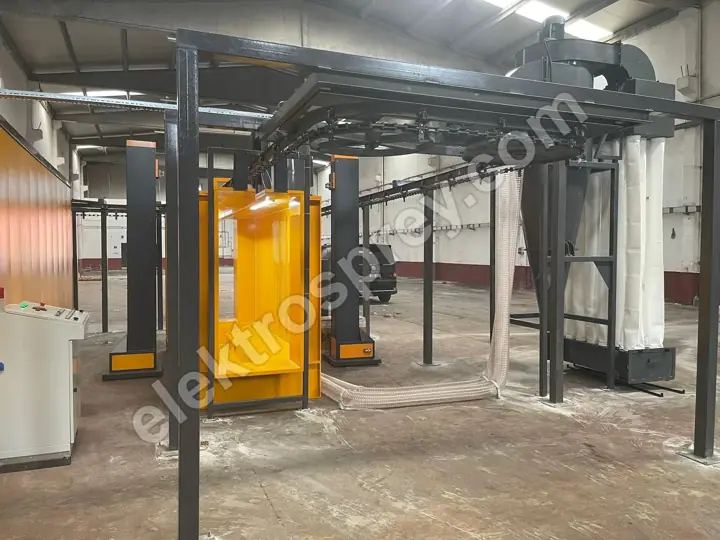 Enlarge
"Should I buy a second powder coating booth, the colour changes are killing me" — the answer hides in how many changeovers you run per shift: at 1–2 colour changes per shift the right call is a quick-change arrangement, at 5 or more per shift a second booth wins almost every time, and the 3–4 change band can fall either way depending on batch size and whether you actually have free floor space. The decision rests on four numbers, not on the booth itself: colour count, average batch size, usable floor area and what one hour of stopped line costs you in output.
This article is not about how a booth is designed so that colour changes go faster; it is about which investment you put your money into. For design detail — internal geometry, filter layout, cleaning arrangement — see booth design that shortens colour change time. Here the question is whether you buy that design in one booth or in two.
The single equation behind the decision: lost hours or occupied floor
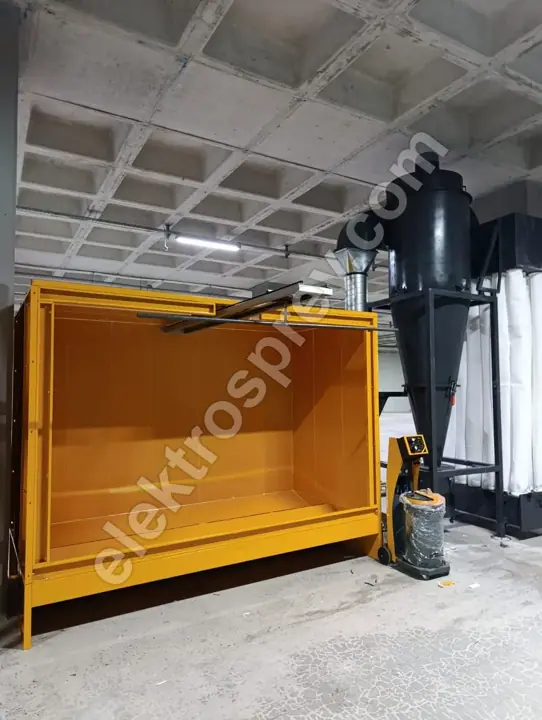
A colour change is not a cleaning task, it is a downtime item. While the booth is being emptied the conveyor stops, the oven heats for nothing and the operator produces nothing. A second booth does not remove that downtime; it moves it off the line. While one colour runs in booth A, booth B is cleaned and prepared for the next colour, so when the turn comes the line stops only for the transfer.
A quick-change arrangement does not remove downtime either — it shortens it. With a fast-release cartridge group, an easily emptied hopper, a dedicated extraction duct and clean internal surface transitions, a colour change drops to a matter of minutes; on the aluminium U-type powder coating plant lines we build, profile colour changes are completed in under 20 minutes. But however well you design it, in a single booth that time never reaches zero and it repeats at every change.
So the equation is: daily changeovers × changeover time = daily loss. If that loss eats a meaningful share of your line's hourly output value, the case for a second booth grows; if it does not, the same money buys more return in the oven, the pretreatment or the conveyor.
Four decision criteria
| Criterion | Points to a quick-change kit | Points to a second booth |
|---|---|---|
| Colour count | 1–2 changes per shift, narrow palette | 4+ changes per shift, constantly rotating palette |
| Batch size | Long runs, same colour for hours | Short runs, 30–60 minute orders |
| Usable floor area | No 2–3 m clearance around the booth | Second booth and escape route fit beside the line |
| Downtime cost | Other work can be done during the stop | Conveyor and oven idle, orders slip |
| Colour separation | Colours from a similar family, low contamination risk | White/light colours rotating with dark ones |
| Manpower | Single shift, staff can be freed for cleaning | Tight shift, cleaning halts production |
If most rows land in the right-hand column, a second booth is clearly right. If most land on the left, put the investment into the internal layout and cleaning equipment of the booth you already have, not into booth count.
Colour count and batch size: this is where the threshold forms
Colour count alone is misleading. A line running ten different colours but coating each one once a week in a single batch suffers far less downtime than a line running three colours but rotating six times a day. The number to watch is not colour variety but daily changeover count.
Batch size is its twin. The smaller the batch, the larger the ratio of changeover time to production time. If a 25-minute colour change follows a 30-minute order, half your line is doing housekeeping. The same change after a four-hour batch is negligible. If your order profile is drifting towards small batches — shops moving from appliance panels to architectural profile and furniture parts are the classic case — a second booth becomes unavoidable.
Run this calculation on your line's real output using the method in powder coating line capacity calculation: with conveyor speed in the 1–6 m/min band and hanger pitch known, how many parts each lost minute represents falls straight out. Base the investment decision on that part count, not on the feeling that "colour changes take too long".
Floor area: where will the second booth go?
The most frequently skipped side of the second-booth decision is space. If two booths are to run side by side, the layout must carry not just the booth shells but both extraction ducts, filter units, powder feed and recovery groups, maintenance access and the operator escape route. The clearance you must leave around a booth for maintenance is as critical as the booth's own width.
There are two typical layouts. In a parallel layout the booths sit on either side of the line or in series, and the part stays on the hanger and is routed into whichever booth it needs; downtime is lowest here, but so is space tolerance. In a standby layout the second booth sits off the line, is cleaned and prepared, then swapped in at changeover; floor demand drops, but handling and positioning time comes back. Do not discuss which layout fits your building without dimensions — draw it on the floor first, using the sketch logic in powder coating plant area and layout.
If there is no space, the decision is already made: the money goes into quick-change equipment for the existing booth, not into a second one.
Downtime cost and the hidden items
| Item | Second booth | Quick-change kit |
|---|---|---|
| Initial investment | Rises distinctly in that direction | Limited increase |
| Floor occupied | Booth + filter + access allowance | No additional area |
| Energy and compressed air | Second extraction and pulse-jet circuit run | Existing infrastructure sufficient |
| Downtime | Only the transfer time | Repeats at every change |
| Cross-contamination risk | Very low, colours kept separate | Depends on cleaning discipline |
| Maintenance load | Two filter groups, two maintenance plans | One group, low load |
| Flexibility | Two colours can run at once | One colour, sequential working |
The hidden items usually make the right-hand column look unfairly attractive. Part of the powder lost during a quick change cannot be recovered; a filtered booth returns 95%+ recovery in normal running, but the cleaning waste at the moment of colour change is not inside that figure. Against that, a second booth means a second cartridge filter group, a second pulse-jet circuit and a second maintenance plan. Write both columns out before you decide.
Frequently asked questions
After how many colour changes per day does a second booth make sense?
The practical threshold is 3–4 changes per shift. Below that band a quick-change arrangement is enough; above it, lost production hours justify the second booth quickly. To find your own exact threshold, measure the daily changeover count, multiply it by the average changeover time and express the result as a share of shift length. If that share passes 10%, evaluate a second booth seriously.
Can white and dark colours be run on the same line with one booth?
They can, but it is the riskiest scenario. On light colours a single dark particle is a visible defect, and going from dark to light pushes cleaning time distinctly above other transitions. If your palette is weighted towards white or light grey and rotates constantly with dark shades, the second-booth case moves forward even when the colour count is low. The alternative is to group light colours at the start of the day and work sequentially towards the dark ones.
Would a larger single booth solve the problem instead of a second one?
No, it solves a different problem. A larger booth solves a part size problem, not a colour change problem; in fact the bigger the internal volume, the larger the surface to be cleaned and the longer the change takes. Booth dimensions are set by the customer's largest part — there is no catalogue size — while colour change is a separate investment heading.
Can a quick-change kit be retrofitted to an existing booth?
It depends on the shell design. A dedicated extraction duct, a fast-release cartridge group and an emptying hopper can be added later; but internal corner radii, surface transitions and floor slope — the geometry that decides where powder clings — cannot be changed afterwards. Send us photographs and dimensions of your existing booth: which improvement will genuinely buy time can only be judged once the shell is seen.
Can two booths share the same oven and conveyor?
Yes, and that is the usual solution. Two booths are tied into a single tunnel line, the part is routed into whichever booth its colour requires, and everything cures in the same oven. In that case the bottleneck is the oven, not the booth; on the tunnel type powder coating plant projects we build in the 500–5,000 parts/hour range, oven length and conveyor speed are recalculated for exactly this scenario.
Summary
A second booth is not a comfort item; it is a capacity investment for lines with short batches and a high colour turnover rate. Four numbers make the decision: colour changes per shift, average batch duration, the floor area that genuinely exists around the booth, and the output lost per hour of stopped line. At 1–2 changes per shift, put the money into quick-change equipment for the booth you have; at 5 or more, put it into a second booth; if you fall in between, measure before you decide. Either way the booth is built with 2–12 guns and an internal air velocity in the 0.5–0.8 m/s band, sized to your largest part — there is no off-the-shelf size. For general selection criteria see powder coating booth selection, and for the product side the filtered powder coating booth page; every unit we build is delivered with a 2-year manufacturer warranty.
Send us your colour list, your daily changeover count and your line layout sketch — we will work out together which side of the threshold you are on.
For plants in the UK, North America and beyond
Where your line is installed shapes the paperwork, the power supply and the rules behind the choices described above.
- Powder–air mixtures can form an explosive atmosphere. In the US, spray application areas generally fall under NFPA 33, and electrical equipment is usually expected to carry UL or CSA listing. In the UK, EN 16985 and EN 50050-2 are widely referenced.
- For the UK, confirm with your importer whether UKCA or CE marking is expected. In the US and Canada, plan for UL or CSA requirements on the electrical side, and check any local documentation rules before shipment.
- For the UK, goods of Turkish origin move under the Türkiye–UK free trade agreement with an EUR.1 certificate or an origin declaration. For other destinations, the origin paperwork depends on that country's trade agreements, so check it with your importer early.
- North America runs at 60 Hz, and 480 V is common in industrial plants, so motors, fans and controls have to be specified for that supply from the start. Confirm the voltage and frequency on site before the line is designed.
Products mentioned: Aluminum Profile U-Type Powder Coating System · Filtered Electrostatic Powder Coating Booth · Tunnel Type Electrostatic Powder Coating System
When you ask for a quote, tell us your country, supply voltage and frequency — get in touch.