
How Is a Wood-Effect Transfer Line Added to a Powder Coating Plant?
Wood-effect joinery demands a second heat cycle on top of an already coated profile. This article explains where the wrapping station and the second oven attach to an existing aluminium powder coating line, how they change floor space, hanging layout and throughput, and what belongs in the quality record.
 Enlarge
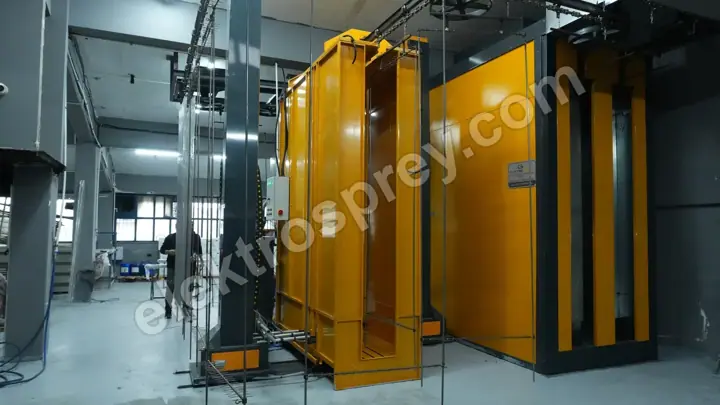
An aluminium profile wood-effect transfer oven does not replace your powder coating line — it is bolted on after it. The profile runs the normal line and is cured in its base colour, is wrapped with printed paper or film at a separate station, and only then does a second oven drive the pattern into the coating. On the aluminium U-type lines we build, profile length runs 3–7 m, so the second oven must accept the same length; most of the floor space comes from that oven plus the wrapping, stripping and cooling stations. Temperature, dwell time and cycle time are not properties of the machine — they come from the data sheet of the transfer paper or film you buy. Without that sheet you can neither size the oven nor calculate capacity.
So wood effect is not a purchase decision but a decision to split the line in two. Below: where that branch attaches, what it slows down, and which line item grows the budget.
How the process splits in two
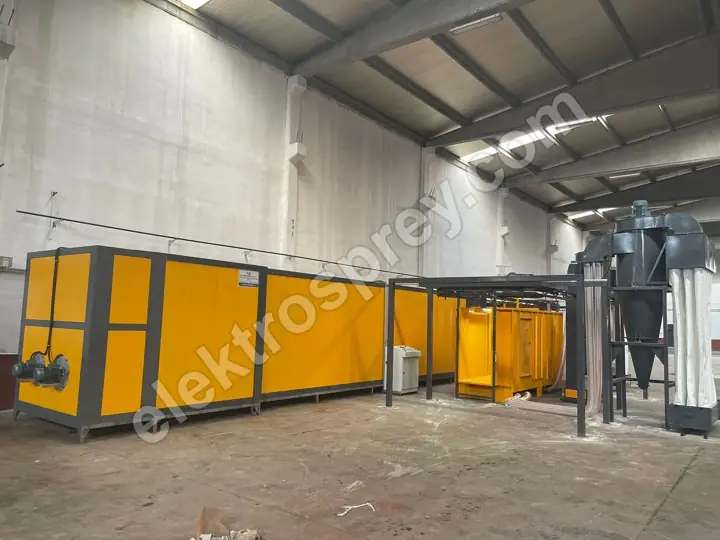
Wood effect is not an alternative to powder coating but a continuation of it. The profile first completes the standard flow: pretreatment, drying, powder application and curing. That stage must end with a single-colour, fully cured, flawless surface — the pattern does not hide a defect underneath, it magnifies it. Only then does the second branch start.
| Step | Where it happens | Relation to the main line | Critical point |
|---|---|---|---|
| Pretreatment + powder application | Existing U-type line | Unchanged | Base colour sets the undertone of the pattern |
| Base curing | Existing line oven | Unchanged | An undercured base leaves marks in the pattern |
| Cooling and buffering | Line exit / buffer rack | New buffer area | Profile must drop to hand-touch temperature |
| Wrapping (paper or film) | New station | Off-line, labour intensive | Wrap direction and tension per the supplier sheet |
| Transfer oven | New oven | Separate branch | Time and temperature come from the sheet, never guessed |
| Stripping, inspection, packing | New station | Separate branch | Scratching during stripping is the most common defect |
Two methods are common: the profile is wrapped in printed paper and heated under vacuum or a membrane, or sleeved into a printed film tube before the oven. Either way the second heat cycle is mandatory, and it will not sit on the rhythm of your conveyor — wrapping and stripping are manual, and the transfer oven runs in batches in most plants.
Floor space and layout: the item that really grows
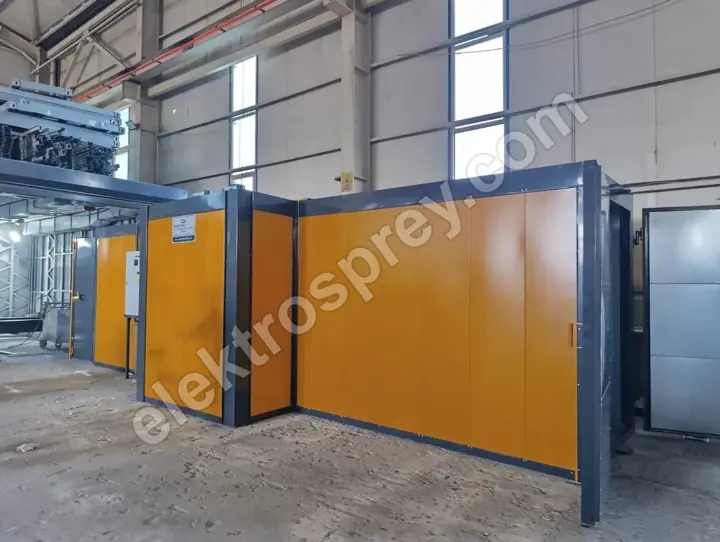
The most frequent planning error is budgeting the oven alone. The transfer branch has a longer space list than the oven:
- Wrapping bench: free bench length of at least one and a half times the profile; for 3–7 m profiles, access from both sides.
- Paper and film store: humidity and temperature controlled, rolls labelled by batch.
- Buffer rack: for base-coated profiles awaiting their turn; without it the line blocks at its own exit.
- Stripping and inspection bench: well lit, since pattern defects show only at the right light angle.
- Manoeuvring space at the oven: the trolley or hanger must load the profile without bending it.
Total square metres depend on the project; we quote no catalogue figure, because profile length, daily target and wrapping method decide it together. Draw the layout with the transfer branch included, using the flow logic in plant floor space and layout. Planning both branches at once beats opening up space later; for the main line itself see aluminium facade profile coating line.
Hanging layout and capacity: why the line slows down
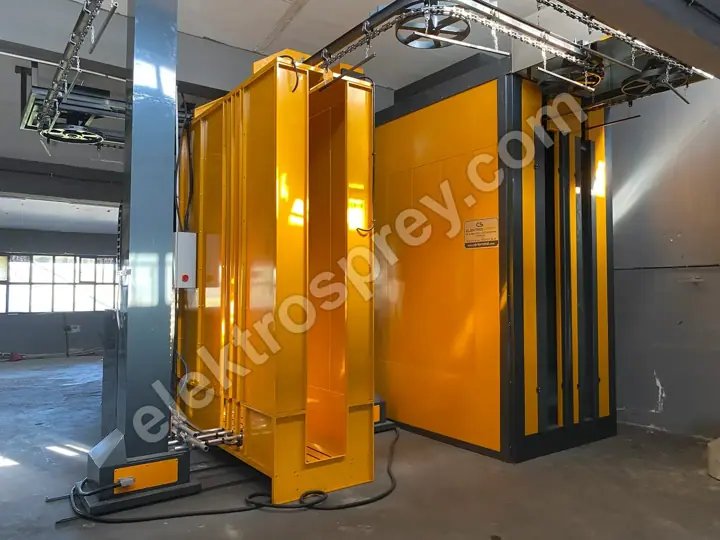
The main line and the transfer branch will not run at the same rate; accept that from the start. The aluminium U-type coating plant we build runs continuously and changes colour in under 20 minutes, so colour variety is no bottleneck there. The bottleneck is wrapping speed and the batch size of the second oven.
| Decision | Effect on capacity | How to measure it |
|---|---|---|
| Wrapping method (paper / film) | Sets profiles per operator per hour | Stopwatch on one profile, average of 20 runs |
| Transfer oven batch volume | Sets the waiting queue | Profiles that fit the oven × cycle |
| Hanger spacing | Widens so the pattern is not broken at contact points | Compare against main line spacing |
| Operator count | Branch stops if wrapping and stripping are not parallel | Idle time recorded within the shift |
| Cooling area | If short, early stripping damages the pattern | Surface temperature at the exit |
A practical rule: whatever share wood-effect products hold in your output, the transfer branch delivers a fraction of the main line's daily throughput. Do not slow the main line to wood-effect speed; decouple the two with a buffer. Hanging differs too — the pattern breaks where the hanger touches, so contact points move to the hidden end, lowering profiles per hanger.
Oven selection and energy load
Oven selection comes down to one question: what temperature band and tolerance does the sheet require? Our box-type electric oven works between 80–250 °C, holds ±3 °C uniformity under PID control and stores 16 baking profiles. Since every pattern and paper brand carries its own recipe, that memory is more useful here than on the main line — the operator selects a recipe instead of typing one. Power is engineered per oven volume within 3–150 kW.
Gas is also an option: our top-loading gas ovens work in the 140–220 °C band, at 50,000–500,000 kcal/h, with 30–40% lower energy cost than electric, under CE and EN 1020. On a transfer branch the choice usually goes to control: for small batches, a narrow band and repeated heat-up cycles, the box-type electric oven is easier to keep in tolerance. With gas infrastructure already in place and large batches, a top-loading oven wins on energy. Compare running costs against your own data with the method in powder coating oven energy consumption.
To be blunt: a second oven raises the plant's connected electrical load and gas demand. If your panel and gas line were sized for the existing line only, that upgrade belongs in the budget as its own item.
Quality and records: what to track on a pattern
Wood effect demands more record keeping than plain colour, because the complaint usually arrives as "the pattern does not match" rather than "the colour is off", and only batch records answer it. Five data points belong in every batch: base colour and powder batch number, transfer paper or film brand and lot number, oven recipe number, the data logger's oven log, and the inspector's sign-off.
Exterior joinery needs one warning more: outdoor durability depends on the class of both the base coating and the transfer material. Working within Qualicoat or GSB, document with the supplier's sheet that the transfer material is rated for exterior use — and trust no sentence presenting this as a property of the machine.
Frequently asked questions
Can the transfer oven replace the existing curing oven?
No — the two do different jobs at once. The curing oven bakes the base coating in continuous flow; the transfer oven heats wrapped profiles on another recipe. Using one for both means stopping the line. Low-volume trials can run on a single oven, but series production needs the second.
Who sets the transfer temperature and dwell time?
The manufacturer of the transfer paper or film. Their sheet gives the temperature band, the dwell time and, where relevant, the vacuum value; the oven is selected to meet those figures, never the other way round. Change supplier and the recipe changes — which is why multi-recipe memory is a practical necessity. Any "so many minutes at so many degrees" advice you hear belongs to that workshop's material, not yours.
Can transfer be done before the base coat is fully cured?
It should not be. A partially cured base cross-links further in the second heat cycle: colour shifts, gloss drops, and pattern adhesion varies batch to batch. Cure the base to the powder data sheet, cool the profile, then wrap. That waiting time is why the buffer rack is mandatory.
How much extra floor space does a wood-effect branch need?
No fixed figure exists; space follows profile length, daily target and wrapping method. Measure it as one and a half times the profile length for the wrapping bench, oven outer dimensions plus manoeuvring room, plus buffer rack and stripping bench. Add those four areas on your plan; we manufacture to those dimensions, not to a catalogue size.
Can I add a transfer branch without disturbing my existing U-type line?
In most cases yes. The branch attaches at the line exit as a separate area; the main conveyor stays untouched. Three things need attention: buffer space at the exit, electrical and gas infrastructure for the branch, and wood-effect batches entering the plan as their own work orders. Send your current layout and we will draw where the branch fits.
Summary
Wood effect is a second branch at the end of a powder coating line, not inside it: base coating and curing stay on the existing line, while wrapping and transfer run at a separate station and oven. The visible line item is the oven, but space and labour grow at the wrapping and stripping station. Oven selection follows the material sheet's temperature band; a box-type electric oven at 80–250 °C with ±3 °C uniformity and 16 stored profiles suits most transfer work, while gas leads on energy for large batches. On lines handling 3–7 m profiles the second oven is built to that same length. Every line we manufacture is delivered with a 2-year manufacturer warranty.
Send us your profile length, your daily target in metres and the technical sheet of the transfer paper or film you use — we will size the oven, the floor space and a realistic capacity for the transfer branch together.
For plants in the UK, North America and beyond
Where your line is installed shapes the paperwork, the power supply and the rules behind the choices described above.
- Gas burners and fuel trains are commonly built to EN 746-2 and EN 676. In North America, expect UL or CSA listed components and a review by the local authority or gas utility; commissioning usually needs the gas supplier's sign-off.
- For the UK, confirm with your importer whether UKCA or CE marking is expected. In the US and Canada, plan for UL or CSA requirements on the electrical side, and check any local documentation rules before shipment.
- For the UK, goods of Turkish origin move under the Türkiye–UK free trade agreement with an EUR.1 certificate or an origin declaration. For other destinations, the origin paperwork depends on that country's trade agreements, so check it with your importer early.
- North America runs at 60 Hz, and 480 V is common in industrial plants, so motors, fans and controls have to be specified for that supply from the start. Confirm the voltage and frequency on site before the line is designed.
Products mentioned: Aluminum Profile U-Type Powder Coating System · Box Type Powder Coating Oven (Electric) · Overhead Pallet Powder Coating Oven (Gas)
When you ask for a quote, tell us your country, supply voltage and frequency — get in touch.