
Conveyor Turn Radius: The Real Limit on Fitting a Line Into Your Building
Conveyor turn radius is the geometric constraint that decides how many times a powder coating line can be folded into a hall. This article explains which inputs produce the radius, how hangers swing at corners, and what the U versus O layout choice costs you.
 Enlarge
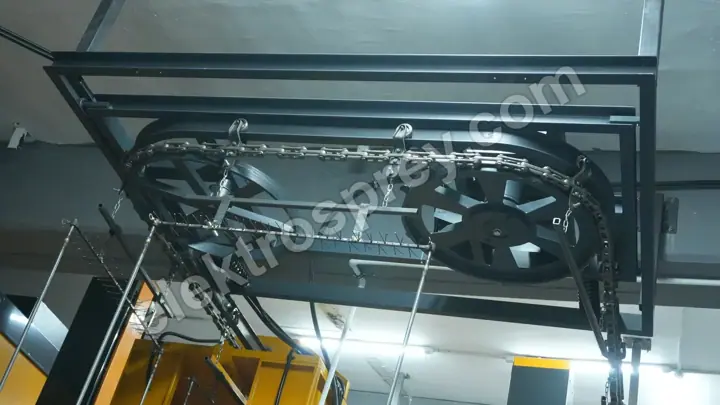
Minimum conveyor turn radius on a powder coating line is never picked from a catalogue: it is calculated per project from chain type, hanger length and the width of the part carried. In practice a tunnel type line capable of up to 5,000 parts per hour wants 120 metres of chain on paper, the hall is 40 metres, the line gets folded three times, and every fold costs both floor length and throughput. Because roof beams, column grid and door height already dictate where those corners land, the layout decision has to come before oven and booth selection.
We cannot print a radius figure here, because the correct figure belongs to your part. What we can set out is which inputs generate it and how a wrong radius quietly slows the whole line down.
The four inputs that set the turn radius
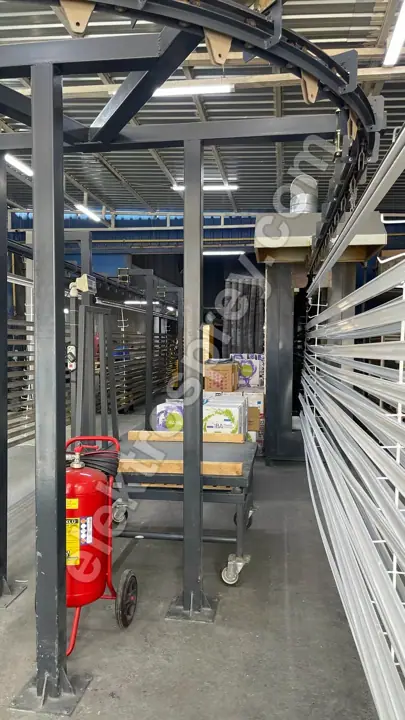
There is no single formula for a horizontal turn. There are four interlocking constraints, and whichever is largest sets the radius.
Chain type. Link pitch and the horizontal articulation angle define the tightest arc the chain can negotiate on its own; in power and free systems the carriers enlarge that arc further. The catalogue value is the absolute minimum, not the working radius.
Hanger length. The longer the hanger, the greater the amplitude of the horizontal swing generated in the turn. A long hanger combined with a tight radius pushes the part off the track axis.
Part width and rotation. In a turn the part also rotates about its own centre of gravity, sweeping one point on the inside of the arc and another on the outside. The sweep envelope is always larger than the physical part width.
Hanger pitch. Two hangers sit at a set spacing on the straight run, but on the inside of an arc that spacing shortens: parts that clear each other on the straight can collide in the corner.
| Input | Direction it pushes the radius | What tightening it costs |
|---|---|---|
| Chain type / link pitch | Longer pitch → wider arc | Fixed; not solved without changing chain |
| Hanger length | Longer hanger → wider arc | More swing, risk of marking |
| Part width | Wider part → wider arc | Larger tunnel cross-section at the corner |
| Hanger pitch | Tighter pitch → wider arc | Lower throughput, parts collide |
| Speed | Higher speed → wider arc | Forced slow-down through the corner |
Read the table this way: tightening a corner is paid for on one of these rows. There is no free tightening.
What happens in the corner: swing and sweep envelope
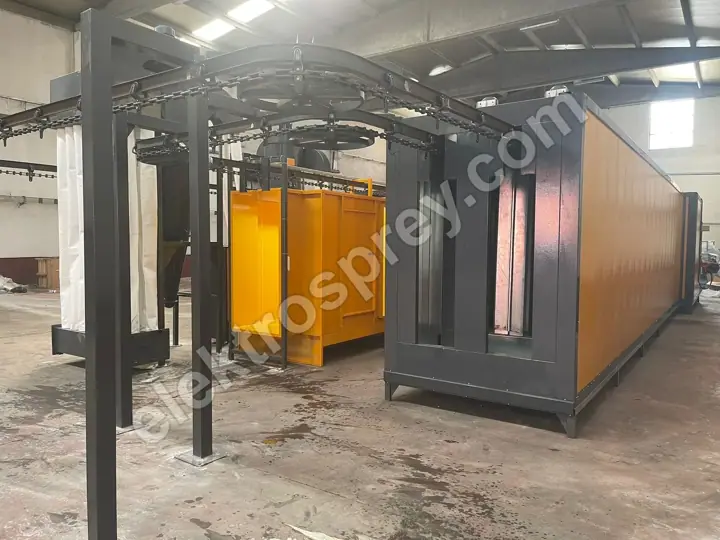
On a straight run the hanger sits under the track axis. Entering the arc, centrifugal effect throws it outward; leaving it, the hanger swings back, and that oscillation takes several metres to damp out. The consequences, in order:
- Tunnel and oven cross-sections grow. A corner inside an oven or booth forces that section wider internally than the straight runs. The heated volume grows and the energy cost rises permanently.
- Part-to-part collision becomes possible. The shortened pitch on the inside of the arc turns into contact on long or wide parts, and contact leaves a mark.
- Marks on the coated surface. While uncured film is being carried, swing produces marks at the hanger contact point and along part edges. We covered that mechanism in detail in conveyor vibration and marking on the coating.
- Transfer efficiency drops inside the booth. If the gun-to-part distance is not constant, the electrostatic charge distribution changes and coverage falls below the 98.5%+ band the booth design promises.
Hence the basic rule: do not put a corner inside a piece of equipment. The arc belongs in the neutral zone between booth exit and oven entry, ideally on the load–unload side, with a straight run after it so the swing can damp out.
Vertical climbs: the second radius everyone forgets
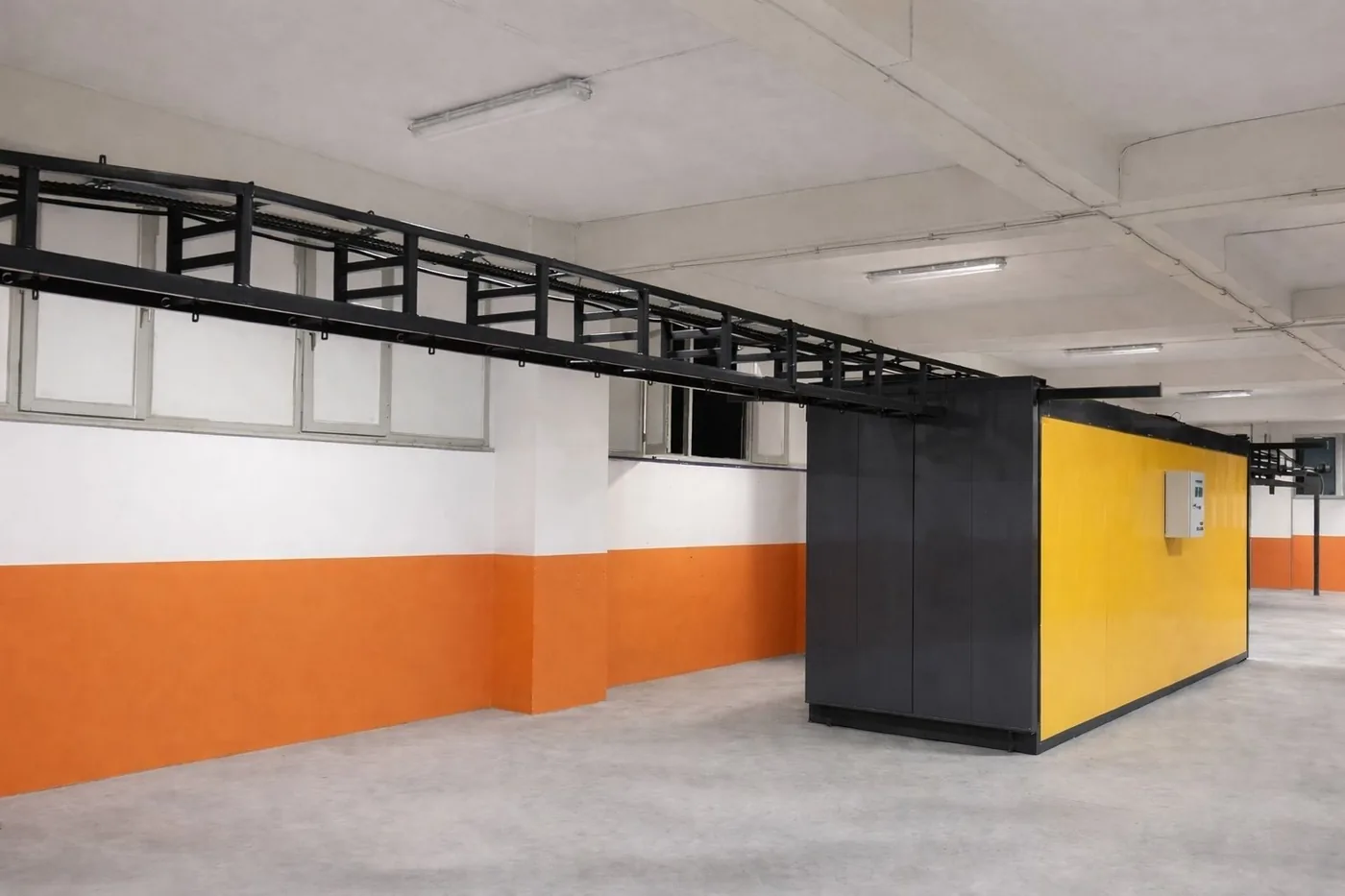
While the horizontal radius gets discussed, vertical transitions are skipped in most projects. Yet lifting the line to oven level, bringing it back down, or clearing a walkway all demand a radius too. As the climb angle increases, the pulling force on the chain and the tilt of the hanger rise with it, and the part stops hanging square to the track axis.
Three things matter here: the climb angle, the transition arcs at each end of the climb, and whether the hanger pitch still leaves room for the part to swing fore and aft. With heavy parts a steep climb also limits the drive unit's pulling capacity. The cheapest vertical transition is the one you never build: keeping oven and booth entries at the same level saves more metres than a series of climb arcs ever will.
U or O? What the layout choice actually costs
Fitting a line into a hall comes down to two schemes in practice. The choice is an operating decision, not an aesthetic one.
| Criterion | U type (load and unload in one place) | O type (loop, separate load and unload) |
|---|---|---|
| Number of corners | Few; usually one wide turn | Many; four corners |
| Staffing | One station, one team | Two stations, two teams |
| Part tracking | Easy; entry and exit side by side | Less visibility, buffer stock builds up |
| Space efficiency | Good in narrow, deep halls | Good in square-plan halls |
| Empty hanger return | Empty hangers travel back | Continuous flow, little empty return |
| Expansion | Extend lengthways | Corner geometry locks it in |
U type wins in narrow, deep buildings: one turn, one station, easy supervision. The price is that empty hangers occupy the return leg, usually dead floor area. With long parts such as aluminium profiles at 3–7 m the scheme is close to mandatory; because the radius grows with profile length, the aluminium U type line is designed around a single wide turn.
O type wins in square-plan halls with a sparse column grid, and separating loading from unloading simplifies shift organisation. The price is four corners: each takes floor space, generates swing and caps line speed.
How the radius eats into throughput
On paper, capacity is conveyor speed divided by hanger pitch; on a line running in the 1–6 m/min band the arithmetic is clean. On the floor, actual throughput comes out lower, and most of the gap is lost in the corners.
The loss has three components. First, the corner speed limit: to keep swing in an acceptable band, corner speed stays below straight-run speed, and since the line runs at one speed, the whole line drops to it. Second, hanger pitch chosen for the corner: pitch is opened up to absorb inside-arc crowding, and hourly part count falls with it. Third, dead chain — return legs carry no work but still carry chain, drive and maintenance.
These also reach into oven length: a speed reduced by corners means a shorter oven for the same cure time, and raising the speed again grows the oven. We set that relationship out numerically in conveyor speed and oven length; the wider layout questions — room sequence, door orientation, equipment adjacency — belong to powder coating plant space and layout.
Frequently asked questions
What is the minimum conveyor turn radius in metres?
Quoting a single number would be guesswork, not engineering. The radius starts from the tightest arc the chain allows and grows as hanger length, part width and pitch are added. At project stage we take the dimensions and weight of your largest part, the hanger design and the target hourly capacity, and calculate the arc from those. A line built on a catalogue radius either scrapes parts in the corner or wastes floor area.
What do I lose if I tighten the turn radius?
Three things, in order: corner speed (and therefore whole-line speed), hanger pitch (and therefore parts per hour), and part-width tolerance. As the radius tightens, the margin between sweep envelope and track axis shrinks; a wider part later on will not fit. A tight radius saves floor space today and closes off tomorrow's product mix.
Can I put a corner inside the oven or the booth?
Technically yes, economically almost never. The sweep envelope forces a larger internal cross-section; in an oven that means extra volume heated for the life of the plant, and in a booth the gun-to-part distance changes, so transfer efficiency and recovery balance both suffer. Unless there is no alternative, the arc goes into the straight zone between equipment.
Does hanger length really change the turn radius?
Yes, and by more than most projects expect. A long hanger behaves like a pendulum: at the same corner speed the swing amplitude grows and the damping distance lengthens. So hanger length is fixed not from part height alone, but jointly with corner geometry and the internal height of the oven.
Should I choose U type or O type?
Look at the proportions of the building and at your workflow. A narrow, deep hall, one loading team and long parts point to U type; a square plan, separate teams and a continuous-flow target point to O type. Column grid and door positions usually decide for you — which is why the first step is not drawing a line, but producing a dimensioned plan of the building.
Summary
Conveyor turn radius is the real geometric constraint on whether a powder coating line fits your hall, and it is calculated from chain type, hanger length, part width and pitch — never chosen from a catalogue. A corner always charges a fee: speed, pitch, equipment cross-section or floor area. Keep corners outside the equipment, minimise vertical transitions, and decide between U and O from a dimensioned building plan. Every line is built to the customer's largest part and delivered with a 2-year manufacturer warranty.
Send us your dimensioned building plan, your largest part and your target hourly capacity — we will work out how many corners it takes to fit the line into your hall.
For plants in the UK, North America and beyond
Where your line is installed shapes the paperwork, the power supply and the rules behind the choices described above.
- Gas burners and fuel trains are commonly built to EN 746-2 and EN 676. In North America, expect UL or CSA listed components and a review by the local authority or gas utility; commissioning usually needs the gas supplier's sign-off.
- For the UK, confirm with your importer whether UKCA or CE marking is expected. In the US and Canada, plan for UL or CSA requirements on the electrical side, and check any local documentation rules before shipment.
- For the UK, goods of Turkish origin move under the Türkiye–UK free trade agreement with an EUR.1 certificate or an origin declaration. For other destinations, the origin paperwork depends on that country's trade agreements, so check it with your importer early.
- North America runs at 60 Hz, and 480 V is common in industrial plants, so motors, fans and controls have to be specified for that supply from the start. Confirm the voltage and frequency on site before the line is designed.
Products mentioned: Aluminum Profile U-Type Powder Coating System · Box Type Powder Coating Oven (Electric) · Tunnel Type Electrostatic Powder Coating System
When you ask for a quote, tell us your country, supply voltage and frequency — get in touch.