
Aluminium Facade Profiles: Vertical or Horizontal Powder Coating Line?
For a facade and window profile manufacturer, line orientation is decided by the building, not by throughput. A vertical line saves floor space but pushes clear ceiling height and oven shell cost up; a horizontal line installs cheaply but brings sagging and hanging density problems. This article separates the two options through profile length, rack layout, pretreatment choice and what can honestly be guaranteed.
 Enlarge
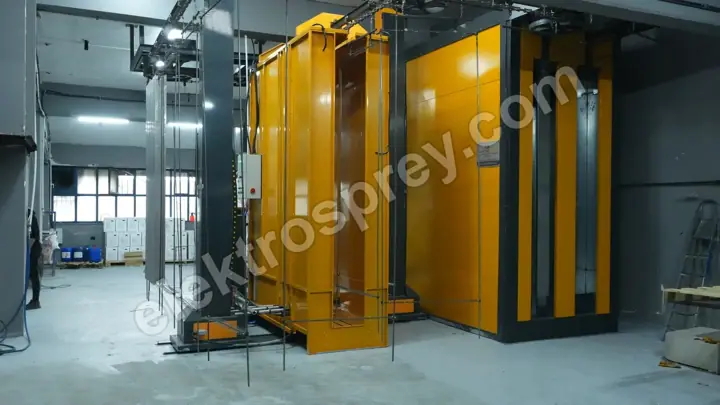
Whether an aluminium profile powder coating line should run vertical or horizontal is answered by profile length and the building, not by throughput: for facade profiles of 3–7 m, a vertical line needs roughly 10–12 m of clear height, while a horizontal line lays the same profile down and relieves the roof but demands at least twice the floor area and a multi-point rack layout that prevents sagging. The decision order is fixed: measure your longest profile first, then measure your building's clear height and column spacing, and only then look at capacity. Manufacturers who reverse that order end up either shortening their product range or putting up a new building.
A facade profile is not an ordinary part for a coating shop. It is thin-walled, long, low in thermal mass, and its visible surface forgives nothing. A line that is more than adequate for sheet metal parts can still produce rejected work in facade profiles. That is why the orientation decision governs every other decision on the line.
Profile length dictates the building, not the line
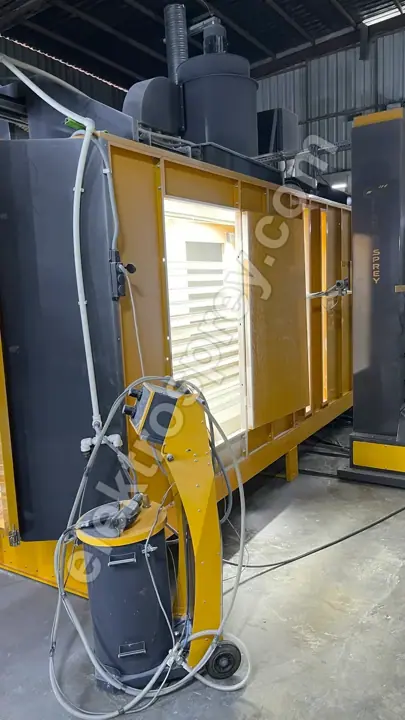
The 3–7 m band is the standard profile length in the facade and joinery trade. Hung vertically, the total height is the sum of the rack hardware above the profile, the safety clearance below it, and the oven's upper and lower heat zones. In practice a vertical oven shell alone exceeds 9 m for a 7 m profile; add the conveyor and the roof truss and the required clear height follows.
In the horizontal solution the same profile travels parallel to the floor. Booth and oven height drop and the roof problem disappears, but the line length — pretreatment plus drying plus booth plus oven — spreads along the longest axis of the building. Do the area and layout calculation before ordering anything; the method is set out step by step in plant area and layout.
| Criterion | Vertical (U type) line | Horizontal line |
|---|---|---|
| Floor area | Low — the U turn puts load and unload in one zone | High — spreads over the full line length |
| Clear ceiling height | Critical constraint, decisive at 7 m profiles | Comfortable, usually fits an existing building |
| Sagging risk | Low — the profile hangs under its own weight | High — bends if support spacing is too wide |
| Hanging density | One top point per profile | Multiple supports along the profile |
| Oven shell cost | High — vertical volume grows | Lower — volume stays controlled |
| Colour change speed | Fast, under 20 minutes | Depends on booth layout, generally slower |
| Load/unload ergonomics | Concentrated at one station | Two separate crews at two ends |
What the U turn gives and what it costs
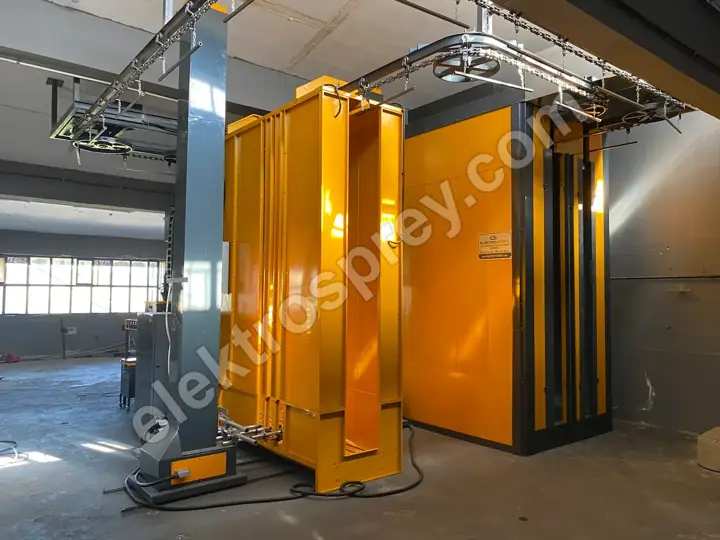
Most vertical lines are built as a U type: loading and unloading sit in the same zone and the conveyor returns in a U. The gain is concrete — one crew both hangs and takes off, transport distances shorten, and work in progress is stored at a single point. In the aluminium U type powder coating plant lines we build, this layout is dimensioned for 3–7 m profiles and always to the customer's largest part; there is no catalogue size.
The cost is the turning radius. A long profile sweeps a wide area at the U turn, and no column, beam or other equipment may sit inside it. In a building with tight column spacing the U turn is compromised and the line carries fewer racks in the same area. In other words, the floor-area advantage of a vertical line largely evaporates in a poorly gridded building.
Hanging density is the real capacity limit
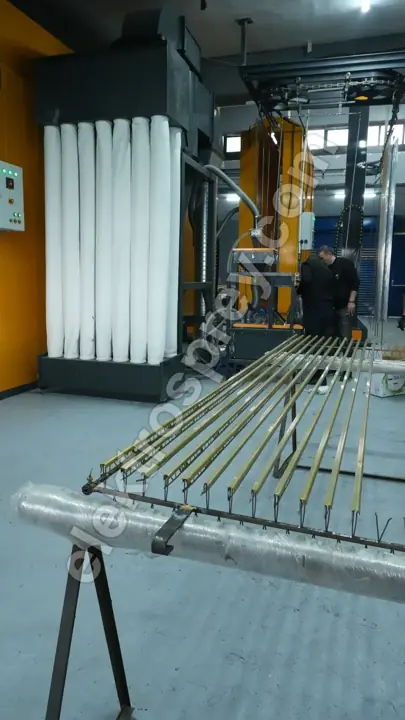
For facade profiles, capacity is thought of in metres per hour and racks per hour, not parts per hour. Three things set how many profiles fit on one rack: profiles must not shadow each other, the electrostatic field must reach between them, and two profiles must never touch inside the oven. Tightening rack spacing raises capacity on paper; on the part it produces thin film on inner surfaces and contact marks.
| Mistake | Symptom on the floor | Correct approach |
|---|---|---|
| Profiles too close on the rack | Thin film and dull zones on inner faces | Open spacing according to profile depth |
| Too few support points on a horizontal line | Sag at mid-span, waviness along the length | Reduce support spacing with wall thickness |
| Rack hardware left coated | Loss of conductivity, kV drop | Make rack cleaning a shift routine |
| Conveyor speed mismatched to product | Under-cure or over-bake | Set speed to profile mass |
Conveyor speed is adjustable in the 1–6 m/min band; thin-walled profiles can run near the top of that band, but speed cannot be raised without recalculating oven length alongside it. To put numbers on capacity before you order, use the method in line capacity calculation.
Pretreatment: immersion or spray
On facade profiles, the quality commitment is largely won in pretreatment. On aluminium the aim is to remove oil and the oxide layer and prepare the surface with a conversion coating; a 3–7 stage arrangement covers degreasing, rinsing, conversion/passivation and final rinse. The stage count decision has its own guide in how many pretreatment stages.
For long profiles, immersion is preferred because it guarantees the chemistry reaches internal channels and closed sections; with spray, the inside of a closed section is usually left blind. In exchange, immersion means tanks as long as the profile and the chemical volume that comes with them — installation and operating load both rise. The decision follows the section: for closed, multi-chamber facade profiles a dip surface treatment line makes sense, while an open, simple section may be served by a spray tunnel.
Quality commitment: know what can actually be guaranteed
Facade work is usually specified under Qualicoat or GSB. It is worth being blunt here: those schemes certify the coated product and the applicator, and a machine builder cannot commit to them on the customer's behalf. What can be committed on the equipment side is that the process is able to meet what those schemes ask for, repeatably — pretreatment stages that can be controlled individually, bath temperature and time records, measurable oven temperature uniformity, and a cure profile that can be logged.
The practical consequence: if certification is your goal, write the measurement and record infrastructure into the specification when you order the line. A temperature logging system added later is both expensive and not always a fit for the existing control panel. Our lines are delivered with a 2-year manufacturer warranty; that warranty covers the equipment, not the coating class achieved on your product.
Frequently asked questions
Is a vertical or a horizontal line better for facade profiles?
Your building decides. If your clear height is sufficient for 3–7 m profiles, the vertical U type line wins on floor area and colour change speed. If the height is not there, or the column grid of an existing building will not allow the U turn, the horizontal line is the right choice. Take the height measurement under the roof truss, at the lowest point.
How much ceiling height does a 7 metre profile need?
The exact figure is calculated per project; the drivers are the oven's upper heat zone, the conveyor and rack hardware length, and the lower safety clearance. Added together, the requirement rises clearly above the profile length itself. The right approach is to give us your longest profile dimension and a building section, and have the line dimensioned to it.
How is profile sag prevented on a horizontal line?
By setting support spacing from the wall thickness and the section's stiffness. Thin-walled wide profiles need more frequent supports. Sag mostly occurs not during spraying but in the oven, as the material softens — so the trial must be run at cure temperature, not at room temperature.
How long does a colour change take?
Our aluminium U type lines are designed for a colour change completed in under 20 minutes. What sets the time is how cleanable the booth interior is, how the recovery unit empties, and how quickly the gun manifold can be stripped. For a joinery manufacturer running many colours, this figure matters as much as throughput.
Can a wood-effect transfer line be added later?
Yes, but the layout has to be planned for it from the start: the transfer oven and wrapping station need a separate flow at the exit of the coating line. Adding it afterwards usually breaks internal traffic. The details are in aluminium profile wood-effect transfer line.
Summary
Orientation on a facade profile line is not a preference, it is a constraint problem. The order is clear: longest profile length, then clear height and column grid, then hanging density and capacity, then pretreatment method, then the quality record infrastructure. A vertical U type line wins in a tall building through floor area and colour change speed; a horizontal line wins by fitting the building you already have, but makes sagging and rack discipline a specification issue. Whichever orientation you choose, the line is built to the customer's largest profile — there is no catalogue size.
Send us your longest profile dimension, the section drawing and your building height and column plan, and we will work out together which orientation is genuinely feasible in your building.
For plants in the UK, North America and beyond
Where your line is installed shapes the paperwork, the power supply and the rules behind the choices described above.
- Pretreatment rinse water usually needs a discharge permit from the local water authority or municipality, whatever the size of the line. The chemistry you choose largely decides how much treatment is needed before discharge.
- For the UK, confirm with your importer whether UKCA or CE marking is expected. In the US and Canada, plan for UL or CSA requirements on the electrical side, and check any local documentation rules before shipment.
- For the UK, goods of Turkish origin move under the Türkiye–UK free trade agreement with an EUR.1 certificate or an origin declaration. For other destinations, the origin paperwork depends on that country's trade agreements, so check it with your importer early.
- North America runs at 60 Hz, and 480 V is common in industrial plants, so motors, fans and controls have to be specified for that supply from the start. Confirm the voltage and frequency on site before the line is designed.
Products mentioned: Aluminum Profile U-Type Powder Coating System · Dip Type Surface Treatment and Washing Line · Overhead Pallet Powder Coating Oven (Gas)
When you ask for a quote, tell us your country, supply voltage and frequency — get in touch.