
How to Choose a Curing Oven Burner: Capacity, Modulation and Combustion Chamber
Burner capacity for a gas-fired powder coating oven is the sum of three separate loads: bringing the oven body up to temperature, continuous losses, and the thermal mass of the parts entering each hour. This article shows how that calculation is built, what on-off versus fully modulating firing does to temperature stability, and when direct heating must give way to an indirect combustion chamber.
 Enlarge
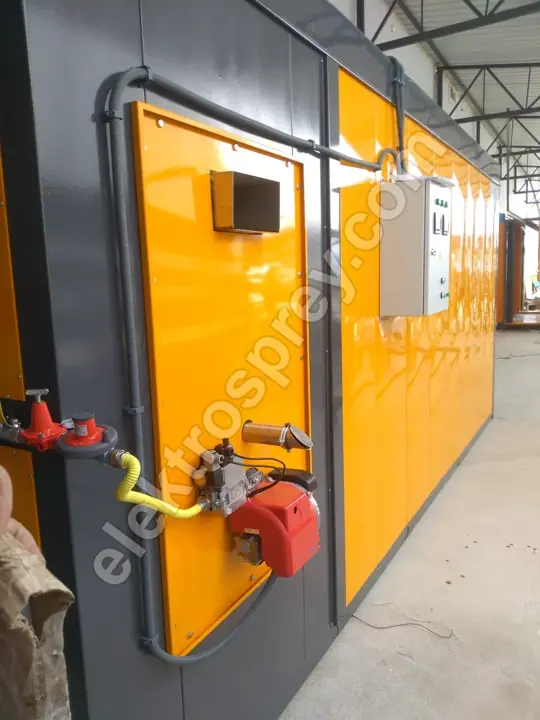
Powder coating oven burner capacity is not calculated from a single formula; it is the sum of three separate loads: the energy to bring the oven body up to operating temperature, the continuous loss load, and the thermal mass of the parts entering the oven each hour. On the top-loading gas-fired ovens we build, that total lands in the 50,000–500,000 kcal/h band — the lower end is a single-chamber workshop oven, the upper end is a tunnel line moving tonnes of steel per hour. Calculate the three items separately instead of estimating a single number, because oversizing hurts just as much as undersizing.
This article is written for a manufacturer who has already chosen gas as the energy source. We are not reopening the gas-versus-electric debate here; that belongs to electric or gas powder coating oven. What remains are four decisions: capacity, modulation type, fuel, and how the combustion products relate to the air touching your parts.
What the three load items actually are
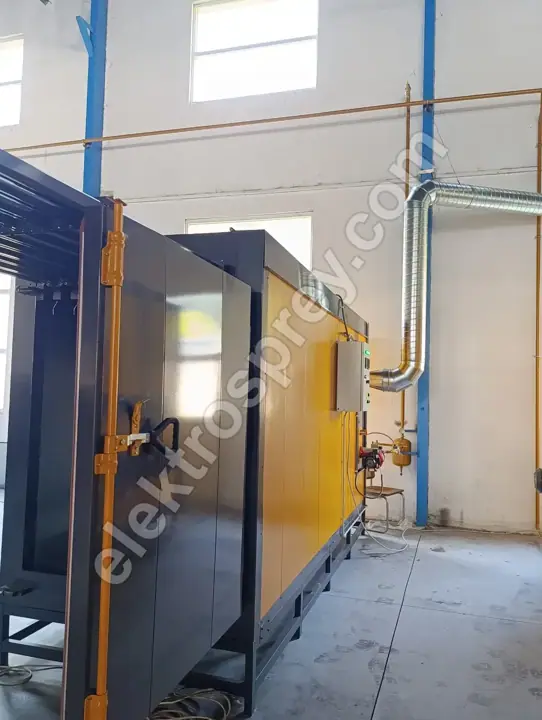
Write the sizing calculation as three separate lines. Compressing it into one number creates an error nobody can trace later.
1. Warm-up load. The oven's steel shell, its rock wool insulation, the inner lining and the air inside all have to travel from ambient to working temperature. That load is divided by your target warm-up time. Our top-loading ovens are designed for a 35–45 minute warm-up; halving that target roughly doubles this load item. In an oven that warms up once per shift, pushing this item hard buys you very little — we cover the trade-off in oven warm-up time and reaching steady state.
2. Continuous loss load. Heat leaving the shell surface, leakage through doors and through the entry and exit openings, and — the largest single item — the exhaust air leaving through the stack. A curing oven must vent the volatiles released during cure, and the fresh air replacing that exhaust is heated from ambient every hour of every shift. Oversizing the stack flow makes the burner pay for it for the life of the plant. This item is tied directly to the oven stack and exhaust design decision, and it has to be settled before the burner is sized.
3. Thermal mass of the parts. The steel, aluminium and hanging fixtures entering the oven per hour, their average specific heat, and the rise to a target in the 140–220 °C band. On a continuously running tunnel line this is the dominant item. Do not forget the fixtures: on most lines the carrier steel weighs as much as the workpiece, and it is reheated on every pass.
| Load item | Driven by | Dominant on | How to reduce it |
|---|---|---|---|
| Warm-up | Shell mass, insulation, target warm-up time | Batch / box oven | Insulation thickness, realistic warm-up target |
| Surface loss | Shell area, insulation, ambient temperature | Every line | 10 cm rock wool, sealed doors |
| Opening leakage | Entry/exit cross-section, air curtain | Tunnel oven | Curtains, labyrinth entry, right conveyor opening |
| Stack exhaust | Exhaust flow rate, fresh air temperature | Every line, continuously | Measure and set the flow, heat recovery |
| Part thermal mass | kg/hour, material, target temperature | Continuous tunnel line | Lighter hanging fixtures |
| Fixtures and carriers | Fixture weight, passes per hour | Dense conveyor lines | Fixture standardisation |
Add a safety margin of 15–25% on top of these six lines. More than that is not insurance — it is damage, for the reasons in the next section.
What oversizing costs you
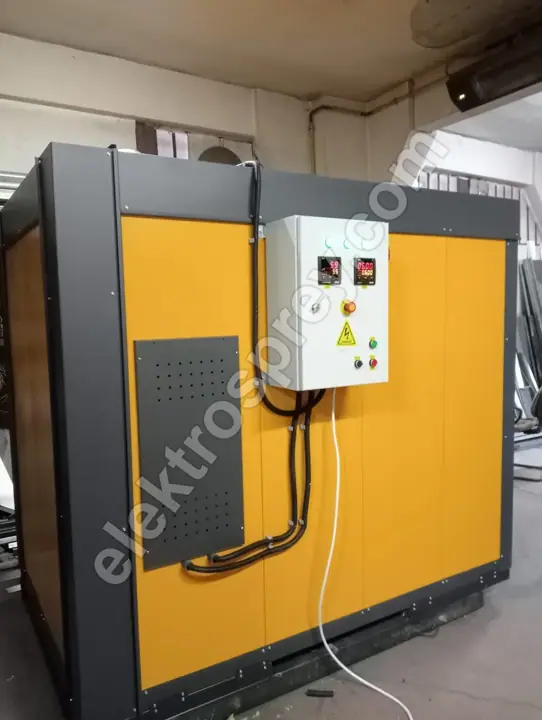
The investor's instinct is "take a bigger one so it never runs short." On a gas-fired oven that instinct produces three concrete penalties.
First, temperature swing. An oversized burner satisfies demand in a very short burst, shuts off, and fires again. The oven wanders in a wide band around the set point. On powders with a narrow cure window that swing comes back as gloss and colour differences between parts on the same rack.
Second, poor combustion at low fire. Burners do not run efficiently below a certain fraction of their design capacity. A burner permanently cycling near its minimum loses combustion efficiency, produces soot and fouls the heat exchanger.
Third, capital cost and the gas supply. A bigger burner means a bigger gas line, a bigger regulator, a higher contracted supply capacity and usually a bigger stack. You pay for the infrastructure of capacity you never use.
The correct approach is an honest calculation, a sensible margin, and the right modulation. Flexibility comes from how the burner modulates, not from how big it is.
Modulation type: on-off, two-stage or fully modulating
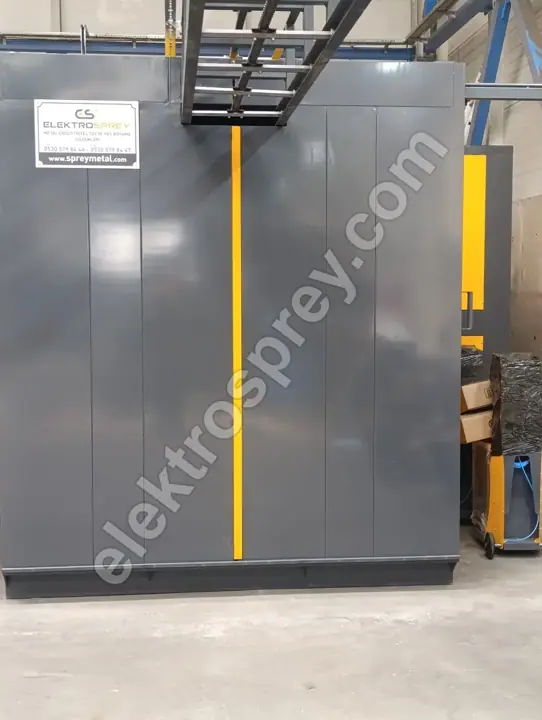
How a burner doses its output matters as much as how much output it has.
| Type | How it fires | Temperature stability | Where it is enough | Weakness |
|---|---|---|---|---|
| On-off (single stage) | Full fire / off | Low — wide swing | One colour, one part type, small batch oven | Swing, frequent cycling, component fatigue |
| Two-stage | High / low / off | Medium | Mid-size oven with clearly varying load | Still swings at intermediate loads |
| Fully modulating | Continuously matched to demand | High — narrow band | Continuous tunnel line, many recipes | Higher capital cost, more careful commissioning |
The decision rule is simple: the more the oven's load varies through the day, the more modulation you need. In a small box oven that reaches steady state in the morning and bakes similar parts all day, a two-stage burner is an honest choice. On a tunnel type powder coating plant running 500–5,000 parts/hour with a conveyor at 1–6 m/min and a product mix that changes through the shift, a fully modulating burner is not negotiable — the oven's demand when the line is empty and when it is full differ by a wide factor.
Modulation pays a second time in energy. A burner that tracks the load overshoots far less than one that cycles between full fire and off. You can quantify that gain for your own line using the method in powder coating oven energy consumption.
Fuel choice: natural gas, LPG or fuel oil
The fuel decision is usually made by the site: if a natural gas main reaches your plot, the discussion is largely over. If it does not, the decision turns into a question of tanks and resupply logistics.
| Fuel | Infrastructure needed | Combustion cleanliness | Decision note |
|---|---|---|---|
| Natural gas | Connection, gas line, regulator station | Cleanest | Default choice where the main exists; no stock to manage |
| LPG | Tank, filling area, safety distances | Clean | Common on sites without a gas main |
| Fuel oil | Tank, pump, filters | Dirtier, soot risk | Not used with direct heating; indirect is mandatory |
Discuss the possibility of a fuel change at the outset. If the gas main is due in a year, specifying a convertible burner, or simply routing and reserving the gas line now, is far cheaper than retrofitting later.
Direct or indirect heating?
This is the most frequently skipped item in burner selection, and the one with the heaviest consequences.
With direct heating, the combustion products mix into the oven's recirculating air and pass over the parts. Efficiency is high, capital cost is lower and warm-up is faster. There is one condition: combustion must be clean. With natural gas or LPG and a properly commissioned burner, that condition is met.
With indirect heating, the burner fires into a sealed combustion chamber, the heat transfers to the recirculating air through an exchanger, and the flue gas leaves through its own stack. The parts never contact combustion products. The price is explicit: the cost of the exchanger, some loss of efficiency and a somewhat longer warm-up.
Decide with three questions:
- Is the fuel liquid? Then indirect.
- Do you coat whites, light shades or high-gloss finishes? Combustion products can cause yellowing on light colours, so for colour-critical work go indirect.
- Does a customer specification or your sector (food equipment, defence, medical devices) forbid contact with combustion products? Then there is nothing to discuss: indirect.
If none of these apply, direct-fired natural gas is the right call on both capital and running cost. Our top-loading oven is built in either configuration, and the shell is always dimensioned around the customer's largest part — there is no catalogue size. The ovens are delivered under CE and EN 1020, and run at 30–40% lower energy cost than an electric equivalent.
Frequently asked questions
What burner capacity in kcal/h do I need?
It is set by the sum of the three load items above, not by oven volume. On the gas ovens we build, the band runs from 50,000 to 500,000 kcal/h (roughly 58–580 kW). A small batch box oven sits near the bottom; a continuous tunnel line pushing high tonnage of steel per hour sits near the top. The exact figure is calculated per project once part kg/hour and stack flow are settled.
Is an on-off burner enough for a powder coating oven?
It can be, on a small batch oven baking a single part type. But the temperature swing is wide, so it is not advisable for gloss- or colour-critical work. Use at least a two-stage burner on any line whose load varies through the day, and a fully modulating burner on continuous lines.
How much efficiency does indirect heating cost?
Transferring through an exchanger costs some efficiency and lengthens warm-up; how much depends on the exchanger surface and flue temperature, so it is calculated per project. Even so, with liquid fuel, colour-critical work or a binding specification, indirect is the only correct choice.
Can I increase burner capacity later?
Only partly. The shell, the insulation, the stack cross-section and the gas supply capacity are all fixed at design time, so swapping the burner alone rarely gets you there. If you expect to grow, the economical route is to size the gas line and stack for the target capacity while sizing the burner for today's need.
Is burner selection the same subject as combustion efficiency maintenance?
No. This article is the purchasing decision: capacity, modulation, fuel, direct or indirect. Once the burner is commissioned, flue gas analysis, air-fuel ratio setting and periodic checks are a separate discipline, covered in burner maintenance and combustion efficiency. A correctly selected burner left unmaintained will burn more gas than a poorly selected one.
Summary
The burner decision on a gas-fired oven comes down to four lines. Size it as warm-up plus losses plus part thermal mass, and add no more than a 15–25% margin. Buy flexibility through modulation, not through a bigger burner. Choose fuel from what the site actually offers, and settle the conversion question at the start. Move to an indirect combustion chamber if you burn liquid fuel, coat light colours or work to a specification that forbids combustion contact. These four decisions do not determine how fast the oven heats on day one — they determine how much gas it burns every month for a decade. Every oven we build is delivered with a 2-year manufacturer's warranty.
Send us your part kg/hour, your target temperature and your oven entry cross-section — we will break the burner capacity down into its three items and calculate it with you.
For plants in the UK, North America and beyond
Where your line is installed shapes the paperwork, the power supply and the rules behind the choices described above.
- Gas burners and fuel trains are commonly built to EN 746-2 and EN 676. In North America, expect UL or CSA listed components and a review by the local authority or gas utility; commissioning usually needs the gas supplier's sign-off.
- For the UK, confirm with your importer whether UKCA or CE marking is expected. In the US and Canada, plan for UL or CSA requirements on the electrical side, and check any local documentation rules before shipment.
- For the UK, goods of Turkish origin move under the Türkiye–UK free trade agreement with an EUR.1 certificate or an origin declaration. For other destinations, the origin paperwork depends on that country's trade agreements, so check it with your importer early.
- North America runs at 60 Hz, and 480 V is common in industrial plants, so motors, fans and controls have to be specified for that supply from the start. Confirm the voltage and frequency on site before the line is designed.
Products mentioned: Box Type Powder Coating Oven (Electric) · Tunnel Type Electrostatic Powder Coating System · Overhead Pallet Powder Coating Oven (Gas)
When you ask for a quote, tell us your country, supply voltage and frequency — get in touch.