
How Do You Eliminate Surface Defects on White Goods Panels?
On a wide, flat sheet-metal panel a single airborne particle or a faint orange peel wave turns the part into scrap. This article explains the line decisions that decide cosmetic quality on white goods panels — pretreatment stages, booth air pattern and pressure direction, conveyor speed and hanger mark placement, and oven uniformity — at the level an investment decision needs.
 Enlarge
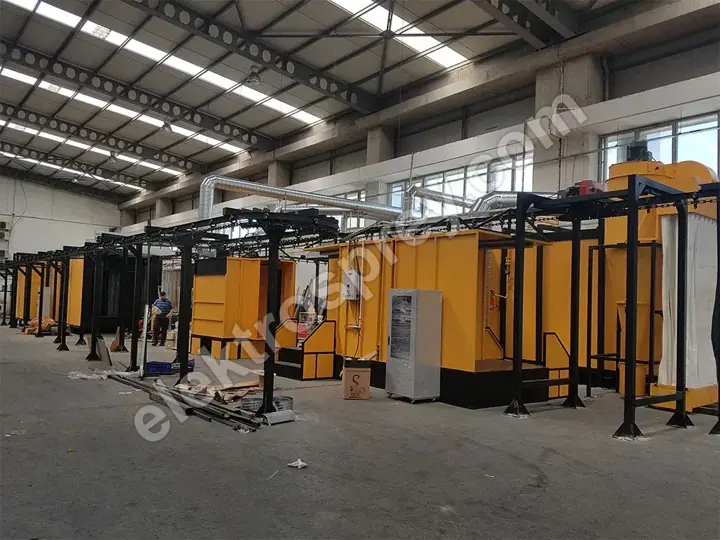
Sheet panel powder coating surface quality on white goods is delivered by the line, not by the gun. On a washing machine door or a refrigerator side panel the acceptance criterion is not thickness or adhesion but what the eye catches from two metres away — and that is set by four line decisions: which of the 3–7 pretreatment stages are rinses, whether booth air velocity stays inside the 0.5–0.8 m/s band, which speed the conveyor is fixed at within its 1–6 m/min range, and whether the oven holds ±3 °C uniformity. Get all four right and the reject rate drops; leave one out and half the panels go through a second coat whatever the line's rated capacity.
The constraint is cosmetic, not throughput. A line that coats a complex chassis without complaint can be rejected on a flat 600 × 900 mm panel: there is no curve, hole or shadow to hide a defect in.
Why is a wide flat panel the most unforgiving part?
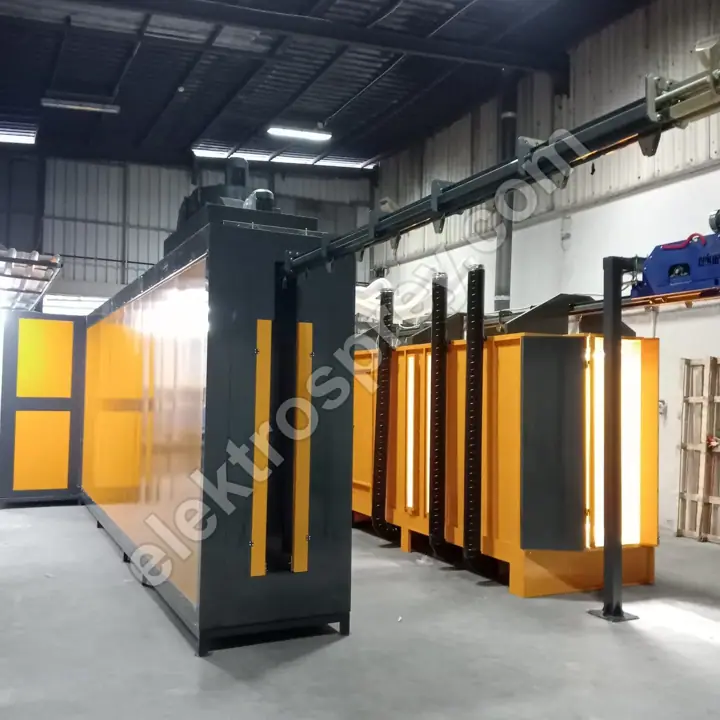
A flat surface behaves like a mirror. Light sweeps it at a single angle, so every deviation becomes visible at once and in the same direction. On a complex part the eye hunts for the defect; on a flat panel the defect finds the eye. Three consequences follow:
- Particle visibility. A 50-micron airborne fibre goes unnoticed on a curved profile but shines as a raised bump on a flat panel after cure.
- Amplified flow defects. An orange peel wave runs uninterrupted across a flat surface, while a break in the geometry cuts it and the eye stops reading one continuous fault.
- Readable gloss variation. A few degrees of bake difference between one end of the panel and the other shows up as a visible band.
So a line built for white goods panels is configured differently from a general-purpose line of the same capacity: the weight of the investment shifts from gun count to discipline over air and heat.
Pretreatment: half the defects form before coating
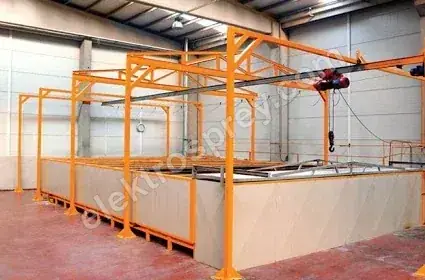
A large share of panel defects is decided before the part enters the booth. Oil film, drawing lubricant, fingerprints and mineral deposits from rinse water all reappear on a flat surface as craters, pinholes or dull patches.
For sheet panels the preferred arrangement is immersion based: in a spray tunnel a vertically hung panel lets rinse water run down and leave streaks, whereas immersion wets the whole surface evenly. The immersion surface treatment line covers degreasing, phosphating, passivation and drying; in panel work what matters is less the stage count than the quality of the final rinse and a droplet-free surface at the dryer exit.
| Stage | What it does on a panel | Defect if skipped |
|---|---|---|
| Degreasing | Removes press and forming oil | Craters, pinholes, dull areas |
| Intermediate rinse | Carries away alkaline residue | Hazy film, weak adhesion |
| Phosphating / conversion | Builds the adhesion surface | Edge lifting, corrosion |
| Final rinse (demineralised) | Zeroes out mineral residue | Drying stains, water-mark bands |
| Passivation | Stabilises the surface | Rust spots during storage |
| Drying | Removes water completely | Boiling blisters, porosity |
How many stages you need depends on substrate, contamination type and target corrosion resistance; the decision order is set out in how many pretreatment stages you need. The practical rule for panels: before adding a stage, measure the conductivity of your final rinse water. Most "unexplained stain" cases trace back to it.
Booth air pattern: where on the line do you stop the particle?
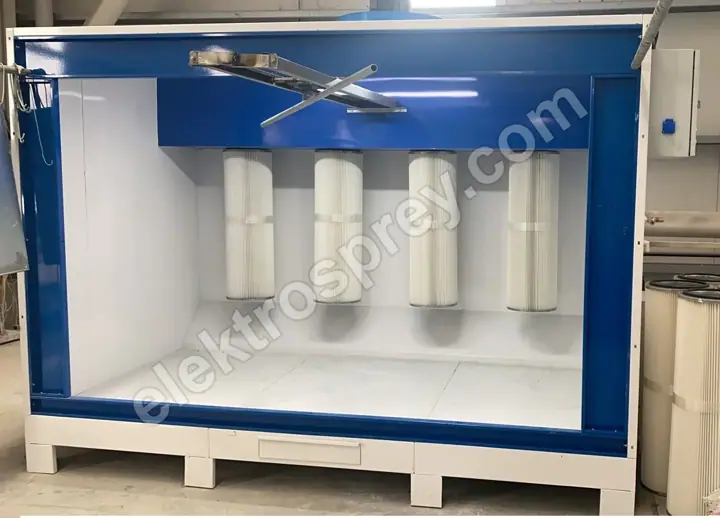
On a panel line the booth is less a powder recovery box than a clean air room. Three decisions dominate it.
Internal air velocity. The 0.5–0.8 m/s band is chosen because it is high enough to keep powder inside the booth and low enough not to strip freshly deposited powder off the part. On a wide panel the upper end is risky: a large flat face acts like a plate against the airflow, the stream turns turbulent behind the panel and leaves thickness variation along the edges.
Pressure direction. The volume around the booth must sit at a slight positive pressure so shop-floor lint cannot leak in. The commonest investment mistake in panel work is buying a good booth and placing it beside a machining area; the defect comes from the neighbour, not the booth.
Filtration and recovery. A cartridge booth delivers 99.9%+ filtration and 95%+ recovery. On panels the reclaim ratio is deliberately kept low: recycled powder accumulates fine particles and foreign matter, and both show on a flat surface. For a high cosmetic class, more virgin powder means giving up some transfer efficiency — and, plainly, higher operating cost.
Gun count (2–12 guns) follows panel width and conveyor speed; the comparison criteria are collected in choosing a powder coating booth. The cartridge filter powder coating booth we build for panel work is dimensioned, like every line we make, around the customer's largest part — no catalogue size.
Conveyor and hangers: you decide where the mark goes
A hanger mark is unavoidable — the question is not whether, but where. That belongs in the design phase: an edge, a hole or a flange hidden after assembly. Deciding after the line is built means paying twice for hanger tooling. Three conveyor items translate straight onto the surface:
- Speed stability. In the 1–6 m/min range the issue is not the speed itself but its fluctuation; if speed drifts, bake time drifts and gloss varies in bands.
- Swing. A panel swinging on its hanger changes gun distance and ruins thickness distribution; a stabilising fixture is a requirement, not a convenience.
- Contact point. Hanger-to-panel contact must conduct well; a panel that cannot discharge answers with back-ionisation and a coarse surface.
A tunnel line can be built for 500–5,000 parts/hour at 98.5%+ transfer efficiency, but on panel work throughput is set by the fastest conveyor speed that still meets the acceptance criterion, not by the oven. For layout and capacity, see the schematic on the tunnel type powder coating plant page; a similar cosmetic sensitivity at smaller scale is covered in powder coating lines for metal furniture components.
Oven: on a flat surface, uniformity is not negotiable
In the oven the panel's problem is not thermal mass but area. If one end of a square metre bakes a few degrees differently from the other, the result is two distinct gloss bands. A box type electric oven with its 80–250 °C range, PID control, ±3 °C uniformity and 16 curing profiles answers exactly this; thin sheet cannot share a ramp with a heavy body part. What to examine when specifying it:
| Decision | Effect on the panel | Measurement method |
|---|---|---|
| Temperature uniformity | Gloss bands, colour drift | Data logger curve on the panel |
| Heat-up ramp | Orange peel, flow window | Surface temperature vs time plot |
| Air circulation direction | Particle transport, streaks | In-oven air velocity measurement |
| Loading density | Shadowing, late cure | Full vs empty regime comparison |
The measurement procedure is set out step by step in oven temperature uniformity. If you are considering gas, the top-loaded pallet type works in the 140–220 °C band at a 30–40% lower energy cost than electric; in exchange, burner-driven air movement calls for more careful duct design on flat panels.
Frequently asked questions
How should the acceptance criterion for a white goods panel be defined?
A micron figure or a gloss value alone is not enough. A workable definition has three parts: viewing distance (typically 1–2 m), lighting condition and defect size threshold. Until those are written down, no line can answer "does it coat well enough" — the same panel reads differently under different light.
How many pretreatment stages does a panel line need?
Stage count ranges from 3 to 7, following contamination type and corrosion expectation. Cosmetically the outcome is decided not by stage count but by the final rinse water and a droplet-free surface at the dryer exit. Measuring the existing rinse water first makes the extra stage unnecessary in most cases.
How does booth air spoil a panel surface?
Two ways. When air velocity climbs above the band it sweeps the freshly deposited powder layer and ruins thickness distribution. And if the area around the booth sits at negative pressure, shop-floor lint enters and remains as bumps after cure. The first is a setting problem, the second a layout problem.
Can hanger marks be eliminated completely on a panel?
No. The part has to be held somewhere, and there the coating is either missing or marked. What you can do is move the mark to an area hidden after assembly and design a fixture that uses the same point every time. The goal is not "no mark" but "a defined, repeatable mark".
Why do the two ends of the same panel differ in gloss?
Almost always the oven: either a local temperature difference or one end more exposed to the airflow. To confirm, attach thermocouples to both ends and record the real temperature curve. If the curves overlap within the ±3 °C band the oven is not the cause, and attention moves to gun layout and film thickness distribution.
Summary
Surface quality on a white goods panel is won across the whole chain, not at one station. The order is fixed: final rinse discipline in pretreatment, air velocity and pressure direction in the booth, speed stability and hanger mark placement on the conveyor, uniformity in the oven. Capacity comes second here; a line that cannot hold the acceptance criterion runs on rework cost whatever its hourly figure. If you are planning the whole investment, our umbrella guide how to set up a powder coating plant is the right starting point. Every line we build is dimensioned around the customer's largest panel and delivered with a 2-year manufacturer warranty.
Send us your panel dimensions, your acceptance criterion and your hourly part requirement — we will work out together how much investment each station actually needs.