
How Dip (Immersion) Pretreatment Washing Works
Immersion beats a spray tunnel the moment the part has an internal surface a nozzle cannot see. The bath sequence of a dip pretreatment line, a line-by-line comparison against spray tunnels, and the drawbacks written honestly.
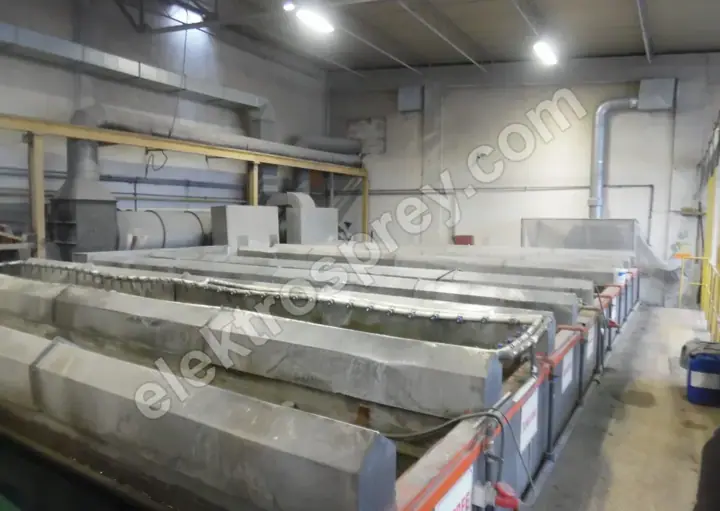 Enlarge
Immersion beats a spray tunnel the moment the part has an internal surface the nozzle cannot see. Box section, tube, closed profile, double-walled housing, deep bore, blind cavity — a spray jet travels in a straight line and carries no chemical to a face it cannot reach, while a part lowered into a bath is wetted everywhere the liquid can enter. What you give up is throughput: a spray tunnel type powder coating line runs a continuous flow of 500–5,000 parts/hour, whereas a dip surface treatment line works in batches and its hourly output is set by the hoist cycle. The stage logic is identical in both, built between 3 and 7 stages; what changes is not the name of the baths but how the part meets the chemical.
One sentence sums up the difference: spray cleans quickly through mechanical action, immersion cleans everywhere through contact time. In a tunnel the part is wetted only while it passes the nozzle zone; in a dip line the dwell time is whatever the hoist program says, and it climbs into minutes without difficulty. You can compensate for a weak chemical with time — you cannot recover the scrubbing action that spray pressure gives you.
Which parts belong in a dip line
Only two things decide in favour of immersion: the geometry of the part and the pattern of your production.
- Closed geometry with internal volume. Box section, tube, welded chassis, hydraulic tank, radiator body, double-walled cabinet. If the inside has to be protected too, there is no practical alternative to immersion.
- Heavy, large single parts. A part too heavy to hang on a conveyor hook is lowered into the bath in a basket or on a dedicated jig. The limit is set by the lifting equipment, not by a conveyor.
- Low to medium volume, high variety. In a shop where a different part runs every day you cannot re-aim a nozzle array for each one; a bath accepts every geometry as it is.
- Soil that needs long contact. Heavy drawing oil, dried rust preventive, old coating removal — here time, not pressure, is the solvent.
Where immersion is the wrong answer is equally clear: when you make many of the same part. Flat panels, rack legs, enclosure doors — simple geometry in high volume — turn a dip line into the bottleneck of the plant because of the hoist cycle.
Dip line vs spray tunnel — line by line
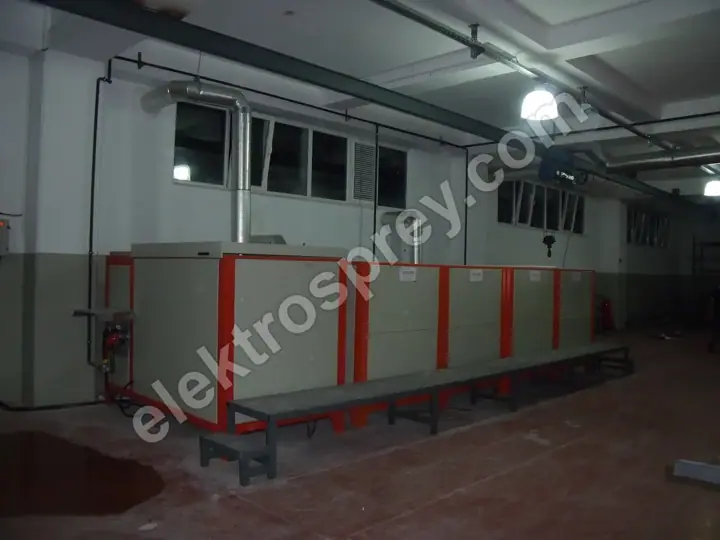
| Item | Dip (immersion) line | Spray tunnel |
|---|---|---|
| Contact time | Set by the hoist program; can run into minutes | Only as long as the part passes the nozzle zone; short and fixed |
| Blind cavities / internal faces | Strong — reaches every surface the liquid can enter | Weak — any face the nozzle cannot see stays unwashed |
| Mechanical action | Almost none; works through chemistry plus time | Present — spray pressure physically strips the soil |
| Chemical consumption | Large tank fill, slow turnover; losses come mainly from drag-out | Small tank, constant circulation; higher evaporation and leakage losses |
| Floor space | Compact in length; the real demand is tank volume and hoist headroom | Long tunnel; every stage adds metres along the line |
| Investment items | Tanks, hoist/monorail, baskets and jigs, heating | Tunnel shell, pumps, nozzle system, conveyor |
| Sludge and effluent | Sludge settles at the tank bottom; periodic dumping and bath renewal | Sludge is filtered continuously; circulation lines can clog |
| Part weight limit | Set by the lifting equipment — an advantage on heavy parts | Set by conveyor hook capacity; struggles with heavy parts |
| Line speed / capacity | Batch; hourly output tied to the hoist cycle | Continuous flow; conveyor 1–6 m/min, 500–5,000 parts/hour |
| Flexibility across part types | High — one bath accepts any geometry | Low — the nozzle layout is designed around the part |
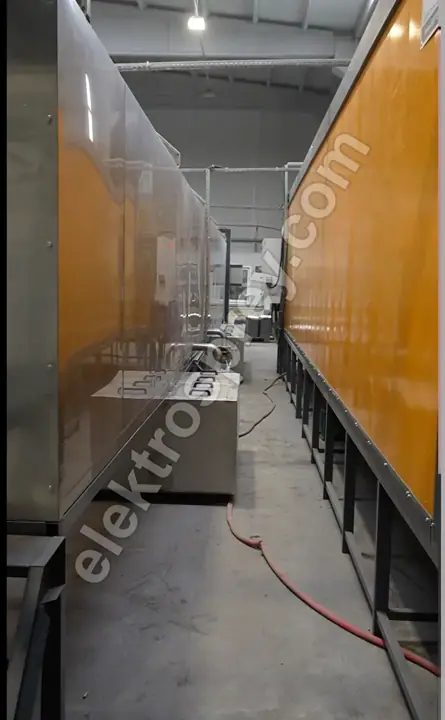
The practical rule that falls out of the table: complex geometry goes to immersion, high volume goes to the tunnel. Some plants build both — standard parts flow through the tunnel, hollow or heavy specials go through the dip line, and the two streams meet again at the same booth and oven.
The bath sequence and what each stage does
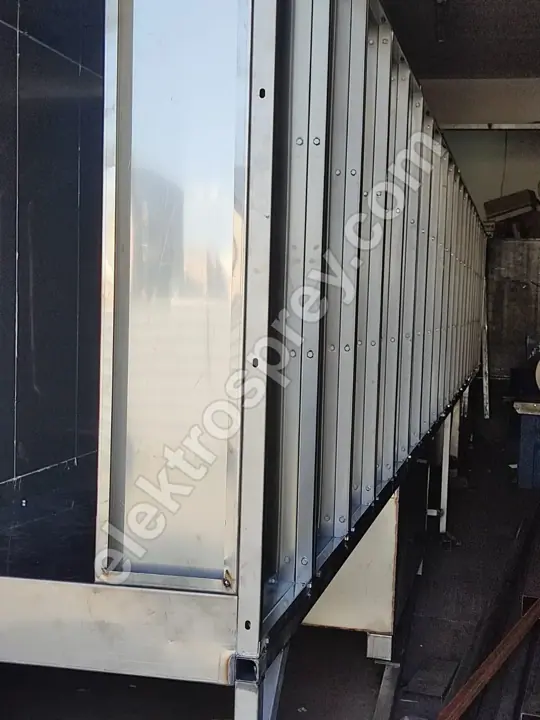
The stage order in a dip line is the same as in a tunnel; the only change is that each bath is a tank. The full sequence:
| # | Stage | Function | Note specific to immersion |
|---|---|---|---|
| 1 | Degreasing | Removes drawing oil, cutting fluid, fingerprints and dust from the surface | Runs hot; oil collects on the tank surface, so a skimming arrangement is mandatory |
| 2 | Rinse | Takes the alkaline chemical off the surface and protects the next bath | Dragged-in alkali lands straight here; the fastest-fouling stage |
| 3 | Phosphating / conversion coating | Builds a micro-crystalline layer the coating can bond to chemically | In a dip line the layer forms on internal faces too — this is the real gain |
| 4 | Rinse | Removes free acid and phosphate residue | Leftover acid upsets the pH of the passivation bath |
| 5 | Passivation | Seals the pores of the phosphate layer and locks it | Dwell time is critical; a short dip only half-seals the layer |
| 6 | Demineralised rinse | Final wash that leaves no mains-water salts or minerals on the surface | Being a tank, its conductivity is monitored and it is renewed at a set threshold |
| 7 | Drying | Sends the part into the booth completely dry | Draining water trapped in blind cavities is the most critical point here |
Shorter lines merge stages 3 and 5, or drop passivation altogether; which stage can be sacrificed for which part is worked through in how many pretreatment stages you need. No stage substitutes for another: you cannot make up for missing phosphating with longer dwell, or for a missing rinse with better chemistry.
The honest drawbacks of immersion
A dip line is easy to sell and harder to run. What you should know before deciding:
Bath contamination. A tank is a closed volume; whatever dirt enters stays there. Oil floats on the degreasing bath and sludge settles under it. A fouled bath does not clean the part — it leaves dirt on it. That is why bath analysis (concentration, pH, temperature, conductivity) is a daily job for a named person, and a dumping and renewal plan has to exist from day one.
Drag-out losses. The film of liquid left on a part leaving a bath is carried into the next one. That is both chemical loss and cross-contamination. The amount depends on surface area, geometry and drain time: a part held over the tank for 10–30 seconds carries visibly less chemical than one pulled straight across. Put drip trays and drain stations into the layout from the start.
Jig and basket design. Racking matters far more in a dip line than in a tunnel. Parts must not lean on each other, contact points must be minimal, and the basket itself must not trap liquid. In a badly stacked basket the parts underneath are half-washed, and you only find out after coating.
Air pockets. If the air inside a closed section cannot escape as the part goes down, that volume is never wetted. On the way out the opposite happens: liquid is trapped inside, carried into the next bath, survives the dryer and turns to steam in the oven. The fix lives in the part design — a vent hole and a drain hole. The rule is simple: vent at the highest point, drain at the lowest, and the part enters the bath at an angle rather than flat.
Heating energy. Degreasing and phosphating baths run hot. A tank holds far more volume than the spray stage doing the same job, and all of it has to be heated and held at temperature. Without tank lids, insulated shells and a surface cover, heat loss can become the single largest item in your operating cost.
Lifting equipment. The hoist, monorail or semi-automatic transfer is part of the investment and it sets the speed of the line directly. A line built around a manual chain block is cheap to install and costs you capacity every day afterwards.
Capacity and space: how the arithmetic works
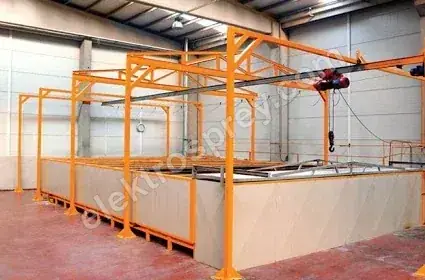
In a dip line hourly capacity comes from the cycle time, not from conveyor speed. One cycle is: load the basket, lower it, hold for the dwell time, lift, wait for draining, transfer to the next tank. The total is the sum of the dwell times plus the transfers. Your parts-per-hour figure is then a function of how many parts fit in a basket and how many minutes the cycle takes.
Two design decisions follow. First, duplicate the bottleneck stage. Whichever bath holds the longest dwell — usually degreasing or phosphating — building two of it raises total capacity more than every other improvement combined. Second, put the drain station inside the cycle. Those 10–30 seconds are forgotten in planning and subtracted from every single cycle in real production.
On space, a dip line is economical in length but expensive in height: the hoist must clear the basket completely out of the tank, so you need tank depth plus basket height plus hook clearance in ceiling height. Plan that vertical dimension before anything else; we go through it in powder coating plant space and layout. For the whole investment and the order in which to make it, our main guide, how to set up a powder coating plant, is the right starting point.
Frequently asked questions
Does immersion clean better than a spray tunnel?
In terms of reaching every surface, yes. In terms of cleaning power, no. Immersion carries the chemical to every point of the part; spray adds mechanical force through pressure. If the soil is thick and sticky, spray strips it faster. But on a part with internal surfaces, whatever the nozzle cannot reach will not be clean — and there immersion has no substitute.
How do you prevent air pockets?
Through part design, not line design. Every closed section needs a vent hole at its highest point and a drain hole at its lowest. Where holes are impossible, the part is dipped at an angle chosen so the trapped air has an escape route. The jig should hold that angle mechanically; you cannot expect an operator to reproduce it by hand on every load.
How can drag-out losses be reduced?
Three ways: drain time, orientation and drip trays. Holding the part over the tank for 10–30 seconds after lifting returns a significant share of the carried liquid to the bath. Racking the part at an angle rather than flat lets the liquid run off from a single point. Drip trays between tanks catch what is lost during transfer.
How often does a dip bath need renewing?
By measurement, not by calendar. Free alkali and oil loading are tracked in the degreasing bath, the total-to-free acid ratio in the phosphate bath, and conductivity in the rinses. A bath is renewed when a measured value leaves its working window and cannot be brought back with a top-up. Shift count, part soiling and drag-out volume shift that interval enormously from plant to plant, so do not trust a general figure like "every three months".
How much space does a dip line need?
In length it is shorter than a spray tunnel with the same number of stages, but it demands ceiling height and hoist clearance. You also need a loading and unloading area, a basket staging area, and a separate chemical store. Because we build each line around the customer's largest part, tank dimensions come from your part — there is no catalogue size.
Can one plant run both a dip line and a tunnel?
It can, and larger plants often do. High-volume standard parts flow through the tunnel, hollow or heavy specials go through the dip line, and after drying both streams meet at the same booth and oven. This raises the initial investment but gives the right result for both part families; trying to do both well with a single line usually means doing both moderately.
Summary
Dip pretreatment carries the chemical to every surface the liquid can enter, which is exactly what a spray tunnel cannot do on box sections, tubes, welded chassis and blind cavities. The stage sequence is the same — degrease, rinse, phosphate, rinse, passivate, DI rinse, dry — but the operation is not: bath contamination, drag-out losses, jig and air-pocket design, tank heating energy and lifting equipment are the real price of the method. For high-volume, simple-geometry production the spray tunnel wins clearly. The right decision sits at the balance between your part geometry and your annual volume. Every line we build is delivered with a 2-year manufacturer's warranty.
Send us the size, geometry and annual volume of your part — we will work out whether you need a dip line or a tunnel and quote it with the tank dimensions.