
Conveyor Chain Lubrication and Tensioning: How Often Is It Really Needed?
Conveyor chain maintenance on a coating line does not fit a single schedule: lubrication, tension checks and elongation measurement run on different intervals. This article covers the separate lubricant regime inside and outside the oven, how far the take-up station should be opened, and how to base the replacement decision on measured elongation.
 Enlarge
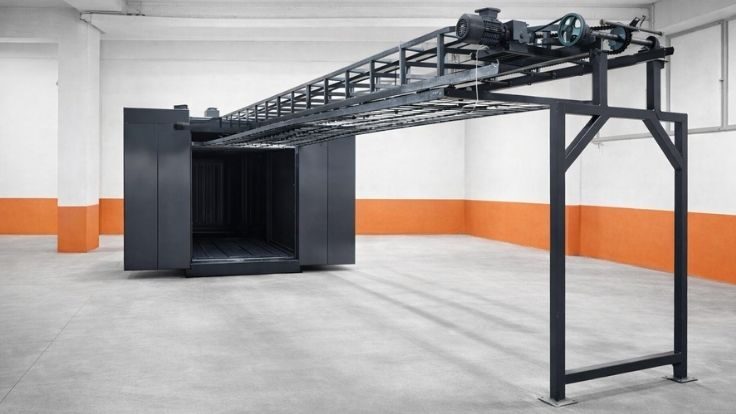
On a coating line, conveyor chain maintenance, tensioning and lubrication cannot share one interval; three separate jobs run on three separate schedules. The pattern that works in the field: a look-and-listen check every shift, lubrication in a weekly-to-monthly band, a tension check monthly, elongation measurement in a six-monthly-to-annual band. A chain running at 1–6 m/min covers kilometres a day, and on a line rated at 500–5,000 parts/hour one hour of chain downtime is that hour's entire output. Tighten the intervals to your real running hours — the bands above assume a single 8-hour shift and are always checked against the chain manufacturer's instructions.
The chain is the backbone of the line: the oven, booth and pretreatment section stay put while the chain moves, heats and wears continuously. That is why so many unplanned stoppages come from the chain — and why almost all of them give a measurable warning first.
What lubrication and tension actually control
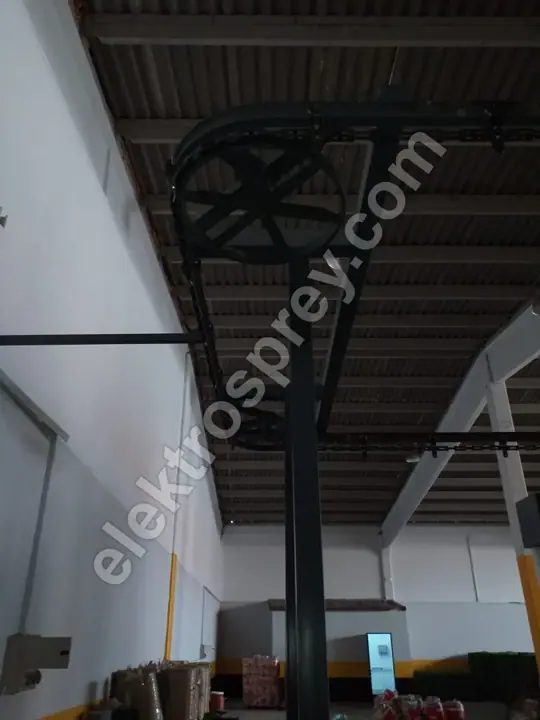
A conveyor chain has two distinct friction points, and they behave differently:
- Roller-to-track contact. Left dry, rolling turns into sliding, pull force rises and motor current climbs with it.
- Pin-to-bushing contact. In every link a pin turns inside a bushing, and this is where elongation is born. Once the oil film is gone, pin and bushing abrade each other, each link gains a few microns of play, and that play adds up along the whole chain.
Tension manages the consequence of that elongation. As the chain stretches the take-up absorbs the slack; if sag grows, the chain no longer seats on the sprocket, hanger pitch drifts and parts pass the guns in the wrong position. Running it tighter is no answer either: excess tension raises pin-and-bushing load, accelerates elongation and shortens bearing and gearbox life. How much the chain has to pull is calculated when the line is designed — item by item in conveyor chain selection and pull force. The subject here is not selection but getting full service life out of the chain you already chose.
Inside and outside the oven: two lubricant regimes
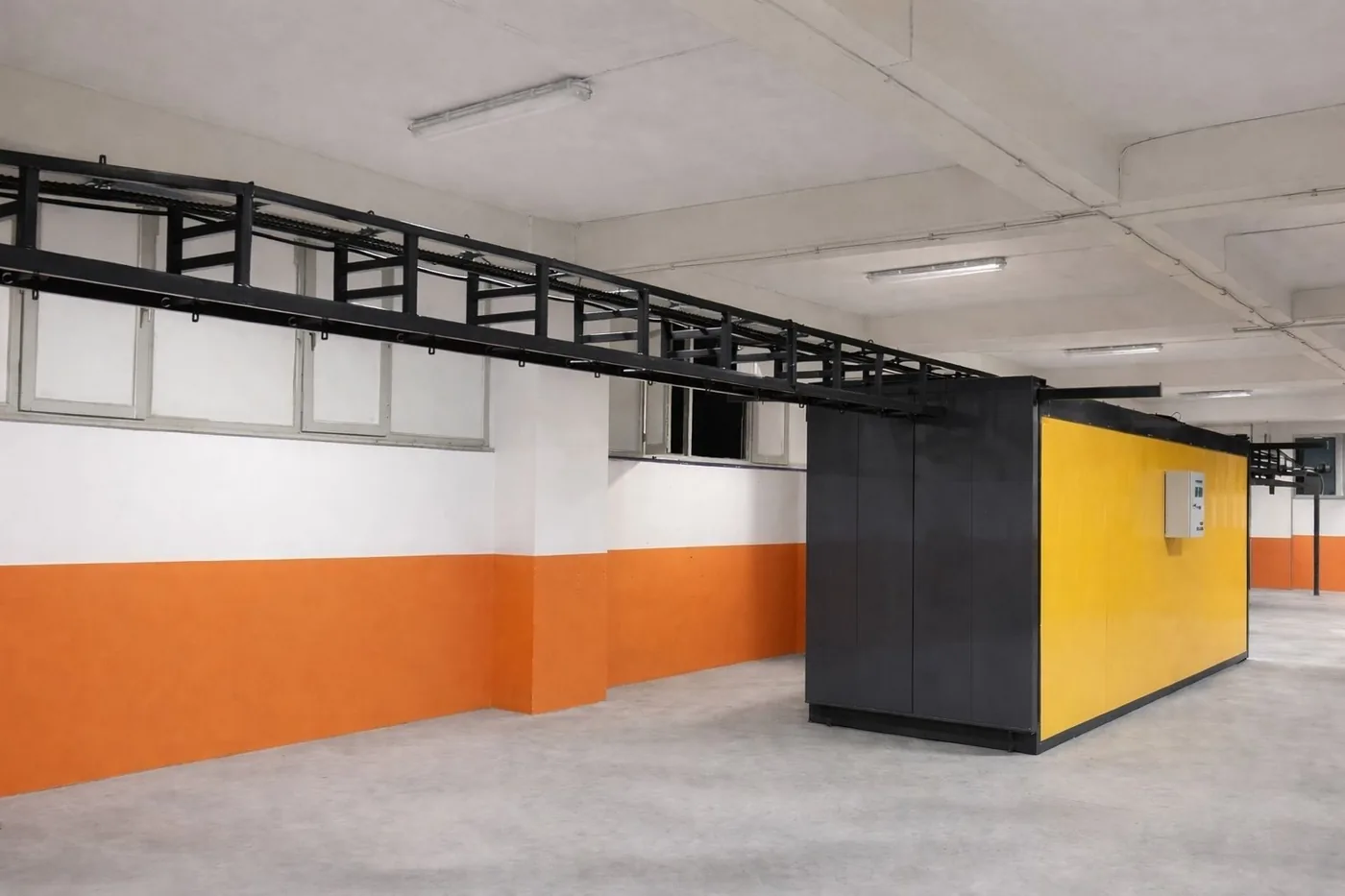
This is what sets a coating line conveyor apart: part of the chain passes through an oven running at 140–220 °C while the rest sits at ambient temperature. Covering both zones with one lubricant is the most common maintenance mistake on these lines.
An ordinary mineral-based oil that works fine outside the oven first thins and drips in the hot zone, then evaporates and carbonises. What stays between pin and bushing no longer lubricates — it abrades. The oven pass therefore needs a high-temperature, residue-free synthetic or dry-film type lubricant. Which product that is should be settled between your chain and lubricant suppliers: give them your oven temperature and chain type, and ask for the recommendation in writing. Do not pick a viscosity grade out of a catalogue — temperature range, drip point and residue behaviour matter far more here.
| Zone | Ambient condition | What the lubricant must do | Typical mistake |
|---|---|---|---|
| Pretreatment and rinse exit | Ambient, humid | Repel water, prevent rust | Lubricant washed off, dry rollers |
| Dry-off oven entry | Warm | Leave no residue | Excess oil dripping onto parts |
| Booth and load/unload area | Ambient | Minimal quantity, no dripping | Over-lubrication, contaminated powder |
| Curing oven interior | 140–220 °C | Withstand heat, leave no carbon | Ordinary oil, carbonising and wear |
| Oven exit and cool-down | Falling temperature | Re-form the film | No lubrication applied at all |
In practice, place the lubrication point so the chain never runs over the part line after being oiled. That spot is usually the empty return run: after parts come off the hangers, before new ones are loaded.
Why a drop of oil opens a crater
This is the one item that looks like maintenance and turns out to be quality. A drop of oil landing on a part in the booth or on the hanger makes the coating pull away from that spot during cure, leaving a crater visible to the naked eye. It is a defect of the line, not of the powder, and changing the batch will not close it.
The routes oil takes to the part are few, and every one of them is controllable:
- Over-lubrication. Surplus oil is thrown clear, collects on the track and drops off with vibration. The correct dose is not "make the chain shine" but "keep pin and bushing wet".
- Wrong lubrication point. The chain passing over the booth or hanger line straight after being oiled.
- No drip trays. A steel tray along every stretch of track above the booth and load area is mandatory; one that is never emptied is worse than none.
- Wrong lubricant. Oil that thins at oven temperature drips at the oven entry; if the drop lands on uncured powder, the defect is certain.
- Oil from the compressed air line. Nothing to do with the chain, but the same defect — which is why the compressor oil separator goes on the same schedule.
If you see craters and changing the powder did not help, walk the whole length of track above the part line by hand. Chain oil is only one source of cratering, but the most deceptive: the defect appears only on the part the drop landed on.
Tensioning: how far to open the take-up station
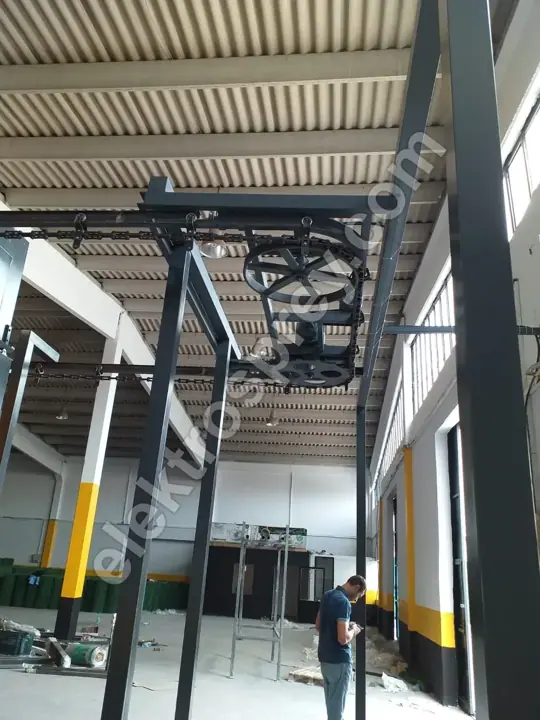
The take-up station — screw, gravity or spring type — absorbs elongation. The target is not a fixed force but acceptable sag and correct seating on the sprocket. What to check:
- Sag on the return run. Where the chain hangs free, sag is visible by eye; if it exceeds the value in the manufacturer's instructions, open the take-up.
- Seating on the drive sprocket. A chain that rides up, chatters or skips a tooth is usually reporting elongation, not tension.
- Remaining take-up travel. Once the station is at the end of its travel the decision is link removal or replacement, not adjustment.
- Motor current. A permanent rise at the same load points to a dry roller or to over-tensioning.
Record how much take-up travel has been used at every check. That single number says more about the chain's remaining life than any other indicator, and it sets the date on which you order the spare — plan it the way we describe in spare parts stock and the critical parts list.
Measuring elongation and deciding on replacement
A chain warns you by stretching before it ever breaks, and the measurement is done on the shop floor: with the chain tensioned, measure a set number of consecutive links (10 or 20, say) from pin centre to pin centre with a tape and compare it with nominal pitch × number of links. The difference, as a percentage, is the elongation.
The replacement threshold depends on chain type and sprocket tooth count; the binding figure is the value in the chain manufacturer's instructions — do not memorise a generic percentage. What matters is repeating the measurement in the same section, by the same method, and watching the curve: accelerating elongation means the lubrication regime has broken down.
| Finding | What it means | Decision |
|---|---|---|
| Elongation below the maker's threshold and stable | Lubrication regime is right | Continue the schedule |
| Elongation accelerating | Oil film failing or contamination entering | Review lubricant type and interval |
| Elongation concentrated in one section | Dry roller, binding or misalignment there | Check track alignment and rollers |
| Take-up travel exhausted | Total elongation at the limit | Remove links or plan replacement |
| Hooked or worn sprocket teeth | The chain has eaten the sprocket too | Replace chain and sprocket together |
| Link play felt by hand | Advanced pin and bushing wear | Replace at the next planned stop |
Replacing chain and sprocket together is a rule, not an option: a sprocket that has carried a stretched chain has lost its tooth profile and will ruin a new one quickly. Budget it as planned maintenance, not capital expenditure.
Building the maintenance schedule
Writing lubrication and tension into a chart of their own achieves little; they belong on the same schedule as the rest of the line's periodic work. The oven fan, booth filters and pretreatment tanks already demand planned stoppages — hang the chain jobs on those stops, using the framework in the periodic maintenance schedule for a powder coating line. When the capacity plan changes — more shifts, higher conveyor speed — the intervals change with it; powder coating line capacity calculation connects throughput to maintenance load.
On the tunnel type powder coating plant and aluminium U-type line projects we build, the conveyor is sized around the customer's largest part; there is no catalogue size. Lubrication point, drip trays and take-up position are therefore decided per project from the layout, and shown to the maintenance team during commissioning.
Frequently asked questions
How often should a conveyor chain be lubricated?
On a single-shift line, a weekly-to-monthly band is a reasonable starting point; with two or three shifts, a hot oven or moisture carried over from pretreatment, it shortens. Find the interval by measurement, not by calendar: if motor current rises noticeably between one lubrication and the next, the interval is too long.
Which lubricant is used on the chain inside the oven?
The oven section needs a heat-resistant lubricant that does not drip and leaves no carbon residue; ordinary mineral oil thins, drips and turns to residue in the 140–220 °C band. The product follows your chain manufacturer's instructions plus a written recommendation from the lubricant supplier for your oven temperature. Do not select a viscosity grade from a catalogue.
What happens if chain oil drips onto the coated surface?
During cure the coating pulls away and a crater forms. Because it shows up on a single part, time is usually lost suspecting the powder batch. The countermeasure has three parts: reduce the quantity applied, move the lubrication point off the part line, and fit drip trays along the booth and load area — then empty them on schedule.
How do you know how tight the chain should be?
The criteria are sag and sprocket seating: sag on the free return run stays within the value in the manufacturer's instructions, and the chain seats on the drive sprocket without chatter or skipping. Running it tighter shortens life rather than extending it — pin and bushing load rises and elongation accelerates.
What tells you the chain is due for replacement?
Any one of three signs is enough: elongation has reached the manufacturer's threshold, the take-up station has run out of travel, or the sprocket teeth have started to hook. All three can be handled at a planned stop; chains rarely fail without notice — it only looks like a surprise when nobody recorded the readings.
Summary
Conveyor chain maintenance is the sum of three jobs: lubrication with the right product at the right point, tension judged by sag and sprocket seating, and elongation managed by measuring and recording it. The oven section demands its own lubricant regime, and lines that ignore that distinction consume chain far faster. Oil dripping onto the finish is where a maintenance error becomes a quality defect — that is where craters begin. Record the readings, watch the curve, replace chain and sprocket together. Every line we build is delivered with a 2-year manufacturer's warranty, with maintenance points marked on site during commissioning.
Send us your conveyor layout, oven temperature and shift pattern — we will work out the lubrication points and the maintenance intervals with you.
For plants in the UK, North America and beyond
Where your line is installed shapes the paperwork, the power supply and the rules behind the choices described above.
- Gas burners and fuel trains are commonly built to EN 746-2 and EN 676. In North America, expect UL or CSA listed components and a review by the local authority or gas utility; commissioning usually needs the gas supplier's sign-off.
- For the UK, confirm with your importer whether UKCA or CE marking is expected. In the US and Canada, plan for UL or CSA requirements on the electrical side, and check any local documentation rules before shipment.
- For the UK, goods of Turkish origin move under the Türkiye–UK free trade agreement with an EUR.1 certificate or an origin declaration. For other destinations, the origin paperwork depends on that country's trade agreements, so check it with your importer early.
- North America runs at 60 Hz, and 480 V is common in industrial plants, so motors, fans and controls have to be specified for that supply from the start. Confirm the voltage and frequency on site before the line is designed.
Products mentioned: Aluminum Profile U-Type Powder Coating System · Tunnel Type Electrostatic Powder Coating System · Overhead Pallet Powder Coating Oven (Gas)
When you ask for a quote, tell us your country, supply voltage and frequency — get in touch.