
Building a Daily, Weekly and Monthly Maintenance Schedule for a Powder Coating Line
The way to stop doing maintenance only when something breaks is to split the work into four columns — daily, weekly, monthly, annual — and put one named owner on every line. A schedule template that divides the work between shift operator, in-house maintenance and external service, equipment by equipment.
 Enlarge
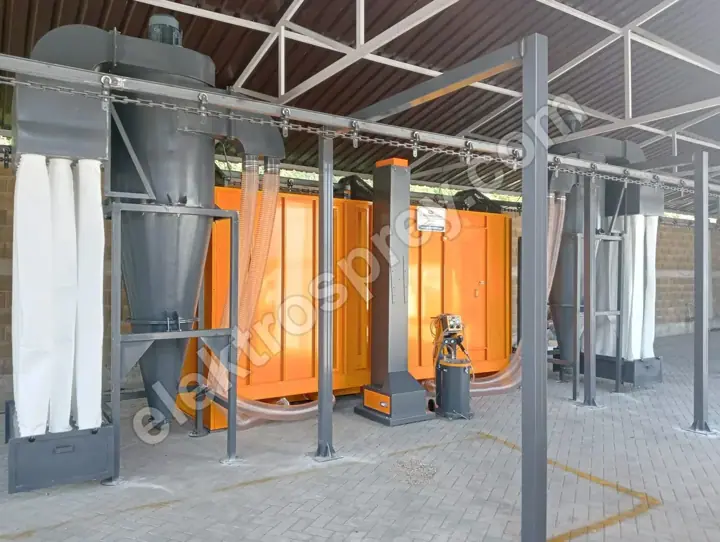
A preventive maintenance plan for a powder coating line is built in four columns: daily (checks the operator makes at the start and end of a shift), weekly (cleaning and measurement by in-house maintenance), monthly (mechanical adjustment and calibration) and annual (a general overhaul during a planned shutdown). When we hand a line over, the oven holds ±3 °C uniformity, the cartridge filter powder booth runs at 95%+ reclaim, the cartridges filter at 99.9%+ and booth air velocity sits between 0.5 and 0.8 m/s. None of those figures hold themselves. Whether they are still true a year later is decided by whether these four columns were ever written down. The real job of the schedule is not to make a list — it is to put one named owner on every line.
The most common failure we see is administrative, not technical: because maintenance is everyone's job, it becomes nobody's. The operator says maintenance handles it, maintenance says nothing has broken, and the external service arrives once a year to find a situation that is already overdue. The moment a schedule draws the line between those three parties, the same plant with the same people stops less often.
Why the schedule needs four columns
A powder coating line is not one machine. It is a chain: pretreatment tunnel, drying and curing oven, powder booth, conveyor, compressor and filtration, all tied together. Nothing in that chain wears at the same rate. Powder builds up on the booth floor within a single shift, conveyor chain elongation takes months, oven insulation fatigue plays out over years. Write one monthly list and the daily work is done far too rarely; put everything on a daily list and nobody fills it in at all.
The logic of the four columns is this:
- Daily — what can be seen, heard and wiped without tools and without stopping the line. Owner: the shift operator.
- Weekly — cleaning and simple measurements that need the line stopped briefly. Owner: in-house maintenance.
- Monthly — work that requires dismantling, adjustment or calibration; usually planned into a shift end or weekend.
- Annual — the general overhaul with the line down for days; its scope and duration are planned separately, and we cover it in annual overhaul and shutdown planning.
Owner, duration and record for each column
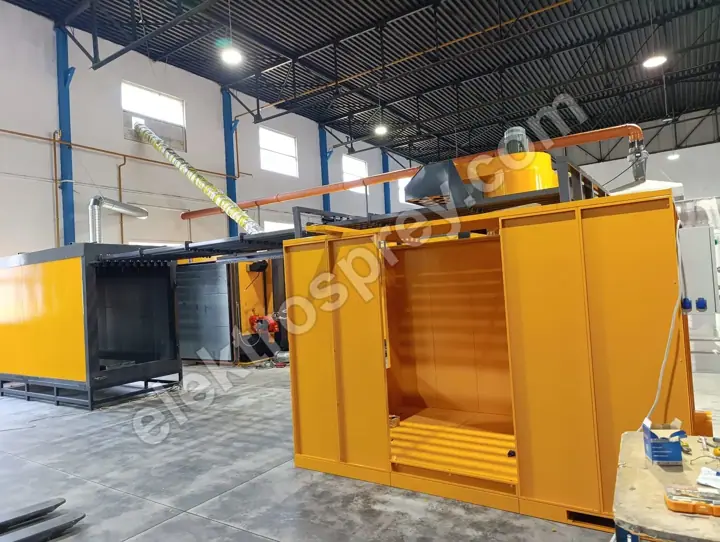
| Column | Who does it | Typical duration | Scope | Record |
|---|---|---|---|---|
| Daily | Shift operator | Short, at shift start and end | Visual checks, cleaning, reading pressures and temperatures, listening for leaks, noise, vibration | Signed shift sheet |
| Weekly | In-house maintenance | Short planned stop | Booth and cyclone cleaning, filter differential pressure reading, bath analysis, chain inspection | Weekly sheet with measured values written in |
| Monthly | In-house maintenance, external service where needed | Planned stop | Belt tension, bearing and fan checks, chain lubrication and tensioning, panel inspection, sensor verification | Maintenance card: work done, parts replaced |
| Annual | External service / manufacturer | Multi-day planned shutdown | Oven temperature mapping, insulation and seal check, burner tuning, ATEX and earthing measurement, conveyor overhaul | Report plus measurement certificates |
The most important column in that table is the last one: the record. Maintenance without a record counts as maintenance not done. The reason is diagnostic, not bureaucratic. When a defect appears and you cannot answer "when was this filter changed, when was the oven last mapped", you stop looking for the root cause and start replacing parts. How to log downtime and its causes is covered separately in downtime records and OEE tracking.
The equipment-by-equipment schedule
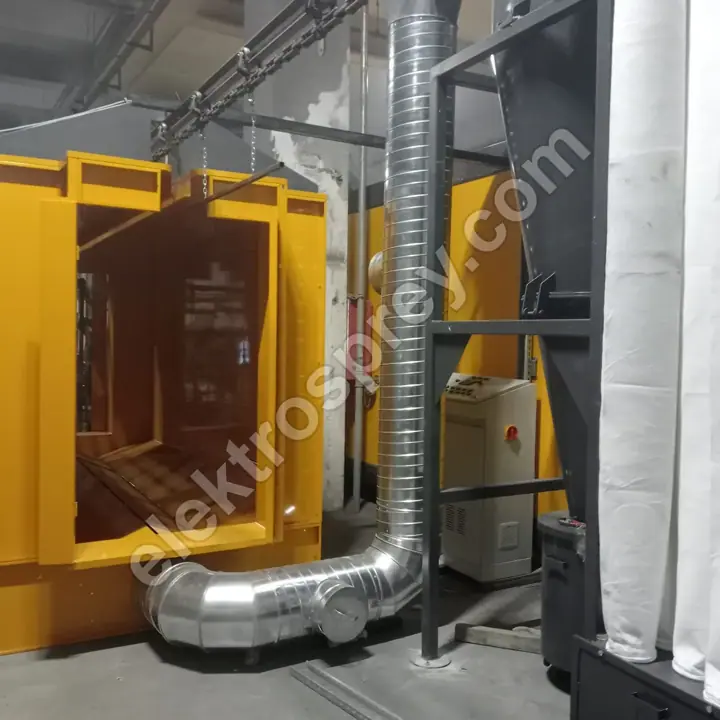
The table below is the skeleton of the sheet that should go on the wall at commissioning. The frequencies are a starting point; tighten them according to your shift count, how dirty your parts are and the powder you run.
| Equipment | Daily | Weekly | Monthly | Annual |
|---|---|---|---|---|
| Powder booth | Floor and wall cleaning, gun tip and electrode check, watch for powder escape | Cyclone and duct cleaning, booth sealing check | Air velocity measurement (target 0.5–0.8 m/s), earthing resistance | Enclosure and ATEX equipment inspection, reclaim efficiency verification |
| Cartridge filters and pulse-jet | Read and log differential pressure, drain the air receiver | Pulse valve and pulse sound check, cleaning interval review | Diaphragm and solenoid check, seals | Cartridge condition assessment and bulk replacement decision |
| Oven (electric or gas) | Set point versus indicated temperature, door and curtain closure, unusual noise | Fan belt tension, internal surface cleaning | Thermocouple verification, door seal, duct and nozzle check | ±3 °C uniformity verified by temperature mapping, insulation and panel check, burner and flue tuning on gas ovens |
| Conveyor | Visual and audible check, damaged hangers, rubbing points | Lubrication points, track cleaning, drive unit observation | Chain elongation measurement, take-up adjustment, gearbox oil level | Chain and roller overhaul, track alignment, drive unit service |
| Pretreatment tunnel / baths | Temperature, level and pump pressure readings, blocked nozzles | Bath analysis (concentration, pH, conductivity), bag filters | Sludge removal, heater and exchanger check, nozzle removal and cleaning | Tank draining, internal inspection, pump and pipework overhaul |
| Compressor and air line | Condensate draining, pressure and oil level | Air filter, oil separator check, leak listening | Dryer dew point check, line filter elements | General service, safety valve test, full leak survey |
| Electrical panel and controls | Alarm screen, emergency stops, indicator lamps | Panel fan and filter cleaning | Terminal tightening, earth leakage relay test | Thermal camera panel survey, earthing measurement |
| Hangers and jigs | Contact point cleaning, removal of deformed hangers | Emptying the stripping queue | Hanger stock count and replenishment | Review of hanger design against the current part mix |
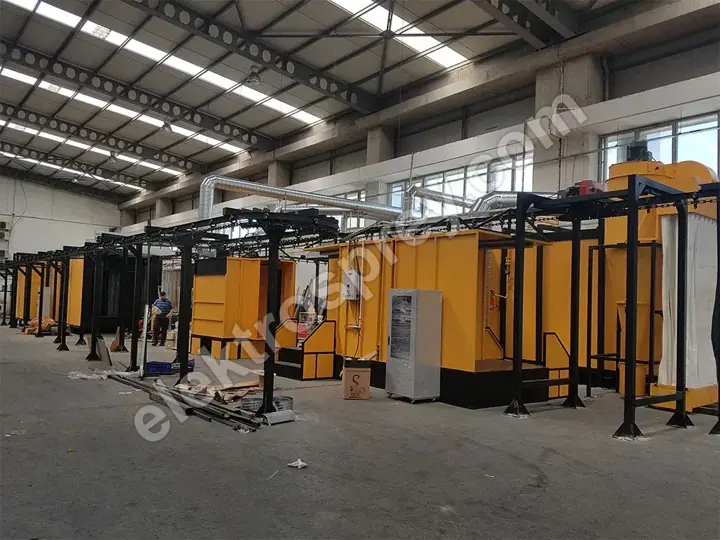
One line in that table pays for itself faster than the rest: logging cartridge filter differential pressure every day. A single reading means little; the information is in the slope. A pressure difference that climbs slowly under the same production pattern says the filters are ageing. One that jumps overnight says the cleaning system has a fault. Only the history separates those two.
Three rules that keep a schedule off the wall and in use
One: every line has a single owner. "The maintenance team" is not an owner. On the shift sheet the person who made the check signs it; on the weekly and monthly sheets the person who did the work writes their name. Shared responsibility means shared drift.
Two: every check item is written so it can be measured. Not "booth cleaned" but "booth floor and walls cleaned, cyclone emptied". Not "filter checked" but "differential pressure read: ...". An item with no measurable outcome is an item that can be ticked without being done.
Three: the schedule lives inside the production plan. A monthly stop that has no slot in the shift plan gets pushed the first busy week and never comes back. Reserve the monthly maintenance window in advance, and place the annual overhaul in your low season, with spare parts ordered at least a month ahead.
These three rules are easiest to establish during commissioning of a new plant; the installation sequence and handover stages are set out end to end in our powder coating plant setup guide.
What postponing maintenance actually costs
The wrong question in a maintenance discussion is "what does maintenance cost us". The right question is where the absence of it gets billed:
- Powder loss. A leaking booth and a blocked reclaim duct drop recovery below the 95%+ figure at handover. Every percentage point lost goes straight onto the annual powder invoice.
- Energy. Tired seals, settled insulation and a drifted burner hold the same temperature with more fuel. That increase grows quietly and is never visible in a single month.
- Rework. An unmapped oven or a dirty pretreatment stage transfers the fault to the part. A stripped and recoated part is paid for three times: material, labour and late delivery.
- Unplanned downtime. A broken chain, a punctured cartridge or a failed heating element stops the line in the middle of an order. A planned stop lasts an hour; an unplanned one lasts as long as the spare part takes to arrive.
- Documentation and safety. In an ATEX booth, earthing and explosion relief have to be evidenced at inspection. Maintenance without a record is, to an inspector, maintenance not performed.
Add these up and the picture is clear: maintenance is not a cost line, it is how you keep the performance you bought. Every line we build is delivered with a 2-year manufacturer's warranty, and the warranty works properly only when these records exist.
Frequently asked questions
Should the operator or the maintenance technician do the maintenance?
Both, but in different columns. The daily column belongs to the operator: cleaning, visual checks, gauge readings. None of it needs tools, and done by the person who knows the line best it produces the earliest warning. The weekly and monthly columns belong to maintenance, because they involve dismantling, measuring and adjusting. The annual column — oven temperature mapping, burner tuning, ATEX and earthing measurement — needs calibrated instruments and certificates, so it goes to external service or to the manufacturer.
Why does cartridge filter differential pressure have to be logged daily?
Because the trend carries the information, not the reading. On a line with no log, filters are either replaced too early, wasting money, or run blocked. In the second case booth air velocity falls below the 0.5–0.8 m/s band, powder escapes through the booth opening and the operator only notices when there is dust on the floor. A one-line daily entry turns that decision from a guess into a measurement.
Is it worth stopping the line for monthly maintenance?
Yes, because the alternative is not "no stop" but a longer one. Most of the monthly work — chain tensioning, belt tension, thermocouple verification, terminal tightening — takes very little time during a planned stop. Skip those items and they come back as chain jump, fan imbalance and cure variation, and this time the fault decides how long you are down, not you.
Does the schedule change with the size of the line?
The logic of the columns does not change; the number of lines and the frequency do. In a workshop with a single box oven and a manual booth on one shift, the daily list is a few items. On a three-shift tunnel line running 500–5,000 parts/hour the same list has to be repeated every shift and the weekly items tightened. The rule: frequency follows running hours, not calendar days.
Are spare parts part of the maintenance schedule?
Yes, and this is the piece most plants are missing. The consumables the monthly and annual columns require — cartridges, gun tips and electrodes, seals, belts, chain rollers, thermocouples, nozzles — belong on a critical spares list with a minimum stock level. Not having the part on the day is the most common reason a schedule slips.
What should be done about maintenance during commissioning?
Commissioning is the zero point of the schedule. Oven temperature map, booth air velocity, reclaim rate, clean-filter differential pressure and conveyor chain length should all be measured and written down at that moment. Every later measurement is compared against that reference; without it, "higher than normal" has no meaning. The training given to operators and maintenance staff at commissioning is also the first training of the people who will sign the sheet.
Summary
Preventive maintenance on a powder coating line works once it sits in a four-column schedule: daily work belongs to the operator, weekly and monthly work to in-house maintenance, the annual overhaul to external service or the manufacturer. The strength of the schedule comes not from the list but from three things — a single owner per line, check items written so they can be measured, and stops built into the production plan from the start. With records kept, the oven's ±3 °C uniformity, the booth's 95%+ reclaim and the 99.9%+ filtration can be held for years. Without them, you will not even know when they were lost.
Send us your equipment list and we will draw up the four-column maintenance schedule and the critical spare parts list for the line as we built it.