
Batch Oven or Tunnel Oven? Deciding by Production Type
The choice between a batch (box) oven and a continuous tunnel oven is made on production regime, not on price. Part variety, daily volume and shift pattern decide between batch ovens, continuous tunnel ovens and overhead pallet handling.
 Enlarge
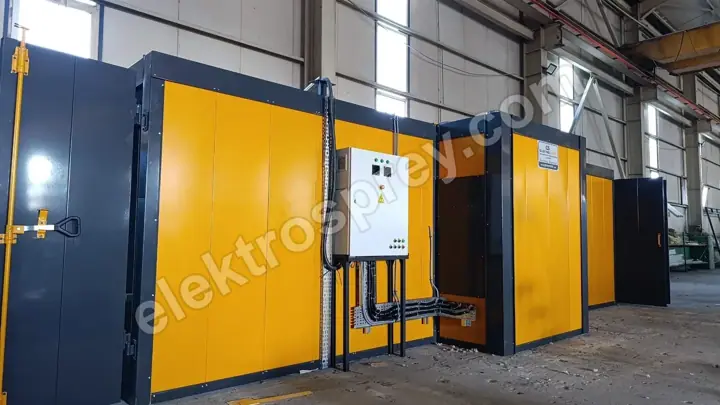
The difference between a batch oven and a tunnel oven — and which one you should choose — is not settled by a price list but by your production regime: if you run high volumes of the same part all day, a continuous tunnel oven is right; if the part type changes during the day and volumes are low to medium, a batch (box) oven is right. A batch type electric oven works between 80 and 250 °C with ±3 °C uniformity and 16 curing profiles, so every part group can have its own stored temperature-and-time recipe. On the continuous side, a tunnel type powder coating line runs at a conveyor speed of 1–6 m/min and produces 500–5,000 parts/hour — here the recipe is not what changes, the line speed is what stays fixed.
Reduced to one sentence: a batch oven buys you flexibility, a tunnel oven buys you throughput. With the same oven budget you buy one of them; nothing gives you both.
The real split: batch regime or continuous regime
Choosing an oven is not an equipment comparison, it is a decision about how your shop runs. In a batch regime parts are loaded onto a trolley or a jig set, go into the oven, the door closes, and they come out when the timer ends. In a continuous regime parts hang on a conveyor and never stop; the oven holds a single temperature all day.
That difference shows up in three places:
- Changing the recipe. In a batch oven, switching temperature and time between two groups is a matter of selecting a profile. In a tunnel, changing the temperature changes the regime for every part currently inside it — in practice, nobody does it mid-shift.
- Idle time. A batch oven produces nothing while it is being loaded and unloaded; it only holds heat. In a tunnel, loading, curing and unloading happen simultaneously at different points on the line.
- Heat loss. Every time a batch oven door opens, hot air escapes and the recovery time back to set point is added to the cycle. A tunnel keeps its entry and exit effectively closed with air curtains and labyrinth geometry.
At Elektrosprey we build both oven types around the customer's largest part; there is no catalogue size. So "batch ovens are small, tunnel ovens are large" is not a valid distinction — batch ovens are also built to take 6–7 metre parts. The split is in the flow, not in the volume.
Decision table: which production needs which oven
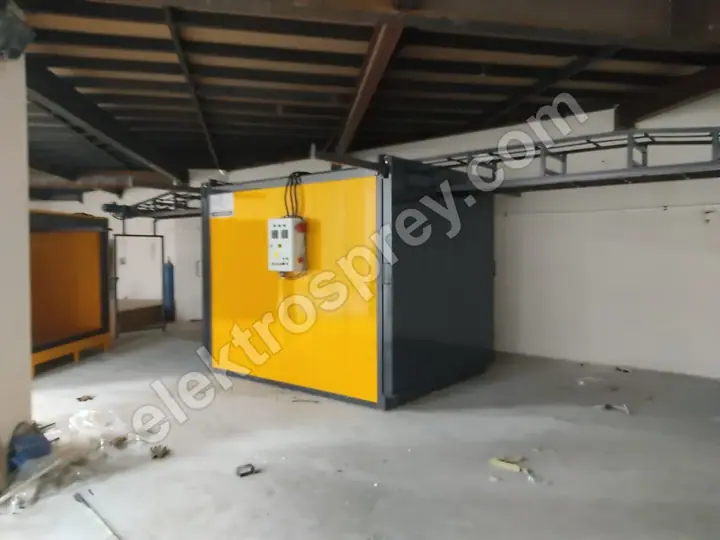
| Criterion | Batch (box) oven | Continuous tunnel oven |
|---|---|---|
| Daily volume | Low to medium; measured in batches per shift | High; continuous flow at 500–5,000 parts/hour |
| Part variety | High — 16 curing profiles let the recipe change group by group | Low; runs one regime, no recipe change during the day |
| Part weight / geometry | Suits heavy, bulky, single parts; loaded on a trolley | Limited by conveyor hook capacity; parts must be hangable |
| Temperature control | PID, 80–250 °C, ±3 °C uniformity | Fixed set point; uniformity held along the tunnel |
| Shift pattern | Fits single shifts and interrupted running | Wants continuous shifts; stopping and restarting is expensive |
| Labour | Loading and unloading is operator-heavy | Conveyor feeding; far more parts per person |
| Warm-up / start-up | Warm-up time is added to the cycle every day | Heats once and stays at regime all day |
| How you grow | You grow by adding ovens | You grow with conveyor speed and tunnel length |
| Investment flexibility | Usable on its own before a full line exists | Only makes sense together with pretreatment, booth and conveyor |
The practical rule from that table: high variety means batch, high volume means tunnel. If you sit somewhere both look right — say two or three part types a day at medium volume — your shift pattern decides. In a shop running one uninterrupted shift the tunnel idles less; in a workshop that splits the day into batches, the box oven does.
Where a batch oven is the right call
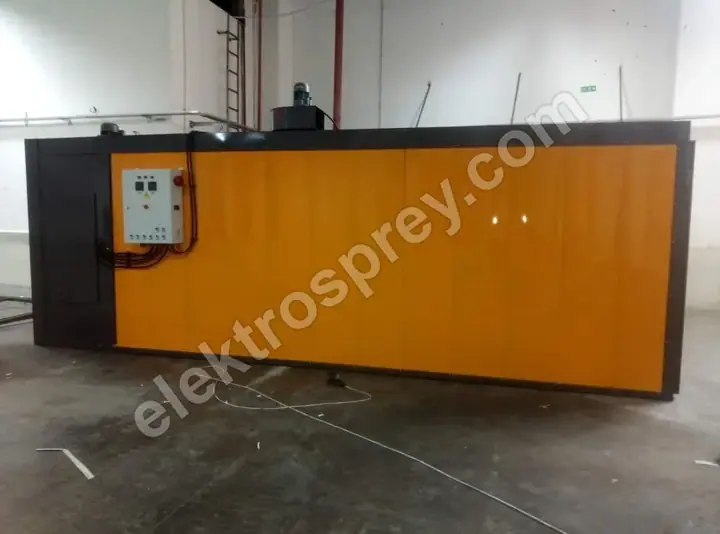
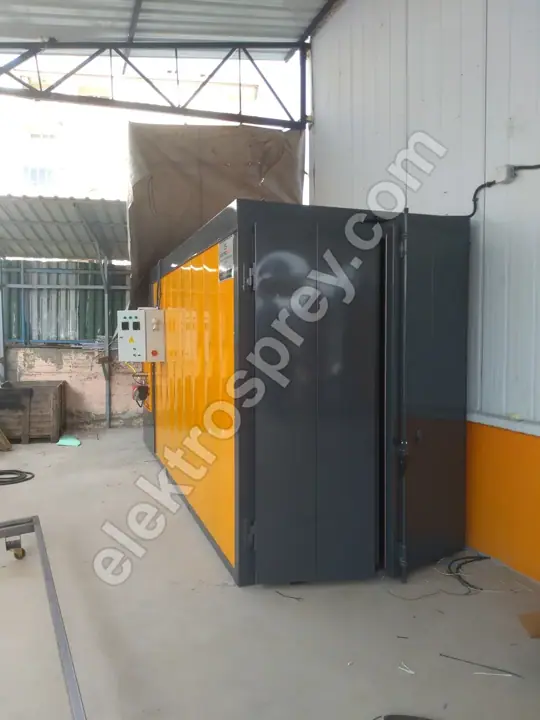
What justifies a batch oven is always the same thing: uncertainty. If what you cure changes daily, if volumes cannot be forecast, or if the plant is still growing, a batch oven lowers the risk.
- High variety, low repetition. Jobbing shops, machine builders, project-based work. Every job has its own film thickness and curing recipe; 16 profiles manage that without leaving it to operator judgement.
- Heavy and bulky parts. Chassis, tanks, enclosure bodies, welded structures. A part that cannot hang on a conveyor hook is rolled in on a trolley.
- Phased investment. Oven first, conveyor later. Because a batch oven works on its own, you can spread the budget over time. We set out the whole investment order in the powder coating plant setup guide.
- Backup and sample capacity. Even plants with a continuous line keep a small batch oven for samples, touch-ups and special jobs.
To be honest about the cost: every door opening loses energy, and heat-up and cool-down repeat on every cycle. At the same annual volume, energy per part in a batch oven is higher than in a properly loaded continuous line. To size that gap against your own consumption, use the calculation method in powder coating oven energy consumption.
Where a tunnel oven is the right call
A tunnel oven has one condition: you must be able to fill it. A continuous oven stays hot and burns energy even when empty. If your conveyor runs half loaded, your cost per part will not beat a batch oven.
A tunnel is the right call if:
- You produce regular, predictable volumes of the same or similar parts,
- You can build the pretreatment–drying–booth–oven chain as one flow (including 3–7 pretreatment stages),
- Your shifts are continuous and your stoppages are planned,
- Your parts are within hangable weight and geometry.
Do not judge by eye whether your volume really earns a tunnel; run the numbers with the method in powder coating line capacity calculation — hanger pitch, conveyor speed and dwell time are solved together. For long parts such as aluminium profiles, a U-shaped layout comes in: an aluminium U-type powder coating line handles 3–7 m profiles and brings colour change under 20 minutes.
Overhead pallet ovens: the third way in between
If you are squeezed between the two extremes, there is a third option: the overhead pallet oven. Parts are loaded onto a trolley or pallet, and the pallet is moved into the oven by an overhead handling system. It keeps the flexibility of a batch oven but moves loading and unloading outside the oven, cutting idle time noticeably.
| Item | Gas-fired overhead pallet oven | Batch type electric oven |
|---|---|---|
| Working temperature | 140–220 °C | 80–250 °C |
| Heat source / power | Gas burner, 50,000–500,000 kcal/h | Electric elements, 3–150 kW |
| Warm-up time | 35–45 minutes | Varies with volume; repeats every cycle |
| Energy cost | 30–40% lower than electric | Higher than gas; in exchange, simple infrastructure |
| Infrastructure needed | Gas line, flue, combustion safety, CE / TS EN 1020 | Only an electrical supply connection |
| Loading method | Pallet prepared outside, idle time shortened | Loading happens at the oven door |
| Low-temperature work | Does not go below 140 °C | Drying and pre-heating possible from 80 °C |
The 30–40% lower energy cost of a gas system looks attractive, but the gas line, flue and combustion safety are a one-off investment plus a permanent maintenance item. Our separate article on electric or gas powder coating ovens puts those two columns side by side.
Space, layout and growth
A batch oven is compact in floor area but needs trolley manoeuvring space in front of it; budget clear space of at least one oven depth. A tunnel oven is expensive in length: dwell time multiplied by conveyor speed gives the run inside the oven, and that run has to fit your building. When it does not, the answer is not to shorten the oven but to fold the line into a U or Ω layout. Layout templates and minimum aisle dimensions are collected in powder coating plant space and layout.
Growth changes the decision too. Growing with batch ovens means adding ovens, and each added oven wants its own operator. Growing with a tunnel means raising conveyor speed or extending the oven; unit cost falls but flexibility falls further. If you want the budget side discussed in ranges rather than fixed figures, powder coating oven prices lists the items that actually drive the price.
Frequently asked questions
What is the real difference between a batch oven and a tunnel oven?
Flow, not temperature. A batch oven works in cycles: a load goes in, the door closes, it comes out when the time is up. A tunnel oven runs continuously: parts enter on the conveyor and leave at the same speed. That is why a batch oven suits changing recipes and a tunnel suits volume. The temperature ranges already overlap — batch types run 80–250 °C, gas-fired overhead pallet ovens 140–220 °C.
At what daily volume does a tunnel oven start to make sense?
A single threshold figure would be misleading; loading, not volume, decides. If you can keep the conveyor full through the shift, a tunnel makes sense. Put your hanger pitch, part length and target conveyor speed into a capacity calculation, then compare the resulting hourly output against your real order book; if the line would run half empty, a batch oven produces more cheaply.
Can one plant use both a batch oven and a tunnel oven?
Yes, and it is common. Series parts flow through the tunnel; samples, touch-ups, oversize items and special recipes are cured in the batch oven. This raises the initial investment but costs far less than stopping a continuous line for a one-off job. A small batch oven pays for itself in a handful of jobs through the downtime it prevents.
In which oven type is temperature uniformity easier to achieve?
It is achievable in both, but the method differs. In a batch oven the air circulates inside a closed volume and ±3 °C uniformity is a measurable acceptance criterion. In a tunnel, uniformity is built zone by zone, with the entry zone tuned to compensate for heat loss. For the measurement method and acceptance criteria, see oven temperature uniformity.
How can the energy disadvantage of a batch oven be reduced?
Through four items: shortening how long the door stays open (prepare loads outside on pallets), not compromising the insulation (10 cm rock wool and sealed gaskets), grouping jobs by plan instead of waiting for a full load, and running consecutive batches back to back before the oven cools. With those four in place, the energy gap per part between a batch oven and a tunnel narrows considerably.
Summary
The answer to "batch oven or tunnel oven" lies in your production pattern, not in the oven. If part variety is high, volumes are low to medium and work moves in batches, a batch oven — 80–250 °C, ±3 °C, 16 profiles, 3–150 kW — is both the more flexible and the less risky investment. If you produce predictable, high volumes of the same part and your shifts run without interruption, a continuous line in the 500–5,000 parts/hour band lowers your cost per part. If you sit between the two, a gas-fired overhead pallet oven keeps the flexibility and cuts idle time with 30–40% lower energy cost and a 35–45 minute warm-up — in exchange for gas line and flue infrastructure. We build every oven around your largest part and deliver it with a 2-year manufacturer's warranty.
Send us the dimensions of your largest part, your daily volume and your shift pattern — we will work out whether you need batch or continuous, and quote it with the internal oven dimensions.