
Why Does Orange Peel Happen? Booth, Oven or Powder to Blame?
Orange peel in powder coating never has a single cause; film thickness, kV setting, oven ramp rate and the flow behaviour of the powder decide it together. This article sets out which setting to change in which order, and when touching the equipment is simply unnecessary.
 Enlarge
The cause of orange peel in powder coating is never one piece of equipment: film thickness, the gun's kV/µA setting, the oven's heat-up ramp and the flow behaviour of the powder produce the same defect together. In most of the cases we see on site the problem closes with three adjustments and no part replaced at all — bringing film thickness back into the range printed on the powder data sheet, dropping the gun off the top end of the 0–100 kV band, and correcting the oven regime. Buying a new booth or a new oven before those three steps have been tried is the most expensive decision available. The order below eliminates causes from the cheapest to the most costly.
Orange peel is not an adhesion or a durability failure; it is a cosmetic flow defect. The powder melted, started to flow out, and froze into gel before it finished levelling. The waviness left on the surface is generally under a millimetre across and only becomes visible at a certain light angle. That is why the same part can look acceptable in your own shop and be rejected at the customer: this defect is caught with light, not with a gauge.
The physical mechanism behind orange peel
In the oven the powder first melts, then flows out, and only then cures. Levelling happens in the time window between those three stages. If the time the molten film needs to level itself is not available before crosslinking starts, the particle pattern left by the gun freezes into the surface. A few practical rules follow directly:
- If the film is too thin, there is not enough material to flow; the particle pattern never closes.
- If the film is too thick, the lower layer heats late while the top surface gels early, and the waviness grows.
- If the oven heats too slowly, viscosity stays high for too long and flow starts late.
- If the oven heats too fast, curing begins before levelling is finished.
- If the powder is coarse or damp, agglomerates leave an uneven deposit.
So orange peel is not "the booth's fault" or "the oven's fault" — it is a missed flow window. Finding the culprit means finding what narrowed that window.
Four suspects, one order of inspection
| Order | Suspect | Symptom on the floor | First action | Cost |
|---|---|---|---|---|
| 1 | Film thickness | Defect concentrated on heavy areas, corners and overlapped passes | Measure, bring back into range, cut powder output | None |
| 2 | kV / µA and gun distance | Centre of a flat panel rough, edges clean; back-ionisation marks | Step the kV down, increase gun distance | None |
| 3 | Oven ramp and uniformity | Parts on the same hanger differ; one oven zone consistently bad | Run a heat map, correct temperature and line speed | Low |
| 4 | Powder and reclaim | Defect tied to one batch or one colour; powder agglomerated | Raise virgin powder ratio, check sieve and storage | Low–medium |
| 5 | Booth and airflow | Defect persists after all of the above are corrected | Measure air velocity and powder escape | Medium–high |
Do not break this order. The most common mistake in practice is to skip items one and two entirely and jump straight to item five — that is, to changing equipment.
1. Film thickness: the most frequent and cheapest cause
Most orange peel cases are thickness distribution problems. The target range is printed on the powder manufacturer's data sheet; do not guess it, measure with a dry film thickness gauge and read at least five zones of the part rather than one. Corners, weld seams and areas close to the hanger take a different charge from the gun than a flat face does.
If the distribution is off, look in this order: powder output (adjustable across 0.5–10 l/min), gun count and position, how the part hangs, and line speed. A gun that passes the same area twice lays down double the intended film and that zone comes out rough. To separate where the deviation is coming from, use the measurement layout in film thickness deviation and micron drift.
2. Gun settings: kV, µA and distance
In both manual and automatic application the second big source is the electrostatic setting. On a unit working across 0–100 kV / 0–150 µA, holding kV permanently at the top end causes back-ionisation in a thick film: the trapped charge makes the powder layer repel itself and leaves a pitted roughness. The symptom is typical — the middle of a flat surface is rough while the edges are clean.
The practical approach is high kV for the first pass and a stepped reduction on the second. Keep gun distance fixed as well; an operator moving closer to the part has the same effect as changing the setting. In shops working with a manual powder coating unit the defect usually lives not in the equipment but in two operators standing at different distances. Simply writing the setting values down makes a measurable difference.
3. The oven: ramp rate and temperature uniformity
The oven is what defines the flow window. A box type electric oven works between 80 and 250 °C and holds ±3 °C uniformity under PID control with 16 baking profiles — profiles exist precisely for this reason, because a heavy part and a thin sheet cannot share a ramp.
Oven-driven orange peel shows up in two typical forms. In the first, one zone of the oven runs colder than the rest: the parts in the same position on every hanger come out rough. In the second, door openings and overloading break the regime — the controller shows the set point but the part surface reaches it late. The way to separate them is a real temperature curve taken from the part itself with a data logger; the procedure is set out step by step in oven temperature uniformity. If the report comes back inside the ±3 °C band, strike the oven off the list and go back up one item.
4. Powder and reclaim: flow behaviour
Powder is a variable too. Powder stored in a damp room, agglomerated, or returned to the circuit without sieving will not fluidise evenly and leaves an irregular deposit. A cartridge booth recovering 95%+ is normal, but the fine fraction of reclaimed powder rises over time and its flow behaviour shifts with it. Put the virgin-to-reclaim ratio and the sieving discipline into a written rule.
| Check point | What to look at | Effect on orange peel |
|---|---|---|
| Powder store | Temperature and humidity, open bags | Agglomeration → uneven film |
| Fluidising | Is the hopper boiling evenly | Irregular output → rough surface |
| Sieve | Is the reclaim sieve blinded | Coarse particles → pattern stays |
| Mix ratio | Is virgin/reclaim ratio recorded | Fines build up → flow degrades |
| Compressed air | Are oil and moisture traps working | Oil contamination → craters and roughness |
| Colour change | Any residue of the previous colour | Mixed powder → cure differences |
5. Booth and airflow: the last place to look
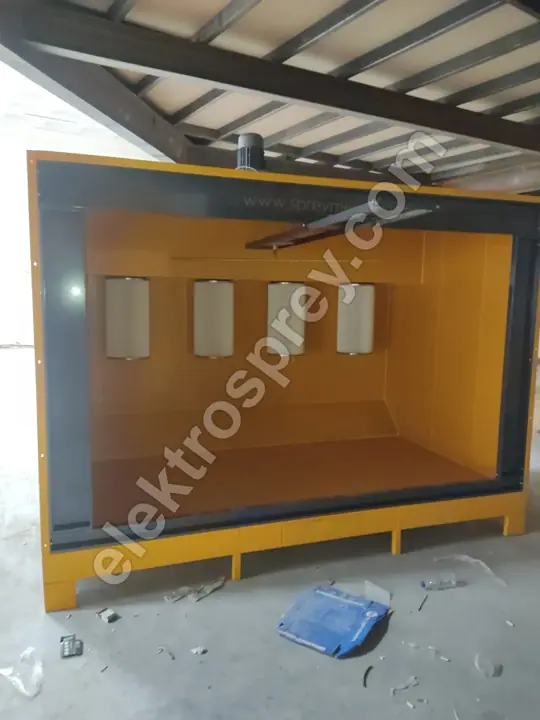
The booth is rarely the direct cause of orange peel; it is the place that makes the other four visible. In a cartridge filter powder booth the internal air velocity sits between 0.5 and 0.8 m/s — that band is chosen because it is high enough to keep powder inside the booth and low enough not to strip freshly deposited powder off the part. If velocity has climbed above the band (fan setting after a filter change, blocked ductwork, working with the booth open), the layer just landing on the part is disturbed and the surface roughens.
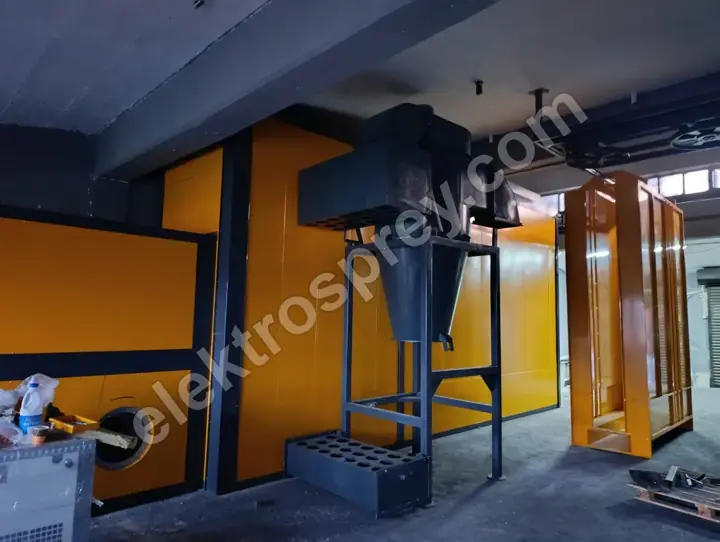
When the booth genuinely is undersized, the symptom is not a defect but a loss: powder escaping, recovery rate falling, colour change taking longer. If that is the picture you have, the decision is no longer a setting but the equipment itself, and the selection criteria are collected in choosing a powder coating booth. Booth count and gun layout are decided at the same point; the cartridge filter powder booth we build carries 2 to 12 guns and is dimensioned around the customer's largest part — there is no catalogue size.
Frequently asked questions
Is orange peel always about film thickness?
Usually yes, but not in one direction. Both a very thin and a very thick film produce the same defect: too thin and there is not enough material to level, too thick and the lower layer heats late while the top gels early. The right response is not "let's put more on" but getting inside the range on the data sheet and staying there across every zone of the part.
Will raising the oven temperature fix orange peel?
Sometimes partly, and often at the price of another defect. More heat speeds up flow but can push you into over-bake, yellowing and gloss loss. Measure the real curve from the part first: if the problem is not the set point but how long the part takes to reach it, the fix is loading pattern or line speed, not a higher set point.
Can I close the defect without replacing the booth?
In the large majority of cases, yes. Once film thickness, kV setting and oven regime are corrected the defect normally disappears. Replacing the booth only becomes a real question when measured air velocity is outside the band, powder is escaping, or the recovery rate has dropped. Never make an equipment decision without measurement.
Why does it appear on some parts and not others on the same line?
That is the fastest clue you can get. If the difference tracks part thickness, it is thermal mass: the heavy part heats late while the thin one cures quickly, and the answer is a separate baking profile. If it tracks position on the hanger, oven uniformity or gun reach is the issue. If it tracks colour, suspect the powder — metallic and low-gloss formulations behave differently in flow.
Is orange peel unavoidable in manual application?
No, but repeatability depends on the operator. Fix kV, output and distance on a written setting card and apply the same pass sequence to the same part, and manual application gives a clean surface as well. The problem is not the gun itself but settings that change every shift.
Summary
Orange peel is the coating missing the flow window between melting and curing. The order of investigation is fixed: film thickness first, then kV and gun distance, then oven ramp and uniformity, then powder and reclaim discipline, and only last the booth and its airflow. The first three steps cost nothing and close most cases. Changing equipment is the right call only when measurements show a deviation that settings cannot correct. If you are planning the whole investment, our pillar guide on how to set up a powder coating plant is the right starting point, and every line we build is delivered with a 2-year manufacturer's warranty.
Send us a photo of the part, your film thickness readings and your oven temperature record — we will work out together which stage the defect is coming from.