
Which Sheet Metal Belongs Inside a Curing Oven? Galvanised, Aluminised, Stainless
The inner shell of a powder coating oven has to stay clean at working temperature for years, because whatever fails on that surface eventually lands on a part. This article separates galvanised, aluminised and stainless sheet by temperature behaviour, discolouration and residue build-up, and shows where each one is defensible.
 Enlarge
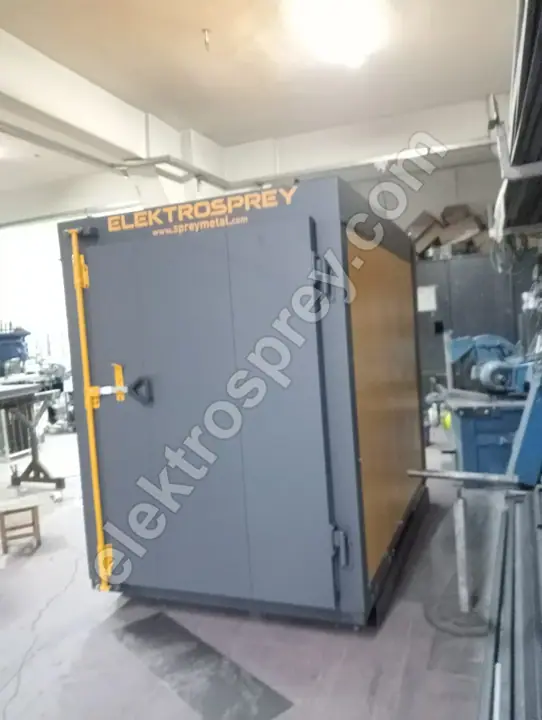
Galvanised or stainless sheet inside a powder coating oven — the short answer is that any oven running continuously at curing temperature needs a stainless inner shell. In the box type electric ovens we build, the inner shell is AISI 304: the oven works across 80–250 °C with PID control and ±3 °C uniformity, so that inner surface sits at curing temperature for its whole service life, and a zinc coated sheet does not stay stable under that regime. Galvanised sheet is defensible only where the temperature stays clearly below the curing band — drying compartments, the outer casing, ductwork. Aluminised sheet sits between the two: it tolerates far more heat than galvanised, but it does not give you the surface quality and repairability of stainless.
The subject starts as a cost discussion and ends as a quality discussion. A difference in inner shell material shows nothing on day one; it shows up on the parts in year three or four.
What the inner shell actually does, and why the material is a quality decision
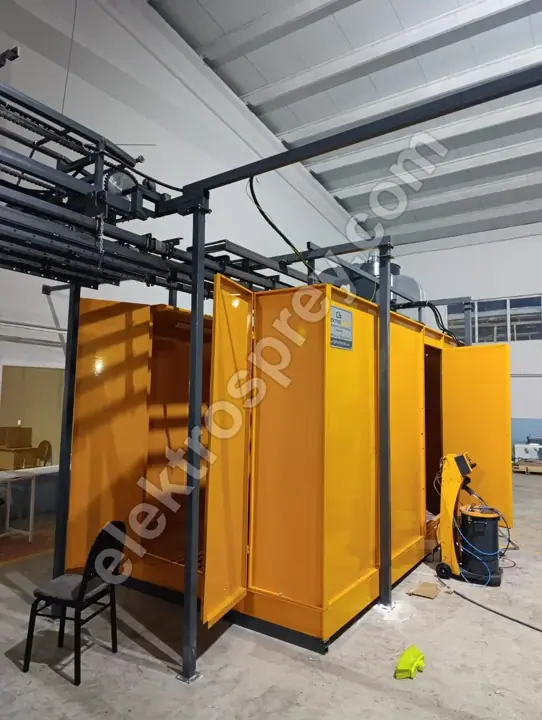
The inner shell is the oven surface that faces the part, and it does four jobs: reflect and distribute heat, guide hot air circulation, protect the insulation pack from paint vapour and mechanical damage, and a fourth one that rarely makes it into a specification — stay clean.
As powder cures, a certain amount of volatile matter is released from the resin. Those volatiles condense on the coldest surfaces in the oven and leave a thin film on the inner sheet. The film bakes a little further with every cycle, darkens, and eventually crusts. This happens in every oven; what matters is how fast it builds and how easily it comes off. On a smooth, non-porous surface that does not shed, the build-up advances slowly and comes off mechanically. On a surface whose coating has broken down, gone matt and started to powder, the residue finds something to grip, and cleaning removes part of the surface as well — so every clean makes the situation worse.
The conclusion is simple: the inner shell material is not a strength choice, it is a choice about whether dirt will be carried onto your parts over the years.
Three sheet classes, one comparison
| Sheet class | Continuous service at curing temperature | Surface and residue behaviour | Welding / repair | Where it belongs in an oven |
|---|---|---|---|---|
| Galvanised (zinc coated) | Not suited to continuous work in the curing band; the coating changes colour and eventually starts to shed | As the coating degrades the surface offers anchor points, so residue builds fast | The coating is lost at every weld; welding fumes are a separate occupational issue | Outer casing, ductwork, drying compartment |
| Aluminised | Tolerates markedly higher temperature than galvanised; does not break down early in the curing band | Acceptable surface, but a scratch or a cut exposes the steel underneath | Coating integrity is broken at every cut and weld line | Intermediate class; hot zones with little part contact |
| AISI 304 stainless | Stable across the whole working band; corrosion resistance comes from the material itself, not a coating | Smooth and non-porous; residue builds slowly and cleaning does not consume the surface | Resistance survives cutting, drilling and repair | The entire cured volume of the inner shell |
The real distinction in that table is not the last column but the third. Galvanised and aluminised sheet carry their resistance in the coating; the moment coating integrity is broken, protection ends at that point. In stainless, the resistance is in the material, so cutting, drilling, welding and annual cleaning do not remove it. An oven inner shell is a surface that gets cut, drilled and fitted with hanger and fan connections during assembly, so this difference appears at first build, not in theory.
Where galvanised sheet is defensible
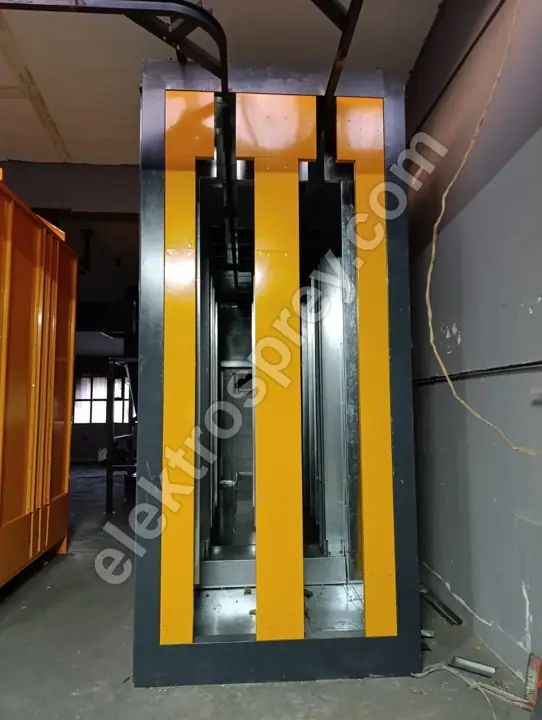
Ruling galvanised out entirely is wrong; putting it inside the cured volume is what is wrong. The outer casing, air ducts, service covers and drying compartments that stay clearly below the curing band are all reasonable places for it. The job expected there is corrosion resistance, and galvanised delivers that cheaply.
When the inner shell itself is galvanised, the problem announces itself in two ways. The first is visual: a yellowish-grey colour shift, then dulling, then a powder that marks your fingers when you wipe the surface. The second is a quality symptom: unexplained spot contamination on parts, showing up as raised specks that get rejected on light colours and high gloss finishes. That second symptom has nothing to do with the thermal performance of the oven — the oven may still be holding its set point perfectly. This is why the cause is so often chased for months in the powder or the booth instead.
Is aluminised sheet a real middle ground?
Aluminised sheet is steel coated with an aluminium based alloy, and it is far more stable at high temperature than galvanised, which is why it is common in exhaust and flue components. Used in an oven inner shell, it does not show the early shedding that galvanised does.
Its weakness sits in two places. First, coating integrity: cut edges, hole rims and weld seams are left unprotected, and degradation starts exactly there. Second, surface quality: it does not give the "wipe and done" ease that stainless offers a maintenance routine. Aluminised sheet is a sensible middle path on projects where the budget is genuinely tight and the oven will run at the lower end of the curing band. On a line turning two or three shifts a day at curing temperature, it is not the right choice.
A zone-by-zone decision table
| Zone / equipment | Typical surface regime | Suitable sheet | Reason |
|---|---|---|---|
| Box type electric oven inner shell | Continuous, in the curing band | AISI 304 | Slow residue build-up; cleaning does not damage the surface |
| Gas fired top-loading oven cure volume | Continuous curing plus combustion products | AISI 304 | Moisture and combustion products accelerate coating breakdown |
| Pre-heat / drying compartment | Clearly below the curing band | Galvanised or aluminised | The temperature regime does not stress the coating |
| Air ducts and fan housing | Hot, no part contact | Aluminised or stainless | No contact with parts; low residue risk |
| Outer casing and service covers | Close to ambient | Galvanised or painted sheet | The job here is corrosion resistance |
| Hangers, carriers and internal fixtures | In the curing band, in direct contact | Stainless | A shedding surface drops straight onto the part |
Sheet class is decided together with insulation and shell rigidity
The inner sheet is never chosen on its own. In our box type electric ovens the inner shell is AISI 304, the insulation is 10 cm rock wool, and heating power is set per project in the 3–150 kW range. Cut the insulation thickness and the surface regime of the inner sheet changes with it: the shell cools faster, more volatiles condense, and residue builds more quickly. Thin insulation therefore affects not only the energy bill but the cleanliness of the inner surface. We worked through that link numerically in oven insulation thickness and heat loss.
Sheet thickness is its own topic. Thin sheet is cheap but ripples under thermal stress, and a rippled inner surface both disturbs airflow and makes cleaning harder. The rigidity of the inner shell is determined by sheet thickness together with the stiffening arrangement behind it — and since we build every oven around the customer's largest part, these dimensions change from project to project. There is no catalogue size.
The maintenance schedule changes with the sheet class
Inner shell material directly sets the annual maintenance load. On a stainless inner shell the work is mechanical removal of the residue film plus a fan and duct check. On coated sheet one more task is added: visual monitoring of coating condition and tracking of degraded areas. Over time that second task stops being cleaning and becomes repair.
The practical test is simple. Wipe the inner surface with a white cloth. If the cloth picks up only dark residue, that is normal paint build-up. If it leaves a light grey, metallic or powdery deposit, the surface itself is breaking down — and that is material which will land on the next batch of parts. For inspection intervals and what to look at, use the checklist in oven maintenance schedule and annual inspection.
Where the cost difference goes
A stainless inner shell costs more in the material line than coated sheet, and that shows in the oven price. In return, the same difference drives your reject rate from surface degradation, your inner shell repair work and the point at which the oven has to be scrapped. The question to ask is not "which is cheaper" but "how many years will this oven run at curing temperature, and how many hours a day." A drying cabinet on a single shift at low temperature and a production oven in the curing band all year do not lead to the same decision. For the full set of items that make up the price, see powder coating oven prices; inner shell material sits there not on its own but alongside insulation and power rating as one of the items that moves the figure.
Frequently asked questions
Is a galvanised inner shell good enough for powder curing?
It works in the short term and creates a quality problem in the long term. Zinc coating is not a surface designed for continuous service in the curing band; colour change and shedding begin over time, and that dust falls directly onto parts. If the oven is for drying, clearly below the curing band, galvanised may be reasonable. If you are curing, specify a stainless inner shell.
How do I tell whether a darkened inner sheet is a fault?
A dark brown to black film is normal — it is condensed volatile matter from curing and it happens in every oven. The fault indicator is not colour but texture. If wiping leaves a light, powdery deposit, or if you see blistering and flaking around weld seams, the problem is the sheet itself rather than the residue. In the first case cleaning is enough; in the second, local renewal has to be discussed.
Should the inner sheet choice be different in a gas fired top-loading oven?
It matters even more there. A gas fired top-loading oven runs in the 140–220 °C band at 50,000–500,000 kcal/h and gives a 30–40% lower energy cost than an electric oven; in exchange, the cure volume contains combustion products and moisture. That environment accelerates the breakdown of coated sheet. In these ovens, which we deliver under CE and TS EN 1020, the cure volume is solved in stainless.
Does a stainless inner shell make the oven slower to heat up?
In practice the determining factors are the insulation pack, shell sealing and installed power, not the inner sheet. The thermal mass of the inner shell material is a small share of the total; heat-up time is set mainly by insulation thickness and heater rating. If heat-up time is a critical criterion, look for the answer in power and insulation selection rather than in sheet class.
Can I convert the inner shell of an existing oven to stainless later?
Technically yes, but it is not a simple re-lining job: removing the inner sheet opens up the insulation pack, the air ducts and the fan connections as well. This work should not be decided without measuring the remaining life of the oven and the condition of the shell. If the shell and insulation are sound, renewal can make sense; if the insulation is wet or has slumped, the cost approaches that of a new oven. Send us photographs and dimensions of your existing oven and we will assess which way is right.
Summary
Choosing the inner shell material is not a strength decision but a contamination decision. In a volume running continuously at curing temperature, stainless is used — which is why the inner shell of the box type electric oven we build is AISI 304. Galvanised sheet belongs in the outer casing, the ducts and the low-temperature drying compartment. Aluminised sheet is an intermediate class and weakens wherever coating integrity is broken. When you decide, weigh working temperature, daily running hours and the expected service life of the oven together; inner shell selection belongs on the same table as insulation thickness and installed power. Every oven we build is delivered with a 2-year manufacturer warranty.
Send us the dimensions of your largest part, your target curing temperature and your daily running hours — we will set the inner shell and the insulation pack against those three figures together.