
What ISO 9001 Actually Changes in a Paint Shop
ISO 9001 is not a certificate on the wall but a recording discipline; in a paint shop it lives in batch traceability, oven temperature records, measuring device calibration and the question of who actually closes a nonconformity. This article explains which data outputs the system demands from the line and how to build them in at the project stage.
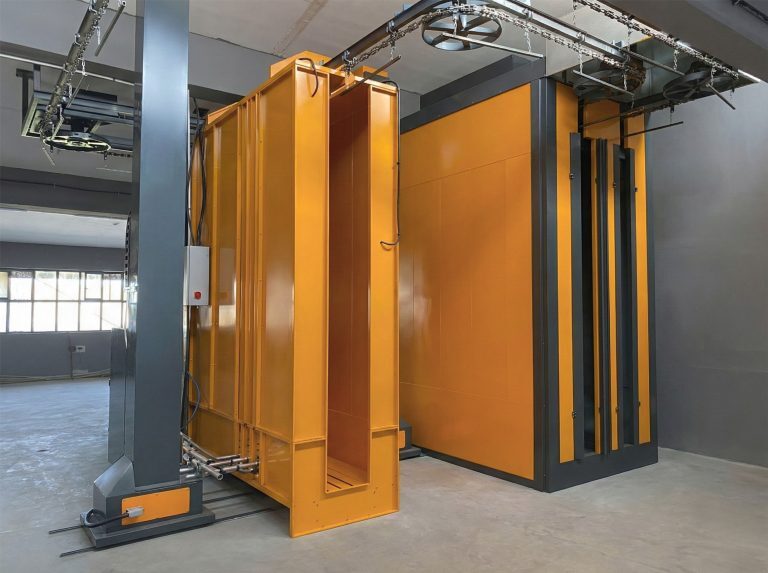 Enlarge
What an ISO 9001 quality system requires in a paint shop has a short practical answer: the ability to show, after the fact, with which setting, at which temperature and with which measuring device every batch was approved. The certificate is the result of that, not the cause. When an auditor walks onto a coating line, four things are usually checked first — the batch record, the oven temperature record, the calibration label on the measuring device, and the sign-off on nonconformities raised in the last three months. A line that does not produce those four carries its system on paper, however good the equipment is, and fails at the first automotive or appliance customer audit.
On the investment side this translates into one rule: choosing equipment that outputs data while you are building the line is both cheaper and easier than trying to manufacture records afterwards. Below we break down which record depends on which equipment feature.
What ISO 9001 mandates in a paint shop, and what it does not
The most common misunderstanding is that the standard says "cure at this temperature, apply this many microns". It says nothing of the kind. ISO 9001 asks for process and evidence; the technical target is set by you, by the customer specification, or by coating-side references such as ISO 12944, Qualicoat or GSB. What the standard wants is proof that you measured the target you set, noticed when it drifted, and closed the drift.
In practice the distinction looks like this:
- Not mandatory: a specific cure temperature, a specific film thickness, a specific equipment brand.
- Mandatory: who measures that value, with which instrument, how often; that the instrument has traceable calibration; and that the decision taken on a deviation is recorded.
So what ISO 9001 changes in a paint shop is not the equipment but the way decisions are made. The shift supervisor's "I can tell by looking" becomes a measured value with a defined limit.
The four data outputs demanded from the line
| Record | Where the evidence comes from | Equivalent on the line | What to ask for at purchase |
|---|---|---|---|
| Batch traceability | Work order + hanger/batch number | Coating sequence matched to batch | Conveyor speed and colour change logged; batch number trackable along the line |
| Cure record | Oven temperature-time data | Oven control panel | Profile selection and a control with data output; a part-based measuring point |
| Product measurement | Film thickness, adhesion, gloss | Sampling station | A bright, fixed inspection station at the line exit |
| Deviation decision | Nonconformity form + closure | Quarantine area | A physically separated, labelled scrap/rework area |
These four rows answer most of what is asked in an audit. Note that the fourth is a layout decision more than an equipment one: with no quarantine area, nonconforming parts end up beside the line and two days later nobody remembers which ones they were.
Oven temperature records: the first thing an auditor looks at
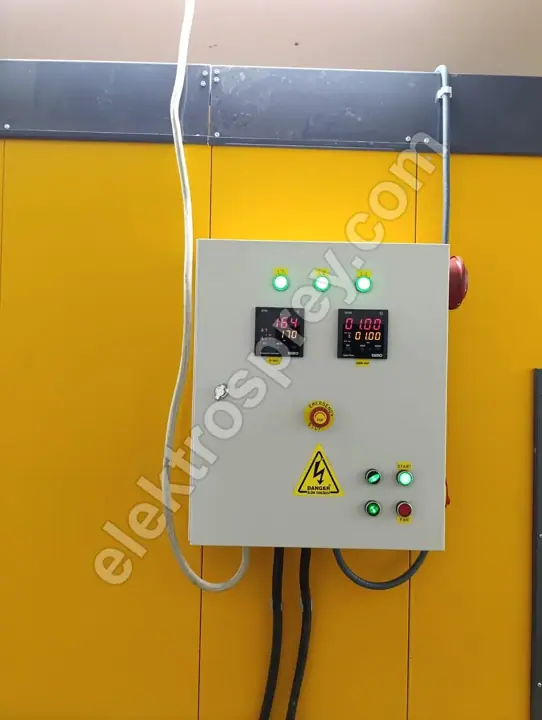
The backbone of quality records in a paint shop is the oven, because curing cannot be undone. A digital display showing the set point does not count as a record; what is wanted is the actual temperature during that batch's bake. Two different data sets get confused here:
- Oven air temperature — the value the control system reads.
- Part surface temperature — the value that governs curing, always lagging the air depending on thermal mass.
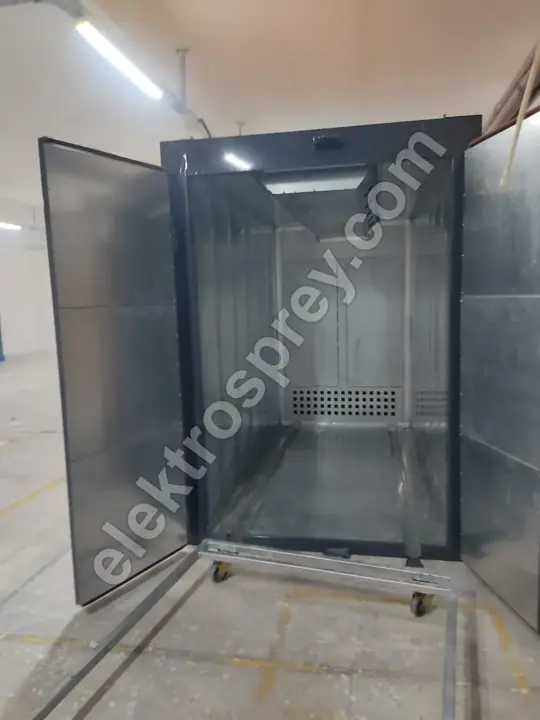
A box type electric oven works in the 80–250 °C band, with PID control giving ±3 °C uniformity and 16 baking profiles. From a system point of view those profiles matter for repeatability, not comfort: if a thick casting and a thin sheet part each have a defined profile, the answer to "which setting was it cured with" lives in a profile number rather than in the operator's memory. The logic is the same for an overhead pallet gas oven; a working band of 140–220 °C and a capacity choice in the 50,000–500,000 kcal/h range, in a system that heats up in 35–45 minutes, means you must be able to show the first and last batch saw the same regime.
The trap most often fallen into is that nobody ever measured whether one zone of the oven runs differently from the rest. Take a heat map at least once a year, and whenever the loading pattern changes; the method is set out step by step in oven temperature uniformity. That measurement is both the evidence the system wants and genuinely useful maintenance data.
Measurement traceability and the calibration schedule
Measuring is not enough; you must be able to show the instrument itself is right. The devices that fall into scope in a paint shop are few and can be listed: dry film thickness gauge, surface/part temperature meter and thermocouple set, bath pH and conductivity meters, gloss meter, pressure and flow indicators, scales. For each one, three pieces of information are recorded — the interval, the last calibration date, and what was done if a deviation was found.
The last item is the critical one and the most often skipped. A thickness gauge found out of tolerance requires not only adjusting the instrument but reviewing the batches previously approved with it. That is why you need a trace of which device was used on which batch. The daily side of calibration and verification against a reference sample is covered in measuring device calibration and reference samples.
| Device / record | Typical interval | Owner | If out of tolerance |
|---|---|---|---|
| Film thickness gauge | Annual external calibration, reference plate each shift | Quality | Retrospective batch review |
| Thermocouple / data logger | Annual | Maintenance | Re-assessment of affected bakes |
| Bath pH / conductivity | Weekly verification | Pretreatment operator | Bath top-up plus record |
| Gloss meter | Annual | Quality | Colour/gloss approvals repeated |
| Compressed air moisture-oil check | Monthly | Maintenance | Filter change, check affected batches |
Who actually closes nonconformities and corrective actions
This is the weakest link in most systems. Nonconformities occur daily in a paint shop — thickness deviation, contamination, colour mismatch, poor adhesion. The standard does not ask for zero defects; it asks that each one ends in a decision: rework, accept under concession, or scrap. The person making that decision must be defined, and must not be the person under production pressure.
The arrangement that works on the lines we build looks like this:
- The defect is caught at the inspection station at the line exit, under fixed lighting.
- The part is physically moved to the quarantine area, labelled with batch number and defect code.
- The decision sits with quality; if a concession against the customer specification is needed, written customer approval is required.
- If the same defect code exceeds a set count in a month, a corrective action is opened and closed by identifying which stage of the line the root cause sits in.
That last point feeds straight back into investment decisions: if the root cause keeps landing in pretreatment, the answer is stage count, not a new booth. For turning acceptance limits into numbers and setting sampling frequency, see sampling and acceptance criteria; to turn a customer specification into a measurable plan, converting a customer specification into a test plan is the first step.
Decisions to take while the line is still on paper
The most expensive quality-system work is exactly the work that costs almost nothing at the project stage. On a tunnel type line running 500–5,000 parts/hour, retrofitting batch traceability is close to impossible; recording which value in the 1–6 m/min range the conveyor was set to, and which baths of a 3–7 stage pretreatment were in service, is a feature you must ask for in the line design. We define those data points with the customer when engineering a tunnel type powder coating plant.
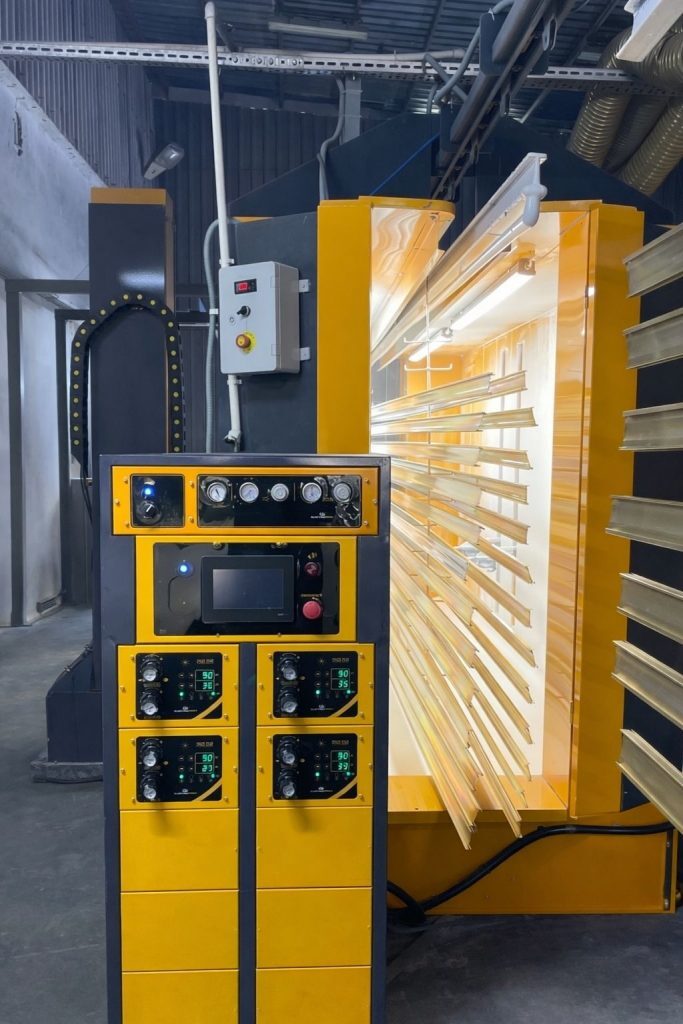
The same logic applies on the wet side: a water curtain wet paint booth captures 99% of overspray and runs on closed-circuit water, but from a quality system perspective the record that matters is not the water circulation or the lighting level itself — it is which batch was sprayed under which booth condition. The 600+ lux LED lighting serves two purposes here: application quality, and making defect detection repeatable.
Frequently asked questions
Which records are mandatory for ISO 9001 in a paint shop?
In practice four groups are expected: batch and work order traceability, process parameters (oven temperature-time, bath values, conveyor speed), product measurements (film thickness, adhesion, gloss) and nonconformity/corrective action records. Add calibration records for measuring devices and personnel competence records. Paper or digital makes no difference; what is required is that the record can be tied back to a batch.
Is an oven temperature record mandatory, or is the display enough?
A display shows an instantaneous value, not a record. When an auditor asks at what temperature you cured a batch on 14 March last month, the display has no answer. So you need temperature-time data from the oven control system, or at minimum periodic part-based curves taken with a data logger. If you are buying a new line, write this into the specification; adding it later always costs more.
Is calibration done once a year for every device?
No, the interval is set by how heavily and how critically the device is used; the standard imposes no single period. Common practice is annual external calibration plus a reference plate check each shift for decision-making devices such as film thickness gauges, and weekly verification for bath meters. What matters is that you can justify the interval you chose and that you keep to it.
Is ISO 9001 enough for an automotive or appliance customer?
It is usually the entry condition, not the only one. Those customers add their own specifications, target values for salt spray or adhesion testing, and sometimes corrosion category references such as ISO 12944. The right approach is to turn the specification line by line into a measurable test plan at contract stage, and to plan the equipment able to run those tests from the start.
Does the recording burden slow production down in a small paint shop?
It does if it is badly designed. Instead of loading the record onto the operator as a second job, make it an output of work already being done: profile number, conveyor speed and colour code written on a single work order line adds a few seconds. The burden comes not from records but from unread forms nobody uses; review your forms once a year and drop the ones nobody reads.
Summary
ISO 9001 does not change the equipment in a paint shop; it introduces a demand for evidence. Which batch was cured on which profile, measured with which device, when that device was calibrated, and who closed the decision when it drifted — the whole system reduces to those four questions. The investment equivalent is equally clear: an oven control with data output, a batch number trackable along the line, an inspection station with fixed lighting, and a physically separated quarantine area. A company that puts those four into the project from the start passes both certification and customer audits without overtime spent manufacturing records. Every line we build is delivered with a 2-year manufacturer warranty, and we define together at the engineering stage which data point comes from where.
Send us your customer specification and the record forms you already keep — we will work out together which data has to come from which point on the line.
For plants in the UK, North America and beyond
Where your line is installed shapes the paperwork, the power supply and the rules behind the choices described above.
- Liquid paint brings solvent emissions that most countries regulate under local air-quality rules. Powder coating contains no solvent, so this burden largely falls away.
- For the UK, confirm with your importer whether UKCA or CE marking is expected. In the US and Canada, plan for UL or CSA requirements on the electrical side, and check any local documentation rules before shipment.
- For the UK, goods of Turkish origin move under the Türkiye–UK free trade agreement with an EUR.1 certificate or an origin declaration. For other destinations, the origin paperwork depends on that country's trade agreements, so check it with your importer early.
- North America runs at 60 Hz, and 480 V is common in industrial plants, so motors, fans and controls have to be specified for that supply from the start. Confirm the voltage and frequency on site before the line is designed.
Products mentioned: Box Type Powder Coating Oven (Electric) · Water Curtain Wet Paint Booth · Tunnel Type Electrostatic Powder Coating System
When you ask for a quote, tell us your country, supply voltage and frequency — get in touch.