
Moving to Low-Temperature Cure: What Changes in Oven and Conveyor?
When a line switches to a low-temperature cure powder, the saving comes from getting the cure time right, not from turning the oven set point down. This article covers what has to change in the oven, the conveyor and the controls, and when the switch delivers no gain at all.
 Enlarge
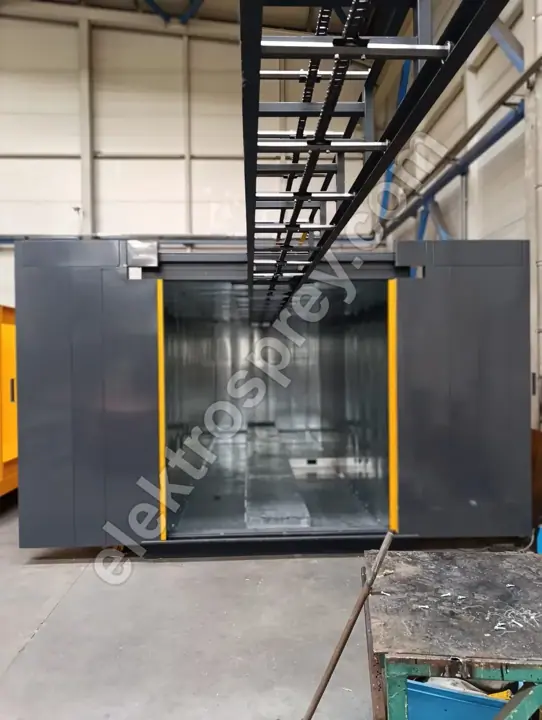
There is no single answer to "at how many degrees does low-temperature cure powder coating bake": the cure temperature and time are stated in the powder manufacturer's technical data sheet and change from formulation to formulation. What never changes is that the data sheet always gives a temperature–time pair — lower the temperature and the time gets longer. That is why, on a line moving to a low-temperature powder, the real decision sits at the conveyor rather than the oven. Our electric ovens run 80–250 °C and our gas-fired overhead pallet ovens 140–220 °C, so the low band is already inside the equipment. What decides your saving is how far you have to stretch the part's time inside the oven to reach down into that band.
A good share of the manufacturers who move to low-temperature powder to cut the energy bill see no gain. The reason is simple: the oven set point drops by 20–30 °C, but because the conveyor is slowed down as well, the oven stays open longer, output per hour falls, and energy per part lands exactly where it started. The sections below separate where this arithmetic wins from where it loses.
What a low-temperature formulation changes, and what it does not
Powder does not cure by oven air temperature but by the metal temperature the part actually reaches. The value on the data sheet means "so many minutes at object temperature". Oven air hits the set point within a minute; the surface of a heavy casting takes tens of minutes to get there. A low-temperature formulation does not remove that gap — it widens it. As the difference between the target temperature and the oven air shrinks, so does the driving force for heat transfer, and the part approaches its target more slowly.
What does change is the loss side. Heat loss is largely proportional to the difference between oven air and the surrounding shop. Dropping the set point genuinely reduces the standing loss — through insulation, door openings and the heat carried away by the conveyor chain. That is where the gain comes from, but it only stays in your pocket if oven residence time does not stretch.
| Item | What happens when the set point drops | Effect on the saving |
|---|---|---|
| Shell and insulation loss | Falls, smaller temperature difference | Direct gain |
| Heat needed to bring the part up | Falls, lower target temperature | Direct gain |
| Heat-up ramp | Lengthens, weaker driving force | Eats the gain |
| Cure hold time | Lengthens per the data sheet | Eats the gain |
| Oven length / line speed | Longer oven for the same output | Raises the investment |
| Hanger and conveyor heating | Falls | Small gain |
In short, low temperature sets up a trade between energy and capacity. Which side wins depends on part mass.
What has to change on the oven side
Low-temperature curing does not call for a different type of oven; it calls for an oven that is stable in the low band. An oven that holds ±3 °C at 200 °C but cannot repeat that at 120 °C will not hold the formulation, because your safety margin has shrunk too. An 8 °C deviation is trivial against a 180 °C target; against a 120 °C target it means uncured film.
What to check in practice:
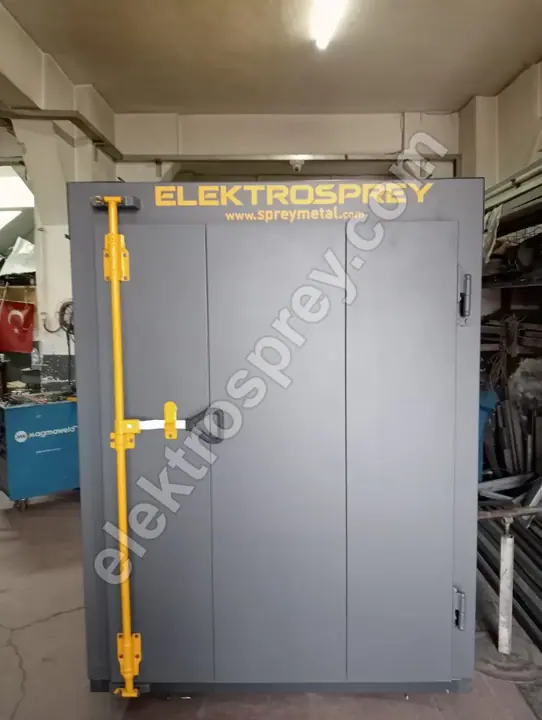
- Control resolution. Our PID-controlled box-type electric oven ships with ±3 °C uniformity and 16 bake profiles. The low-temperature recipe lives in its own profile; an operator dialling the set point by hand at every colour change is a source of error.
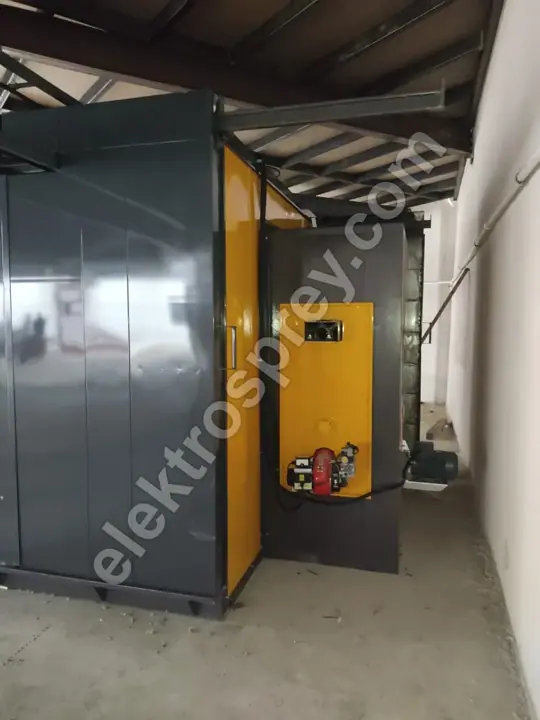
- Lower limit. Electric ovens reach down to 80 °C; the practical floor for gas-fired overhead pallet ovens is around 140 °C, because burner modulation and flue draught stop being stable below that. If your recipe sits under 140 °C, a gas oven is the wrong tool.
- Air circulation. Convection weakens at low temperature. If fan flow and duct layout stay unchanged, the oven's cold corners become far more visible in the low band.
- Thermal mass. Hangers, pallets and carriers heat up on every pass too. At low temperature their share of the total grows, so lines running heavy carriers see less gain than expected.
The gas oven's 30–40% lower energy cost against electric still holds in the low band — but only above 140 °C. We compared the two technologies in detail in electric or gas powder coating oven; to put numbers on the cost side, use the calculation table in powder coating oven energy consumption.
Conveyor and capacity: where the saving disappears
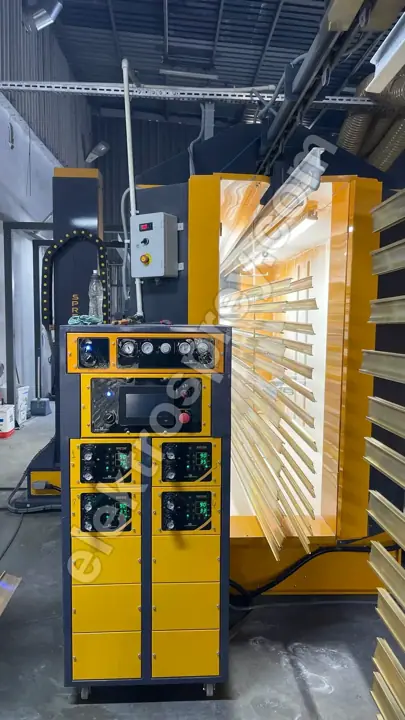
On a tunnel line, oven length and conveyor speed together give the part's residence time. If cure time gets longer you have three options, and none of them is free.
| Option | What you do | The price |
|---|---|---|
| Slow the conveyor | Longer residence in the same oven | Parts/hour falls, the gain erodes |
| Extend the oven tunnel | Longer residence at the same speed | More investment and floor space |
| Increase hanger density | More parts in the same time | Coating access and uniformity suffer |
| Add a second hanging row | Vertical capacity | Larger oven cross-section and air distribution |
Conveyor speed is adjustable across 1–6 m/min, and the 500–5,000 parts/hour capacity band comes out of that speed multiplied by oven length. So moving to a low-temperature formulation usually means a longer oven tunnel. If you are engineering a new line, say so at the start — extending a tunnel after it is built costs far more than the same metres would have cost up front. For how to frame the capacity calculation, use the method in powder coating line capacity calculation; in our tunnel-type powder coating plant projects, oven length is already set by the customer's slowest-curing formulation.
What has to change in control and verification
Because a low-temperature formulation leaves a narrow safety margin, "the oven reads 150" is not enough. Verification is done on the part.
- Object temperature curve with a data logger. Thermocouples attached to the part record the real curve through the oven; the curve is what tells you when the data sheet's hold time actually started.
- Take the heaviest part as reference. Build the recipe around the curve of the thickest, heaviest part on the line. Thin sheet cures anyway; if the heavy part does not cure, the line stops.
- Cure testing. Solvent rub (MEK) and adhesion tests are the practical shop-floor checks that curing finished. With a low-temperature formulation they are not optional.
- Profile lock. On a panel with 16 profiles, the low-temperature recipe is locked into its own number and the setting card is posted at the shift board.
- Alarm band. Alarm below the set point and above it. Overbake does as much damage as underbake; we covered how to set those limits in the cure window and overbaking.
Frequently asked questions
At how many degrees does low-temperature cure powder coating bake?
We cannot give a single figure — the powder's technical data sheet is binding. It always states object temperature together with hold time, and may offer more than one valid pair for the same formulation. The firm data on our side is the oven's operating band: 80–250 °C for electric, 140–220 °C for gas-fired overhead pallet ovens. If your recipe's target sits inside that band, the equipment suits it; below it, the oven type has to change.
Does lowering the oven temperature definitely cut the energy bill?
No. The bill is measured by energy per part. Even with a lower set point, if the longer cure time forces a slower conveyor, fewer parts leave the line each hour and energy per part can stay flat or even rise. Always make the comparison in kWh per part, never in kWh per hour.
Is low temperature mandatory for heat-sensitive parts?
For MDF, some cast-plastic composites and certain heat-treated alloys, yes — there low temperature is a material constraint, not a savings choice. In that case the decision is not driven by energy arithmetic but by the oven's lower limit and its control accuracy. An electric oven has a clear advantage over gas in this scenario.
Can we convert our existing line to a low-temperature formulation?
In most cases yes, but do not promise it before measuring three things: how the oven performs for uniformity in the low band, whether the existing tunnel length covers the longer residence time, and whether the control panel can hold a separate profile. If the oven holds ±3 °C in the low band and the tunnel has time to spare, the conversion is a settings job. If there is no spare time, it becomes a tunnel extension investment.
Can one line run both a standard and a low-temperature formulation?
Yes, but only with mixed-production planning. Two formulations want two different conveyor speeds, and alternating them within one shift upsets the oven's thermal regime. The practical answer is to split the formulations into day or shift blocks and change the profile at each block. Colour-change discipline is organised on the same logic.
Summary
Moving to a low-temperature cure powder is not an oven decision but a line decision. The data sheet gives you the temperature–time pair; your job is to make that pair fit oven length, conveyor speed and part mass. The electric oven offers the wide lower band at 80–250 °C, while the gas oven keeps its 30–40% lower energy cost advantage within 140–220 °C. The saving is only real when kWh per part goes down; if residence time stretches and capacity falls, the switch takes you nowhere. If you are planning the whole investment, the powder coating plant setup guide is the right starting point, and every oven and line we build is delivered with a 2-year manufacturer's warranty.
Send us your powder's technical data sheet, the dimensions of your heaviest part and your target capacity — we will work out together whether the low-temperature recipe fits inside your existing tunnel length.
For plants in the UK, North America and beyond
Where your line is installed shapes the paperwork, the power supply and the rules behind the choices described above.
- Gas burners and fuel trains are commonly built to EN 746-2 and EN 676. In North America, expect UL or CSA listed components and a review by the local authority or gas utility; commissioning usually needs the gas supplier's sign-off.
- For the UK, confirm with your importer whether UKCA or CE marking is expected. In the US and Canada, plan for UL or CSA requirements on the electrical side, and check any local documentation rules before shipment.
- For the UK, goods of Turkish origin move under the Türkiye–UK free trade agreement with an EUR.1 certificate or an origin declaration. For other destinations, the origin paperwork depends on that country's trade agreements, so check it with your importer early.
- North America runs at 60 Hz, and 480 V is common in industrial plants, so motors, fans and controls have to be specified for that supply from the start. Confirm the voltage and frequency on site before the line is designed.
Products mentioned: Box Type Powder Coating Oven (Electric) · Tunnel Type Electrostatic Powder Coating System · Overhead Pallet Powder Coating Oven (Gas)
When you ask for a quote, tell us your country, supply voltage and frequency — get in touch.