
ISO 12944 Corrosivity Category: Is Your Part C3 or C5?
The corrosivity category of the environment your part will live in directly sets the number of pretreatment stages on the line, whether a primer coat is required, and the target film thickness. This article shows how to identify the category from an environment description and what that decision changes in the line specification.
 Enlarge
The answer to how an ISO 12944 C3, C4 or C5 corrosivity category is selected is not found in a laboratory but at the place where the part will spend its service life: the category is set by the moisture, salt and pollutant load the part is exposed to, and this single decision directly determines the pretreatment layout — anywhere between 3 and 7 stages — whether a primer coat is needed, and the target film thickness. An investor who does not write the category on the first line of the line specification makes one of two mistakes: either building a seaside-grade line for indoor furniture and carrying unnecessary capital and running cost, or pushing outdoor parts through a shallow line and taking the whole job back two years later.
Let us draw one boundary at the outset: the category is an environment classification, not a paint recipe. Which primer, which film thickness and which test duration satisfy that category comes from the paint manufacturer's system data sheet; those values change from brand to brand and from formulation to formulation, and they are not numbers a machine builder can hand you. Our job is to build the line so that the system the paint manufacturer describes can be applied repeatably.
Reading the category from the environment
Choosing a category is the engineering answer to "where will this part sit". Three facts are enough: will the part stay indoors or outdoors, is there salt or sulphur-bearing pollution in the air, and how often will the surface stay wet.
| Environment description | Typical example | Category band | What the line must provide |
|---|---|---|---|
| Heated enclosed space, no condensation | Office furniture, indoor luminaire body | C1–C2 | Short degrease-led pretreatment, single coat |
| Rural or low-pollution outdoor atmosphere | Agricultural machine panel, racking | C2–C3 | Full pretreatment sequence, single powder coat |
| Urban or industrial air, moderate humidity, condensation | Facade profile, electrical cabinet, pole | C3 | Conversion coating mandatory, primer in most systems |
| High-humidity industrial zone, chemical vapour | Process equipment, industrial steelwork | C4 | Long pretreatment plus primer and topcoat |
| Coastal strip, constant salt load, frequent wetting | Port equipment, seaside railing | C5 | Longest pretreatment, controlled zinc/primer system |
| Immersion or permanently wet surface | Submerged body, part in constant contact | Im classes | A powder line alone is not sufficient |
If your customer does not give you the category in writing, do not guess — ask where the part is going and how it will be mounted. The sentence "it will stay outside" spans C3 to C5, a threefold cost difference, and if you do not see that difference in the first quotation you will pay it out of your own pocket later.
What the category changes on the line
Four things change on the line as the category rises, and all four are capital items.
Number of pretreatment stages. A layout that gets by with degreasing and rinsing at the lowest category needs a conversion coating (phosphate or nano-ceramic) and a demineralised final rinse at C3 and above. More stages mean more tanks, more chemical consumption, more waste water load and a physically longer line. Settle how many stages you actually need with the decision table in how many pretreatment stages you need.
Coating system. At higher categories, systems that stop at a single topcoat are rare; primer plus topcoat becomes the norm. That means a second application station and usually a second cure step. Line length and conveyor layout are drawn around this decision.
Target film thickness and inspection frequency. The paint manufacturer gives the target range; the line's job is to hold that range on every area of the part. As the category rises, tolerance narrows at weak spots such as corners, weld seams and cut edges.
Records. A customer who accepts a high-category job audits the process, not just the result: bath concentration, temperature, conductivity, film thickness readings and oven temperature logs. A line that produces no records may win the job but will not win the second order.
Pretreatment: the most expensive consequence of the category
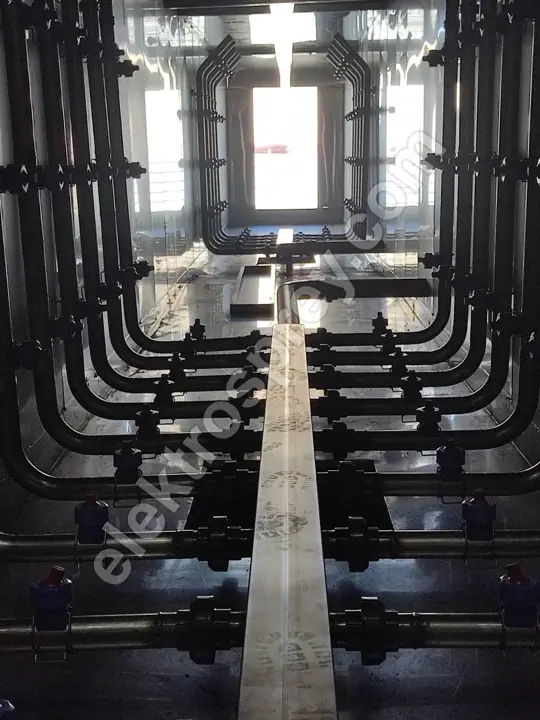
Most of the corrosion resistance sits under the paint, not in it. A thick film applied over an oily, oxidised or salt-contaminated surface fails earlier than a thin film applied over a properly prepared one. That is why the first invoice for a category decision lands on pretreatment.
| Stage | Purpose | Critical from which category |
|---|---|---|
| Degreasing | Drawing oil, cutting fluid, fingerprints | Every category |
| Rinsing | Stopping alkaline carry-over | Every category |
| Conversion coating | Crystal or ceramic layer for the paint to key into | C3 and above |
| Intermediate rinse | Preventing chemical carry-over | C3 and above |
| Demineralised final rinse | Dropping conductivity, clearing salt residue | C4–C5 |
| Passivation | Sealing the coating, improving edge protection | C4–C5 |
| Drying oven | Delivering a fully dry surface | Every category |
Whether these stages are built as immersion tanks or as a spray tunnel is a separate decision driven by part geometry. Box sections, closed-volume fabrications and complex shapes cannot be reached everywhere by spray; for those parts an immersion surface treatment line covering degreasing, phosphating, passivation and drying gives more consistent results. For open, flat geometry a spray tunnel is faster and uses less chemistry.
A test result and a category are not the same thing
This is the most common confusion on the shop floor. How many hours a coating system survives in a salt spray cabinet is a comparative figure established in the manufacturer's laboratory; the hour count does not translate directly into "it lasts this many years" or "it satisfies this category". The test is valuable for comparing two systems under identical conditions and for catching drift in production. We covered that distinction, and where the test is genuinely useful, in how many salt spray hours are meaningful.
The practical consequence on our side is simple: if your customer has given you a target in hours, ask your paint supplier for a system that meets it, obtain the system data sheet, and build the line so it reproduces the pretreatment and cure conditions that sheet demands. The line's responsibility is to hit the sheet; writing the sheet is the paint manufacturer's job.
Powder or liquid?
A high category does not by itself change the method, but two situations bring liquid paint into play. First, when the part is too large, already heat-treated, or assembled and cannot take oven temperature. Second, when the customer's specification can only be met with a liquid system. The second case is common in defence and heavy industry work; we collected the logic of those specifications in defence industry coating systems.
Moving to the liquid side changes what the line needs: a water curtain liquid paint booth running at 99% overspray capture with a closed-loop water circuit and an ATEX Zone 2 layout, plus the ventilation infrastructure to match. The drawback belongs in the same paragraph: a liquid line demands more operating discipline than a powder line on solvent management, waste and occupational safety.
Planning capacity against the category
As the category rises, time per part rises with it, which lowers the number of parts leaving the same line. Long pretreatment, an extra primer coat and a second cure pull the conveyor down within its 1–6 m/min band. Wherever your target category lands within a tunnel line's 500–5,000 parts/hour range, line length and oven volume grow accordingly. An investor who aims at a high category but reserves floor space for low-category throughput discovers after building the line that it does not fit the building.
The order of decisions is: category first, then coating system, then stage count, then cycle time, and only then floor area and budget. Reverse that order — starting from "this is the space I have, what fits" — and you have sacrificed the category to the floor plan. On the tunnel type powder coating plant projects we size to the customer's largest part and target category, this sequence goes on the first page of the specification.
Frequently asked questions
How do I work out which category my part falls into?
By describing where it will be mounted. An enclosed, heated space with no condensation sits in the lowest band. Any part left outdoors, exposed to rain and sun, sits at least in the middle band. Airborne salt (a coastal strip) or continuous chemical vapour moves you into the upper band. When in doubt, ask the customer for the category in writing; a verbal "it will stay outside" is not a specification.
How much does the difference between C3 and C5 change the cost of the line?
We cannot give a figure, because it depends on part geometry and capacity, but the direction is clear: additional baths, demineralised water preparation, a second application station and a longer oven all push both capital and running cost upward. Against that, the returned work from a line built for the wrong category costs far more than the difference.
If I apply a thicker film, does a low-category line become a high-category one?
No. Extra film thickness does not compensate for missing surface preparation; in fact a thick film reduces flexibility and can increase the risk of cracking and flaking at edges. Corrosion resistance is decided by surface preparation and the correct system, not by thickness. The target range comes from the paint manufacturer's data sheet, and going outside it does not add protection.
Does the category decision change when coating galvanised steel?
The substrate changes, the decision logic does not. A galvanised surface provides a protective layer of its own, but paint adhesion on it demands different pretreatment chemistry and careful drying. The category is still set by the environment; the pretreatment recipe is chosen for the substrate together with your paint and chemical suppliers.
Can I run jobs of different categories through the same line?
Yes, and this is the right layout: build the line for the highest category and let lower-category work skip stages. The reverse is not possible. That is why designing pretreatment tanks to be bypassable from the start is far cheaper than adding tanks later.
Summary
The corrosivity category is not a label; it is the first line of the plant specification. The chain that runs from environment description to category, then to pretreatment stage count, coating system, target film thickness and record-keeping discipline, runs in one direction only and cannot be built backwards. Exact film thicknesses, test durations and service life claims come from the paint manufacturer's system data sheet; the line's job is to apply that sheet repeatably on every part. Plan the investment in this order and you will neither build stages you do not need nor see work come back from the field two years later. Every line we build is manufactured to the customer's largest part and delivered with a 2-year manufacturer warranty.
Send us the mounting environment of your part, your target category and your customer specification if you have one — we will work out together how many stages the line needs.
For plants in the UK, North America and beyond
Where your line is installed shapes the paperwork, the power supply and the rules behind the choices described above.
- Gas burners and fuel trains are commonly built to EN 746-2 and EN 676. In North America, expect UL or CSA listed components and a review by the local authority or gas utility; commissioning usually needs the gas supplier's sign-off.
- For the UK, confirm with your importer whether UKCA or CE marking is expected. In the US and Canada, plan for UL or CSA requirements on the electrical side, and check any local documentation rules before shipment.
- For the UK, goods of Turkish origin move under the Türkiye–UK free trade agreement with an EUR.1 certificate or an origin declaration. For other destinations, the origin paperwork depends on that country's trade agreements, so check it with your importer early.
- North America runs at 60 Hz, and 480 V is common in industrial plants, so motors, fans and controls have to be specified for that supply from the start. Confirm the voltage and frequency on site before the line is designed.
Products mentioned: Dip Type Surface Treatment and Washing Line · Water Curtain Wet Paint Booth · Tunnel Type Electrostatic Powder Coating System
When you ask for a quote, tell us your country, supply voltage and frequency — get in touch.