
How Much Electrical Power and What Transformer Does a Powder Coating Line Need?
The electrical power of a powder coating plant is not one number: connected load, coincident load and contracted capacity are three separate calculations. Which one sizes the transformer, why power factor correction belongs in the project from day one, and how electric versus gas ovens change the infrastructure bill.
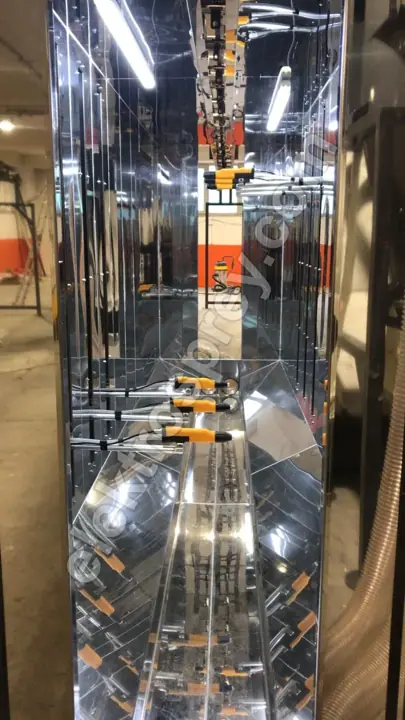 Enlarge
The electrical power of a powder coating plant is never one number; it is three separate numbers, and confusing them produces the most expensive surprise of the whole investment: connected load (the sum of every nameplate), coincident load (what actually runs at the same time) and contracted capacity (the figure you sign with the utility). The largest single item in the connected load is almost always the oven: the box type electric oven we build carries 3–150 kW of heating elements depending on the model. Add the booth extraction fan, the conveyor gearmotor, the pretreatment pumps, the bath heaters and the compressor, and the connected load grows quickly — but a transformer is sized on the worst coincident scenario, not on the connected load. That is also where the answer to "do I need a transformer" comes from: a small manual shop usually lives within an existing low-voltage supply, while a continuous line with an electric oven in practice needs a transformer of its own.
This article covers what kind of load each piece of equipment really is, how coincidence is established, how kW becomes kVA, and why power factor correction belongs in the project rather than being bolted on later. The consumption side — cost per part — is covered separately in powder coating oven energy consumption. Here the subject is not consumption but power. They are different things: power is how much you can draw from the grid at one instant, consumption is what you pay at the end of the month.
Connected load, coincident load, contracted capacity
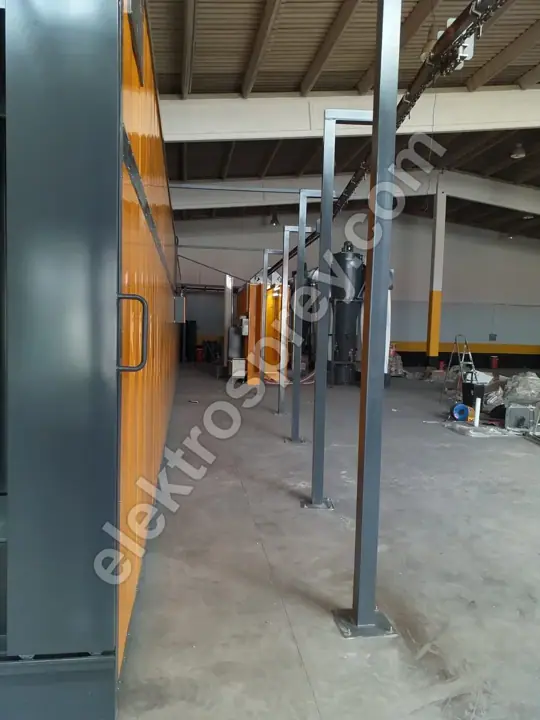
Connected load is the sum of the nameplate rating of every motor and every heating element on the line. It is the biggest number on paper and the most misleading one in practice, because these loads never all run at full capacity simultaneously.
Coincident load is what is actually drawn in a defined operating scenario. On a powder coating line, at least three scenarios are calculated separately:
- Morning heat-up. Oven elements at full load, pretreatment bath heaters at full load, no production yet. In most plants the peak lives here.
- Steady-state production. The oven has reached temperature and the PID keeps element groups only partially energised, while the booth fan, conveyor, pumps and compressor run continuously.
- Shift start overlap. The compressor is charging, the hoist is lifting and the pretreatment pumps start together.
Contracted capacity is the ceiling you agree with the utility. Set it too low and you risk tripping and penalties at peak; set it too high and you pay a standing charge for capacity you never use. The correct approach is to find the worst coincident scenario and add a measured allowance for growth.
The loads on the line and how they behave
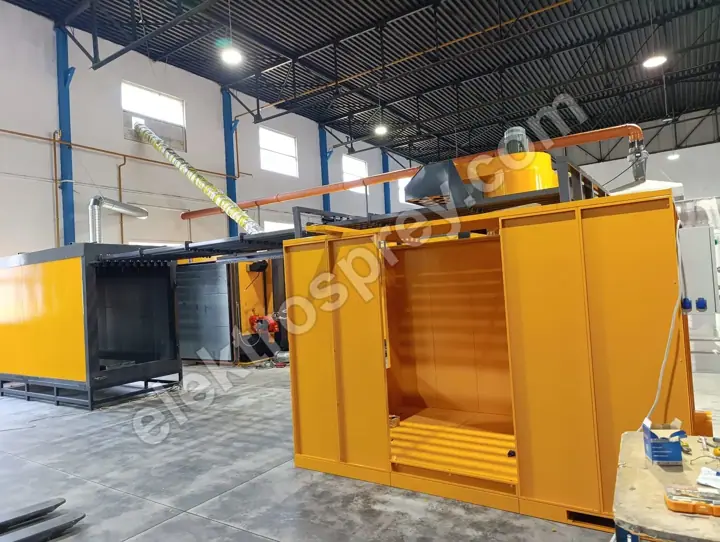
You cannot treat every load the same way; thermal loads and motor loads behave very differently towards the grid.
| Equipment | Load type | Coincidence behaviour | Note |
|---|---|---|---|
| Electric oven element bank | Thermal, PID staged | Full during heat-up, partial in steady state | 3–150 kW by model; the largest item on the line |
| Oven circulation fan | Continuous motor | Constant whenever the oven runs | The fan turns even when the elements are off |
| Gas oven burner + fan | Small motor load | Constant and low | Heat comes from gas: 50,000–500,000 kcal/h is thermal, not electrical |
| Powder booth extraction fan | Continuous motor | Constant through production | Sized for the airflow giving 0.5–0.8 m/s internal air velocity |
| Pulse-jet + compressor | Intermittent, sharp draw | Cuts in and out | Starting current is the hidden item that strains contracted capacity |
| Conveyor gearmotor | Small continuous motor | Constant | 1–6 m/min speed range, set from the drive |
| Pretreatment pumps | Continuous motors | Multiply with stage count | Every spray stage wants its own pump |
| Pretreatment bath heaters | Thermal, thermostatic | Full in the morning, partial later | If chosen electric, the second largest load after the oven |
| Lighting, hoist, workshop sockets | Mixed | Variable | Small, but still adds to contracted capacity |
The practical conclusion from the table: the electrical profile of the line is dictated by whether you heat with electricity or with gas. If the heat comes from gas, what remains is almost entirely motor load and the total connected figure drops dramatically.
Where the transformer rating comes from
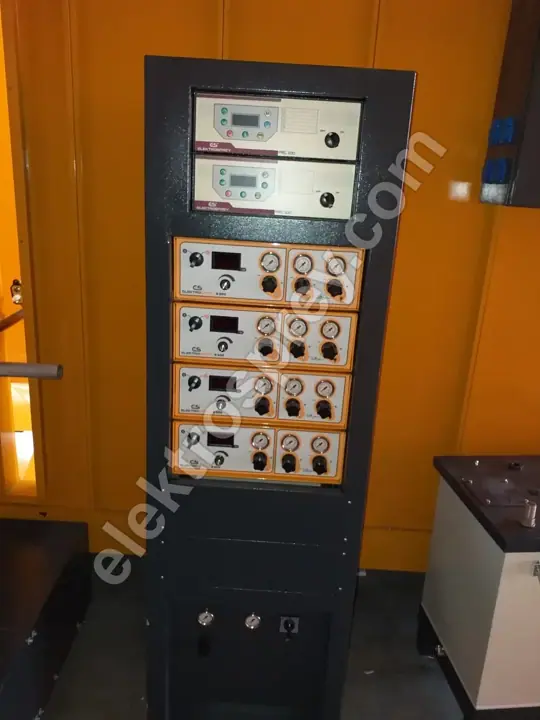
Transformer selection is a six-step calculation and the order matters.
| # | Step | What is done | Common mistake |
|---|---|---|---|
| 1 | Load schedule | Every nameplate listed, motors and heaters separated | Leaving out the compressor, hoist and lighting |
| 2 | Build scenarios | Heat-up, steady state and shift start totalled separately | Settling for a single "average" scenario |
| 3 | Apply coincidence | Only the loads genuinely running in each scenario are counted | Writing the whole connected load onto the transformer |
| 4 | kW to kVA | Active power divided by power factor to get apparent power | Using the post-correction power factor |
| 5 | Growth allowance | Headroom left for a second booth, second shift or extra oven | Leaving zero headroom and swapping the transformer in two years |
| 6 | Standard rating | Rounded up to the next standard transformer size | Choosing a rating that sits on the limit |
Step four is the one most often skipped. A transformer is rated in kVA, not kW; in a motor-heavy plant with a poor power factor the same work needs a larger transformer. Step five is where the expensive mistake lives: extending the line later — one more booth, one more oven — means a fresh connection application if there is no transformer headroom. The full list of investment items is in powder coating plant installation cost, and the order of works is in our pillar guide how to set up a powder coating plant.
Power factor, harmonics and starting currents
Power factor correction. The motors on the line — fans, pumps, gearmotors — are inductive and draw reactive power from the grid. Once reactive energy exceeds the ratio set by the distribution company it appears on the bill as a penalty. The answer is an automatic stepped correction panel, and sizing that panel together with the line project is both cheaper and more correct than adding it later. In practice the target power factor is held in the 0.95–0.99 band.
Harmonics. Conveyor drives, soft starters and thyristor-controlled element banks inject harmonic current into the supply. In a plant with harmonics an ordinary correction capacitor can hit resonance, overheat and lose its life early; where drive load is significant, detuned correction is used instead. This is a decision made in the project, not on site — discovering it on site means rebuilding the panel.
Starting currents. Large fan and pump motors draw multiples of rated current at start. Direct-on-line starting means both voltage dip and unnecessary strain at peak. A soft starter or a variable frequency drive removes that spike, and bringing the booth and oven fans up in sequence rather than together is a free improvement made in the automation.
Cables and voltage drop. Even a correctly rated transformer does not help if the panel-to-oven run is long and the cross-section is undersized. Oven elements are a long, steady load; voltage drop lengthens heat-up time, and on the cartridge filter powder booth fan it reduces airflow and touches coating quality directly.
Electric or gas: the infrastructure side
Oven choice is not only an operating cost decision, it is an infrastructure decision. The difference between a gas-fired top-loading pallet oven and an electric oven shows up in the transformer and panel bill long before it shows up on the energy bill.
| Item | Electric oven | Gas oven |
|---|---|---|
| Contribution to connected load | High — the largest load on the line | Low — only burner and fan motors |
| Transformer requirement | Usually needs a dedicated transformer | A smaller rating is often enough |
| Additional infrastructure | Connection application, panel, cable sizing | Gas contract, gas line, flue, gas safety equipment |
| Operating energy cost | Reference | 30–40% lower than electric |
| Time to commissioning | Short if the electrical supply is ready | The gas contract process can hold the line up |
The decision is made by adding up both columns: the operating advantage of gas is clear, but the gas line, the flue and the contract process are a cost and a schedule of their own. The technical comparison of the two oven types is in electric or gas powder coating oven.
Frequently asked questions
Does a powder coating plant need its own transformer?
It depends on how the line is heated and on your existing supply. A workshop with a manual unit, a small booth and a small oven usually runs on the existing low-voltage supply. A continuous line with an electric oven and electrically heated pretreatment quickly exceeds that supply and needs a dedicated transformer. The decision is made after the load schedule and the coincidence calculation, never by estimate.
Why is contracted capacity not the same as connected load?
Because the loads on the line never all run at full output together. Once the oven is at temperature the PID keeps only part of the element bank energised, the pretreatment heaters cycle on thermostat, and the compressor runs intermittently. Contracting the full connected load means paying a standing charge for capacity you will never use. The reverse is equally true: contract on average consumption and you will exceed the limit during morning heat-up.
How much transformer headroom should be left?
Enough above today's worst-case scenario to cover a two-to-three year growth plan. How much that is depends on your intentions: if a second booth, a second shift or an extra pretreatment stage is possible, put them into the load schedule now. Stepping up the transformer rating costs far less than replacing the transformer and reapplying for a supply connection two years later.
Can power factor correction be added later?
It can, but you pay twice. Correction affects panel layout, cable routing and metering transformers, so retrofitting usually means rearranging the panel. If there is drive or thyristor load, the detuned type is required — and if that is not decided up front, the capacitors overheat and fail early. The right approach is to treat correction as part of the line's electrical project.
If the supply is inadequate, is a smaller line the answer?
Shrinking the oven is usually the wrong answer; the oven sets line capacity, and a small oven is a permanent bottleneck. The correct order is: first evaluate moving the heat to gas, then spread the peak over time (do not put pretreatment heating at full load in the same hour as the oven), then sequence the motor starts. If that is not enough, the answer is to enlarge the supply, not to shrink the line.
Who provides the figures and who does the calculation?
The load schedule and the coincidence scenarios come from the company building the line; the capacity application and the transformer project are done by a licensed electrical designer. Because we build every line to the customer's largest part, oven, booth and pump ratings also follow your part — there is no catalogue figure. We issue the equipment power schedule with the quotation, and the designer uses that schedule directly.
Summary
The electricity of a powder coating line is managed with three numbers: the connected load is scheduled, the coincident load is found through scenarios, and the contracted capacity and transformer are chosen from the worst of those scenarios plus a growth allowance. The single biggest decision shaping the electrical profile is whether heating is electric or gas: an electric oven at 3–150 kW is the largest item of connected load, while a gas oven limits electrical load to the burner and fans and runs at 30–40% lower energy cost. Power factor correction, harmonics and starting currents are not details to be solved afterwards — they belong in the project from the start. Every line we build is delivered with a 2-year manufacturer's warranty and with its equipment power schedule.
Send us your part dimensions, target capacity and existing supply rating — we will produce the load schedule and coincident power scenarios and clarify exactly what transformer you need.