
How Do You Keep Combustion Efficiency in a Gas Oven Burner?
In a gas-fired coating oven the fuel bill usually grows without a fault ever appearing; the air-to-fuel ratio simply drifts. This article explains how to read excess air from a flue gas analysis, how to service the burner head, ignition electrode and flame sensor, and how often the setting has to be repeated.
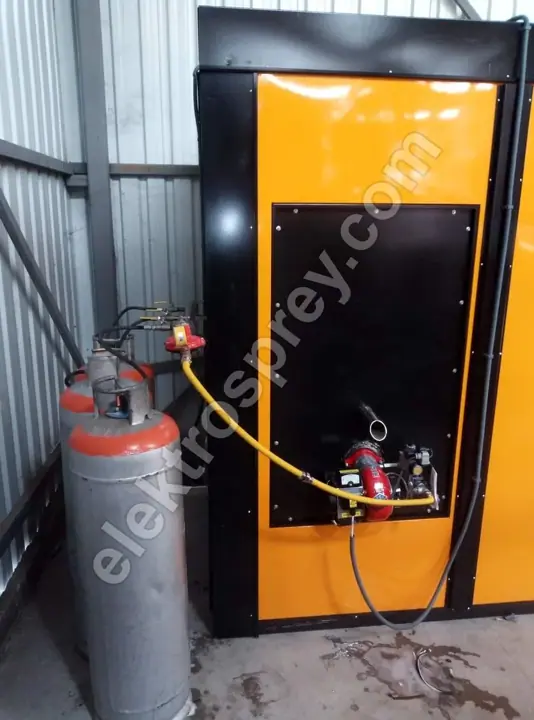 Enlarge
Coating oven burner service decides combustion efficiency directly: in a gas-fired oven working in the 50,000–500,000 kcal/h band, the air-to-fuel ratio determines how much of the gas you burn reaches the parts and how much leaves through the stack. When that ratio drifts, the oven raises no alarm — it still holds its set temperature and production is not interrupted — but it burns more gas for the same work. The loss does not arrive in one step; it grows a little every month. That is why the measure of maintenance on a gas oven is not "is it running" but what the flue gas analysis says.
The 30–40% lower energy cost of a gas oven compared with an electric one holds only while its setting is maintained; a drifted burner throws much of that advantage out of its own stack. The drawback, plainly: an electric oven has no maintenance item of this kind, while a gas oven needs at least one instrumented service visit a year. If you are buying the fuel saving, you are buying this discipline too.
Where combustion efficiency is lost
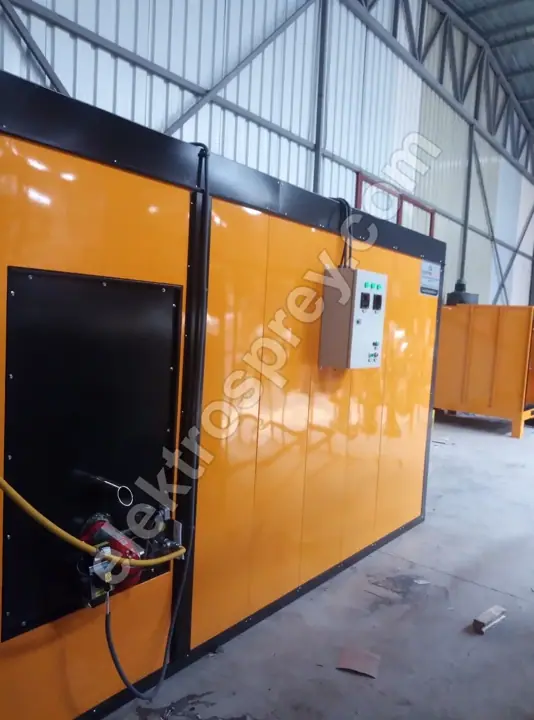
Heat from the burner takes three routes: into the parts and oven air, out through the stack, out through the shell. Maintenance is about the second. Two things enlarge the stack loss:
- Excess air. Air beyond what combustion needs is heated and thrown out of the stack; every extra cubic metre burns fuel just to warm itself.
- Insufficient air. The worse case. Fuel does not burn completely: carbon monoxide appears in the flue, soot builds on the head, the flame turns long and yellow. Efficiency drops and a safety problem is created at once.
Between the two lies a narrow working band, and the burner is set into it by measurement. You cannot hit it by guessing, by flame colour, or by repeating last year's setting: gas quality, site altitude, ambient temperature, stack draught and fan fouling all shift the band.
The second source of loss is the heat transfer surface. Soot on the exchanger or flue tubes sends part of the heat up the stack even with a correctly tuned burner, which is why a rise in flue gas temperature is a fouling indicator independent of the burner setting.
Flue gas analysis: the only real measurement
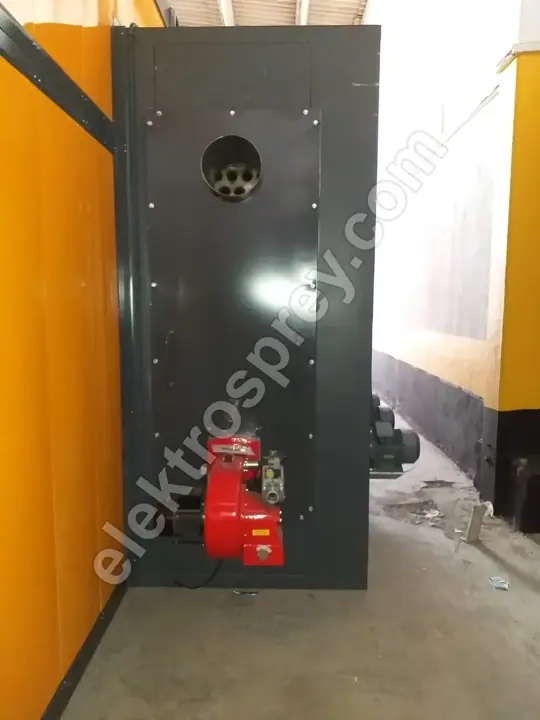
A flue gas analyser reports the state of the oven you cannot see from inside it. Exact target values are printed in the burner manufacturer's commissioning data; the table below is an interpretation frame, not an acceptance criterion.
| Reading | Typical interpretation range | What it means | First action |
|---|---|---|---|
| Flue oxygen (O₂) | Single-digit percentages on natural gas | High means excess air; heat leaves the stack | Trim air damper and fan to the burner data |
| Carbon monoxide (CO) | Must stay at low ppm levels | A rise means incomplete combustion | Add air, clean the head, verify gas pressure |
| Flue gas temperature | The value measured after tuning is the reference | A steady rise indicates soot in the exchanger | Clean the heat transfer surfaces |
| Stack draught | The negative pressure band in the burner data | Weak draught starves combustion, excess adds air | Check stack section, cowl and sealing |
| Calculated efficiency | Derived from O₂ and flue temperature | A drop between two reports is a real loss | Check fouling first, then the ratio |
| Gas pressure (inlet/nozzle) | The band on the burner plate | Below it, flame length and capacity fall | Check the regulator and gas filter |
The only correct use of this table is comparison. Keep the commissioning report and read every later measurement against it: a single number tells you little, the difference between two tells you everything. The same series is used when budgeting the oven's annual energy demand — we covered that calculation in powder coating oven energy consumption.
Burner head, ignition electrode and flame sensor
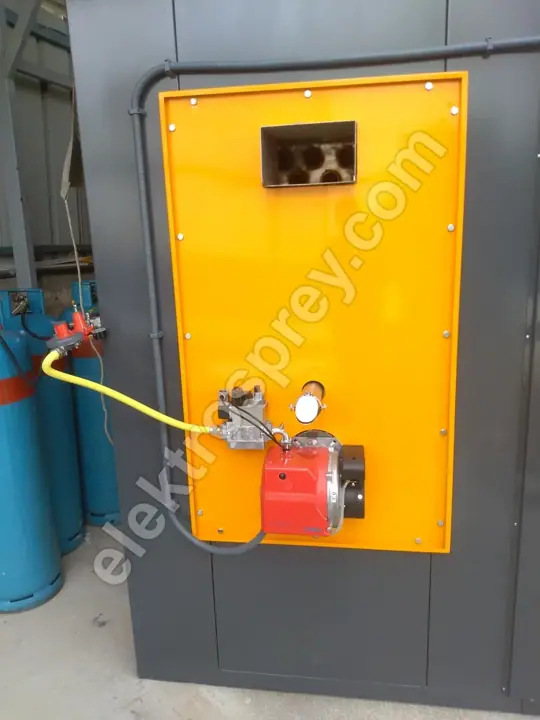
Mechanical maintenance has three critical parts, all small, cheap and easy to neglect.
Burner head and diffuser. There are always fine particles in the air of a coating plant; with an unfiltered combustion air intake the head and diffuser get coated. A coated head distorts the flame, spoils the mixture and raises CO. Clean with wire brush and compressed air; never enlarge or sand the ports.
Ignition electrode. The spark gap is specified in millimetres and is not set by eye. An open gap delays ignition; a closed one weakens the spark. Either way the burner locks out after a few attempts — this alone is behind most "burner failure" call-outs. A cracked porcelain insulator is replaced, not cleaned.
Flame sensor (ionisation rod or UV cell). The ionisation current is in the microamp range; even a thin oxide layer on the rod tip pulls the signal down, so the burner sees "no flame" while the flame burns and goes to safety. Service means polishing the rod with fine abrasive and measuring the earth connection.
| Part | Symptom | Service action | Effect on efficiency |
|---|---|---|---|
| Burner head / diffuser | Yellow, long, unstable flame | Clean with brush and compressed air | High — produces CO and soot |
| Ignition electrode | Late ignition, repeated attempts | Measure gap, check insulator | Indirect — downtime and wasted gas |
| Flame sensor | Lockout while the flame burns | Clean tip, measure current | Indirect — production stoppage |
| Combustion air fan and filter | Loss of capacity, noise | Clean impeller, change filter | High — shifts the ratio |
| Gas filter and regulator | Pressure drop, unstable flame | Replace cartridge, measure pressure | Medium — limits capacity |
| Heat exchanger / flue tubes | Rising flue gas temperature | Remove soot deposits | High — heat goes up the stack |
A service calendar: which job at which interval
The interval depends on daily running hours and dust load. A single-shift top-loading gas oven and the oven of a three-shift tunnel line cannot share one calendar. A practical frame: visual checks weekly, mechanical cleaning monthly to quarterly, a full instrumented tuning at least once a year and every six months on multi-shift work. Repeating the tuning at the start of the heating season, when gas composition and ambient temperature change, is normal.
Holding the set point across the 140–220 °C working band is no reason to skip service; the loss shows up not in the temperature but in the gas burned to hold it. Heat-up time is a good early warning: if the 35–45 minutes in the commissioning report is lengthening noticeably, capacity has been lost, usually to fouling or gas pressure. Plan oven service with the rest of the line using the schedule in the periodic maintenance calendar for a powder coating line; on a tunnel type plant an oven stoppage stops everything, so the service window follows the conveyor shutdown.
Draw the line of responsibility clearly. Visual checks, filter changes and external cleaning belong to the plant's own maintenance team; the gas train, pressure setting and safety device testing belong to an authorised service engineer. The ovens we build are delivered under CE and TS EN 1020, and that conformity holds only while the safety chain is left untouched.
Frequently asked questions
How often should the burner be tuned?
On a single-shift oven, one full instrumented tuning per year is enough for most plants; on multi-shift work in a dusty environment, six months. Three situations call for tuning without waiting for the calendar: gas supply conditions have changed, a burner component has been replaced, or flue gas temperature and heat-up time have drifted from the commissioning values.
How do you know combustion efficiency has fallen?
The most reliable indicator is more gas for the same output, so record monthly gas use divided by parts produced or hours run. The second is a longer heat-up time; the third, a rising flue gas temperature. Flame colour alone is not a measure: yellow is a definite warning, but a flame can look perfectly blue while excess air keeps efficiency low.
If the oven holds its set temperature, is burner service still needed?
Yes. Holding the set point is not a measure of efficiency; a badly tuned burner holds the same temperature by burning more gas. The oven shows a shortfall only once its capacity is used up — by which time you have paid for excess fuel for months. The reason for service is the bill, not the breakdown.
How do you tell a dirty flame sensor from a real fault?
A dirty sensor gives a typical picture: the burner ignites, the flame is visible, it goes to safety seconds later, and after a reset it sometimes runs normally. In a genuine gas or ignition fault the flame never forms or never holds. Measuring the ionisation current settles it: below the data sheet threshold, the problem is the sensor. Never paper over repeated lockouts with a reset.
Does the dust in a powder coating environment affect the burner?
It does. If combustion air is drawn from around the oven, fine airborne particles settle on the fan impeller, intake filter and diffuser; air flow falls and the mixture shifts towards the fuel side. That is why the position and filtration of the combustion air intake is settled when the plant layout is decided.
Summary
Combustion efficiency in a gas oven disappears quietly: the oven runs, holds its temperature, and only the bill grows. The tool that makes the loss visible is flue gas analysis, read against the commissioning report. Mechanically, three parts decide the outcome — burner head, ignition electrode, flame sensor — and servicing all three is cheap. The calendar is built on shift count and dust load; the gas train and safety devices go to an authorised engineer. With that discipline the 30–40% lower energy cost of a gas oven holds for years; without it, that advantage is the first thing you lose. Every oven we deliver carries a 2-year manufacturer's warranty, and its commissioning report is the starting point for these comparisons.
Send us your oven's commissioning report, your latest flue gas analysis and your monthly gas consumption record — we will work out together whether the loss is in the setting, in fouling or in capacity.