
Why Is the Coating Peeling Off? Adhesion Loss Before You Blame Pretreatment
A film that lifts under a fingernail or comes away in a cross-cut test usually traces back to degreasing and rinsing quality, but insufficient drying and incomplete cure produce the same result. This article gives a diagnostic order for adhesion loss that you can run without changing any equipment.
 Enlarge
When powder coating is not sticking and peels off, the cause sits in one of three places: a tired pretreatment bath, moisture left on the surface after drying, or a cure that never completed. Most of the cases we see in the field close without replacing a single component of the line — log the concentration and temperature of the degreasing bath, measure the conductivity of the final rinse, and record an actual cure curve from the part itself. On a pretreatment line running anywhere from 3 to 7 stages, those three measurements usually narrow the source of adhesion loss within a day. Trying a new booth, new guns or a different powder formulation before those three steps is the most expensive decision available to you.
Adhesion loss is not a cosmetic defect the way orange peel or pinholing is. The film looks even, the gloss is right, the thickness you measure is on target — and then the part flakes off when it takes an impact or gets cut. That is exactly why it slips through the line unnoticed and shows up at the customer's site, during assembly, or in the first corrosion test. The only way to catch it in-house is to pull sample parts at regular intervals and run an adhesion test.
What adhesion is actually built on
A powder film holds onto metal through three mechanisms stacked on top of each other, not one:
- Mechanical keying: the micro-roughness of the surface. The crystalline structure on a blasted or phosphated surface lets the molten film flow into it and freeze there. Mirror-bright, untreated sheet is the hardest surface to bond to.
- Chemical bonding: the bond the conversion coating (phosphate, zirconium) forms with the resin. That bond only forms when it sits on genuinely clean metal.
- Cure: the cross-linking of the resin. An undercured film stays soft and resists neither solvent nor impact; what lifts in the adhesion test is the coating itself, not the interface.
Separating which of those three collapsed is the whole of the diagnosis. Look under the flake that came off. If the metal is bright and bare, the interface failed and the problem is in pretreatment. If a dull grey conversion coating is still sitting there, the interface held and the failure happened inside the film — which points you at cure or at the powder.
Diagnostic order: from the cheapest suspect to the most expensive
| Order | Suspect | Symptom on the floor | First action | Cost |
|---|---|---|---|---|
| 1 | Inadequate degreasing | Bare bright metal under the flake; defect follows one supplier's parts | Check bath concentration and temperature, run a water-break test | None |
| 2 | Weak rinsing | Defect persists after the bath is renewed; staining on the surface | Measure final-rinse conductivity, raise overflow rate | None–low |
| 3 | Incomplete drying | Defect concentrated in holes, folds and profile interiors | Check drying temperature and dwell, correct hanging angle for drainage | Low |
| 4 | Undercure | Flake breaks inside the film; coating scratches with a fingernail | Record an actual temperature curve from the part | Low |
| 5 | Weak conversion coating | Adhesion marginal, early blistering in salt spray | Audit bath point, contact time and water quality | Medium |
| 6 | Powder / substrate mismatch | Problem stays on one substrate only after the above are fixed | Review primer and substrate compatibility with the powder supplier | Medium |
Do not break this order. The most common mistake we see is jumping straight to changing the powder or raising the oven temperature without ever looking at items 1 and 2 — both waste time and usually open a new defect.
Degreasing and rinsing: the largest single share of adhesion
Most adhesion cases start here. As bath chemistry depletes, cleaning power drops with no visible change: the part still comes out wet and still looks bright. The cheapest check is the water-break test — hold a degreased and rinsed part vertically; if the water drains as an unbroken film the surface is clean, and if it beads up and breaks into droplets there is oil residue and there is no point applying powder to that part.
Rinsing gets neglected more often than degreasing. Alkaline salt residue left on an under-rinsed surface dries into what amounts to a thin interlayer between film and metal; adhesion can look normal at first and then break down quickly once moisture reaches it. The metric is well defined: monitor the conductivity of the final rinse and set the overflow rate from it. How to size stage count and rinse layout is covered in how many pretreatment stages you need, and where an immersion arrangement beats spray tunnels on part geometry is compared in immersion pre-washing.
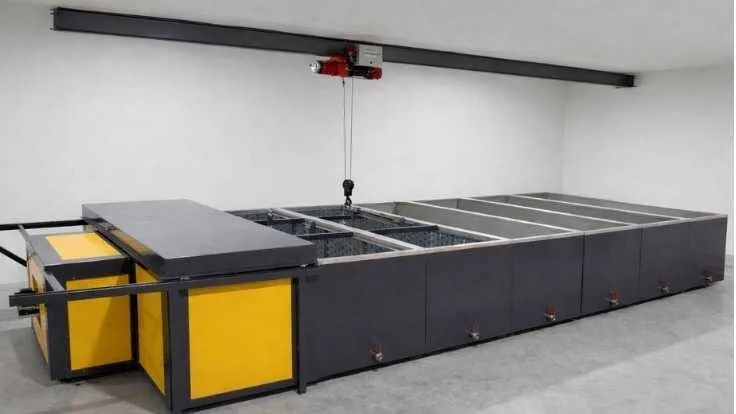
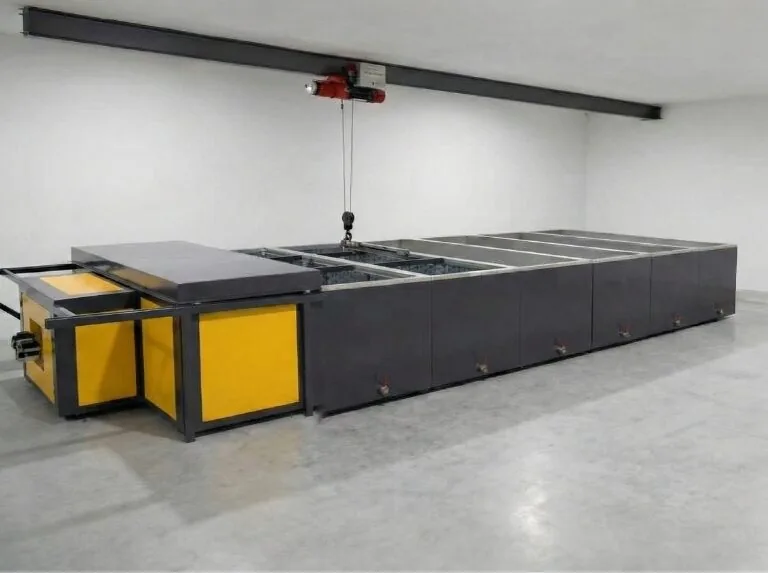
On parts with complex geometry, box sections or internal cavities, a spray tunnel cannot reach every surface evenly. For that kind of work a dip surface treatment line covering degreasing, phosphating, passivation and drying raises adhesion repeatability on its own — every line is built to the customer's largest part, and there is no catalogue size.
Drying: leftover surface moisture is a silent adhesion killer
A part leaving pretreatment must be fully dry before it enters coating. Water left on the surface flashes off during cure, building pressure under the film and disrupting the bond between conversion coating and resin. The symptom is characteristic: the defect is not on flat faces but concentrated where water clings — hole edges, inside folds, weld pockets, hanger contact points.
Two things get confused here: drying the surface of the part, and heating the part through. A heavy section can look dry on the outside while still holding water in a fold. The fix is usually not more temperature but changing the hanging angle so water drains, plus a longer drying dwell. On a conveyorised layout that means the drying zone length has to be calculated together with throughput; in a tunnel type line running in the 500–5,000 parts/hour band, the drying zone is sized at the same time as the pretreatment stage count.
Undercure: the most frequently misdiagnosed cause
An undercured film fails the adhesion test, but the failure is not at the interface. It is easy to tell apart: if the conversion coating is still in place under the flake, and the film scratches with a fingernail or softens and marks when wiped with a solvent cloth, the cure is short.
Cure is not the oven's displayed temperature — it is the part spending a defined time at a defined temperature. Powder formulations typically call for a cure window in the 180–200 °C band over a span of some tens of minutes; the exact figure comes from the powder data sheet. What you have to measure is when the part enters that window. If the oven reads 200 °C but a heavy part's surface only reaches it near the exit, in practice no cure has taken place.
| Checkpoint | What to measure | Effect on adhesion |
|---|---|---|
| Degreasing bath | Concentration, temperature, soil loading | Oil residue → interfacial failure |
| Final rinse | Conductivity, overflow rate | Salt residue → breakdown with moisture |
| Drying exit | Moisture in folds and holes | Vapour under film → local lifting |
| Oven | Time–temperature curve from the part | Incomplete cross-linking → soft film |
| Oven uniformity | Zone-to-zone deviation | Different results on the same hanger |
| Hangers and contact | Contact marks, earthing resistance | Poor charging → thin film, weak grip |
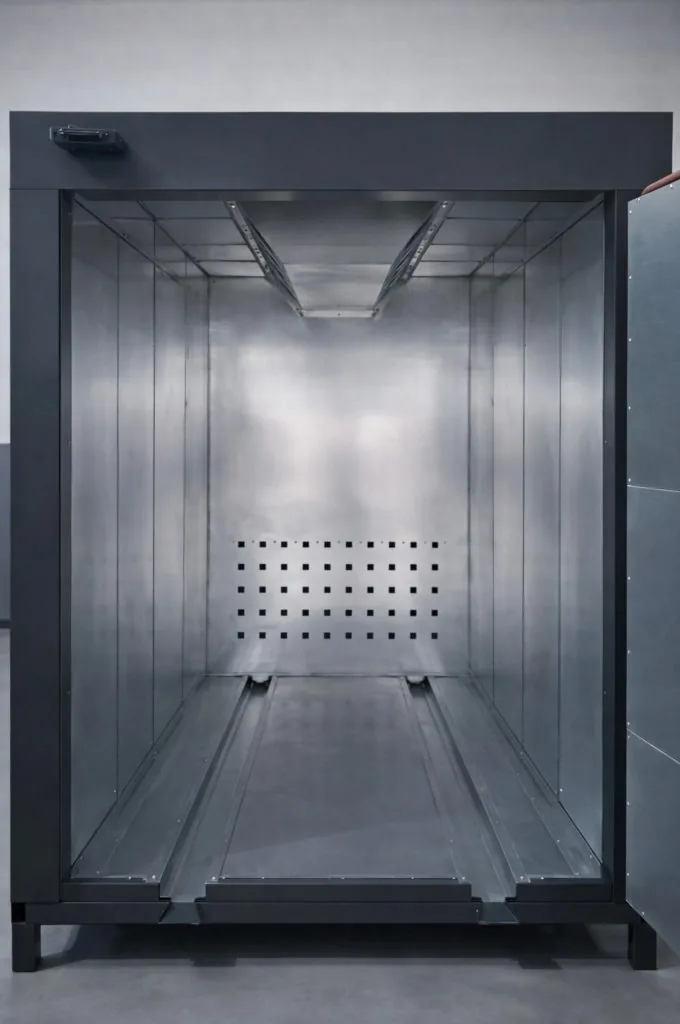
While you are measuring on the oven side, note the temperature distribution too. A box type electric oven works across 80–250 °C with PID control, ±3 °C uniformity and 16 baking profiles; profiles exist for precisely this reason, because a heavy casting and thin sheet cannot share a cure regime. If the measurement lands inside the band, take the oven off the list and go back up one item.
Frequently asked questions
How is an adhesion test carried out?
The most common method is the cross-cut test: a sharp blade or multi-blade cutter scores a set of parallel lines crossing at right angles through the film, debris is brushed away, a specified tape is applied over the cut area and pulled off at a fixed angle. Assessment is based on how much film has detached from the edges of the squares. Cut spacing is chosen according to film thickness, and the result is compared against the acceptance criterion set by the powder supplier — do not invent your own limit, take it from the data sheet. On thick films and elastic resins the cross-cut can mislead, in which case impact and bend tests are the complement.
Can I identify the cause just by looking under the flake?
Yes, and it is the fastest way to split the problem. Bare, bright metal under the flake means the failure is between metal and coating: degreasing or rinsing is the suspect. A matt grey conversion coating still present under the flake means the interface held and the break is inside the film: cure, or powder-to-substrate compatibility, is the suspect. That single look tells you which end of the diagnostic order to start from.
Will raising the oven temperature fix adhesion?
If the problem genuinely is undercure it helps in part, but if the cause is in pretreatment it does nothing at all and opens new defects — yellowing, gloss loss, overbake. Record an actual time–temperature curve from the part first. If the curve enters the window, stop blaming the oven; if it does not, the answer is usually not more temperature but a slower conveyor or a lighter loading density.
Why is adhesion harder on galvanised and aluminium parts?
Because both carry a surface layer — zinc, or an oxide — that behaves differently from steel, and a standard iron phosphate regime does not form the same chemical bond on them. Aluminium needs zirconium-based conversion coatings or chemistry formulated for it; on galvanised material the primary problem is white rust and drawing lubricant residue. If you run mixed substrates, do not force the bath regime into a single recipe — set it up for the most difficult substrate.
Why does salt spray blister when adhesion tests fine?
They are not measuring the same thing. An adhesion test measures the mechanical strength of the interface in dry conditions; salt spray measures how that interface holds up under moisture and ions. A weak or partial conversion coating can pass the dry test at the limit and still blister early in corrosion testing. If blistering advances from the scribe line, the suspects are the conversion coating and rinse quality; the full breakdown is in early corrosion in salt spray.
Summary
Adhesion loss is not an equipment failure, it is process drift. The order is fixed: degreasing and rinsing first, then drying, then cure, and only last the conversion coating and powder-substrate compatibility. The first three steps require no investment and close most cases. Looking under the flake, the water-break test and a temperature curve taken from the part — those three measurements end the guessing. If you are planning the whole investment, our umbrella guide on setting up a powder coating plant is the right starting point; every line we build is delivered with a 2-year manufacturer's warranty.
Send us a photo of the failed part, your bath measurement records and your oven temperature curve — we will separate out which stage the defect came from together.
For plants in the UK, North America and beyond
Where your line is installed shapes the paperwork, the power supply and the rules behind the choices described above.
- Pretreatment rinse water usually needs a discharge permit from the local water authority or municipality, whatever the size of the line. The chemistry you choose largely decides how much treatment is needed before discharge.
- For the UK, confirm with your importer whether UKCA or CE marking is expected. In the US and Canada, plan for UL or CSA requirements on the electrical side, and check any local documentation rules before shipment.
- For the UK, goods of Turkish origin move under the Türkiye–UK free trade agreement with an EUR.1 certificate or an origin declaration. For other destinations, the origin paperwork depends on that country's trade agreements, so check it with your importer early.
- North America runs at 60 Hz, and 480 V is common in industrial plants, so motors, fans and controls have to be specified for that supply from the start. Confirm the voltage and frequency on site before the line is designed.
Products mentioned: Dip Type Surface Treatment and Washing Line · Box Type Powder Coating Oven (Electric) · Tunnel Type Electrostatic Powder Coating System
When you ask for a quote, tell us your country, supply voltage and frequency — get in touch.