
How Thick Should Curing Oven Insulation Be? Heat Loss Math
In a curing oven, insulation is not a line on the invoice but a body design decision. We explain how panel thickness and rock wool density drive outer skin temperature and standing heat loss, and how to check whether the insulation line in a quotation has any real substance behind it.
 Enlarge
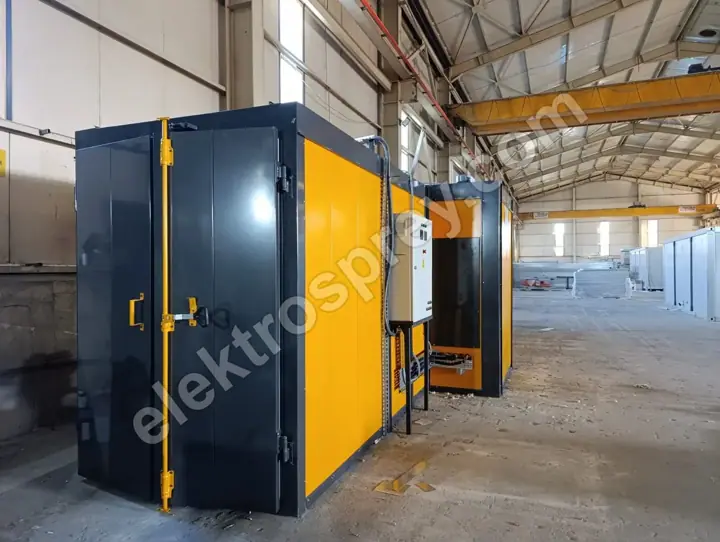
The manufacturer's answer to how thick powder coating oven insulation should be is short: in an oven working in the curing band, the rock wool inside the panel must not drop below 10 cm (100 mm). That is why we build our box type electric ovens with 10 cm rock wool as standard, alongside an 80–250 °C working range, ±3 °C uniformity and an AISI 304 inner shell. 100 mm is not a fashion; it is the threshold at which standing heat loss falls into an acceptable band and the outer skin stays workable.
Because insulation appears as a single line in a quotation, it is usually mistaken for a cost item. It is not. Insulation thickness sets the body cross section, the panel joint detail, the door seal design — and therefore the energy the machine will burn for the next ten years. It is paid once at investment and repaid, or lost, on every shift afterwards.
Insulation has two separate jobs
Two things are expected from insulation in a curing oven, and they are independent of each other:
- Cutting standing heat loss. Once the oven reaches setpoint, the heaters or the burner keep working to replace what escapes. This consumption continues even when nothing is being coated.
- Keeping the outer skin in a safe band. An operator touching the outer sheet must not be burned, and the shop floor temperature around the oven must stay tolerable.
Thickness alone does not deliver both. Thickness sets the thermal resistance; density decides whether that resistance survives the years. Low density rock wool settles inside the panel under vibration and its own weight: the upper zone empties, the lower zone compacts. Ten years later a 100 mm panel effectively carries 60 mm across its top half. We listed the field symptoms one by one in signs of ageing oven insulation.
How much does thickness change heat loss
Heat crossing a flat panel is inversely proportional to the thermal resistance of the insulation, and that resistance is proportional to thickness. Surface resistances and thermal bridges soften the arithmetic, but not its direction: halving the insulation roughly doubles the loss through that surface.
| Rock wool in panel | Loss through the same surface (100 mm = reference) | Outer skin temperature trend | Practical consequence |
|---|---|---|---|
| 50 mm | About 2x | Clearly above ambient, contact risky | The hidden cost of a cheap quote |
| 75 mm | About 1.3x | Borderline, heats the shop in summer | Short term saving, long term loss |
| 100 mm | Reference | Brief hand contact possible | The accepted threshold for curing ovens |
| 150 mm | About 0.7x | Closest to ambient | High temperature, three shifts, cold hall |
Those ratios hold for the same density and the same body detail. Comparing two panels of different density changes the ratio, which is exactly why "10 cm insulation" on its own is not enough information in a quotation.
Density: the invisible half of thickness
Rock wool used in curing ovens is typically slab material in the 100–140 kg/m³ band. Below that band two problems start at once: thermal conductivity rises faster than expected at temperature, and the slab cannot hold its own shape. Above the band is not automatically better either — body weight, handling and erection loads all grow.
The right question is not "how many kg/m³" but which temperature class, in which orientation, held by what. On the roof panel gravity compresses the wool, on side panels it shears, and on the door every opening is an impact. In our own build the insulation is never left loose inside the panel; it sits in a compartmented sheet cage with retaining pins. Asking about that detail separates quotations far better than asking for a thickness figure.
| Check point | Seen in a weak solution | What a sound solution shows |
|---|---|---|
| Density | Not stated, or very low | Slab density and temperature class in writing |
| Retention | Wool loose inside the panel | Compartmented cage and retaining pins |
| Door seal | Single layer, heat fatigued material | High temperature seal, adjustable pressure |
| Thermal bridge | Sheet profiles continuous inside to outside | Interrupted profile, bridge breaking detail |
| Conveyor slot | Open slot | Curtain or labyrinth narrowing the opening |
| Inner shell | Painted sheet | AISI 304 stainless inner shell |
Who calculates standing loss, and how you audit it
The loss calculation has three parts: conduction through the body surfaces, leakage through door and conveyor openings, and the heat carried away by the parts and hangers entering the oven. That third part has nothing to do with insulation and is usually the largest — we separated the three in powder coating oven energy consumption.
As a buyer, this is the part you can audit yourself:
- Ask how installed power relates to loss. We build electric ovens from 3–150 kW; that rating is chosen by calculating heat-up time and standing loss together. Excessive power for a given volume is often there to cover for thin insulation.
- Ask for a skin temperature commitment. "Will not exceed ambient by more than X" is a commitment that can be written into the quotation and verified with a contact thermometer at commissioning.
- Ask for the heat-up time. The 35–45 minute heat-up of our top loading gas ovens is the result of designing insulation and burner capacity as one package.
If you want to see where the difference between two quotations actually comes from, the cost breakdown in powder coating oven prices includes the insulation line.
Is insulation worth the same in electric and gas ovens
No, because the unit cost of the lost heat differs. Our top loading gas ovens run in the 140–220 °C band at 50,000–500,000 kcal/h and give a 30–40% lower energy cost than electric. That does not make insulation less important on a gas oven; the opposite, since gas ovens are usually larger, so surface area and total loss grow with them.
On continuously running tunnel lines the equation changes again. In a tunnel type plant running 500–5,000 parts/hour, the oven stays hot 16–24 hours a day, and one step of extra insulation pays back far faster than it ever would on a box oven. On a batch oven opened for a few hours a day, heat-up losses dominate instead and the decision goes the other way.
Frequently asked questions
How many cm of insulation should a powder coating oven have?
For ovens working in the curing band the floor is 10 cm of rock wool, and that is the standard value in our box type electric ovens. Going one step thicker can be justified by calculation for ovens running three shifts, for large volumes, or for a cold hall. Below 10 cm, the saving is handed back through the energy bill within the first years.
Why does rock wool density matter as much as thickness?
Because thickness is a day-one value and density is a year-ten value. A low density slab settles inside the panel and leaves a void in the upper zone; the measured panel thickness stays the same while the effective insulation shrinks. Ask for density and the retention detail to be written next to the thickness.
How hot can the outer surface of the oven get?
On a properly insulated body the outer sheet reads measurably above ambient but stays in a band that allows brief contact; door frames, vents and corner profiles are always hotter than the panel field. Have the acceptance figure written into the quotation and measure several points with a contact thermometer at commissioning — a single point reading misses thermal bridges.
How much does thicker insulation raise the investment?
As insulation grows, material, body cross section and shipping volume grow with it, so the effect is never confined to one line. Against that, installed power and standing consumption fall. The decision follows how many hours a day the oven stays hot: on a continuous line thicker is almost always right, on a batch oven opened for two hours a day it is usually unnecessary.
How do I tell whether my existing oven's insulation is tired?
The fastest method is to scan the outer skin with a thermal camera or contact thermometer once the oven is at regime. A clearly warmer band across the upper part of a panel compared with its lower part means the wool has settled. Heat-up time creeping up over the years, heaters cycling more often at setpoint, and noticeable warming of the shop around the oven all point to the same picture.
Summary
Insulation is the easiest line to trim in a quotation and the slowest one to show its consequences. In a curing oven 10 cm of rock wool is the floor; every centimetre below it enlarges the loss through that surface disproportionately and pushes the outer skin into an unworkable band. Alongside thickness, ask in writing for density, the retention detail, the door seal and the thermal bridge solution — the real substance of insulation shows up in those four lines. Every oven we build is dimensioned around the customer's largest part and delivered with a 2 year manufacturer warranty.
Send us your part dimensions, target capacity and shift pattern, and we will size the body insulation and the installed power in the same calculation.